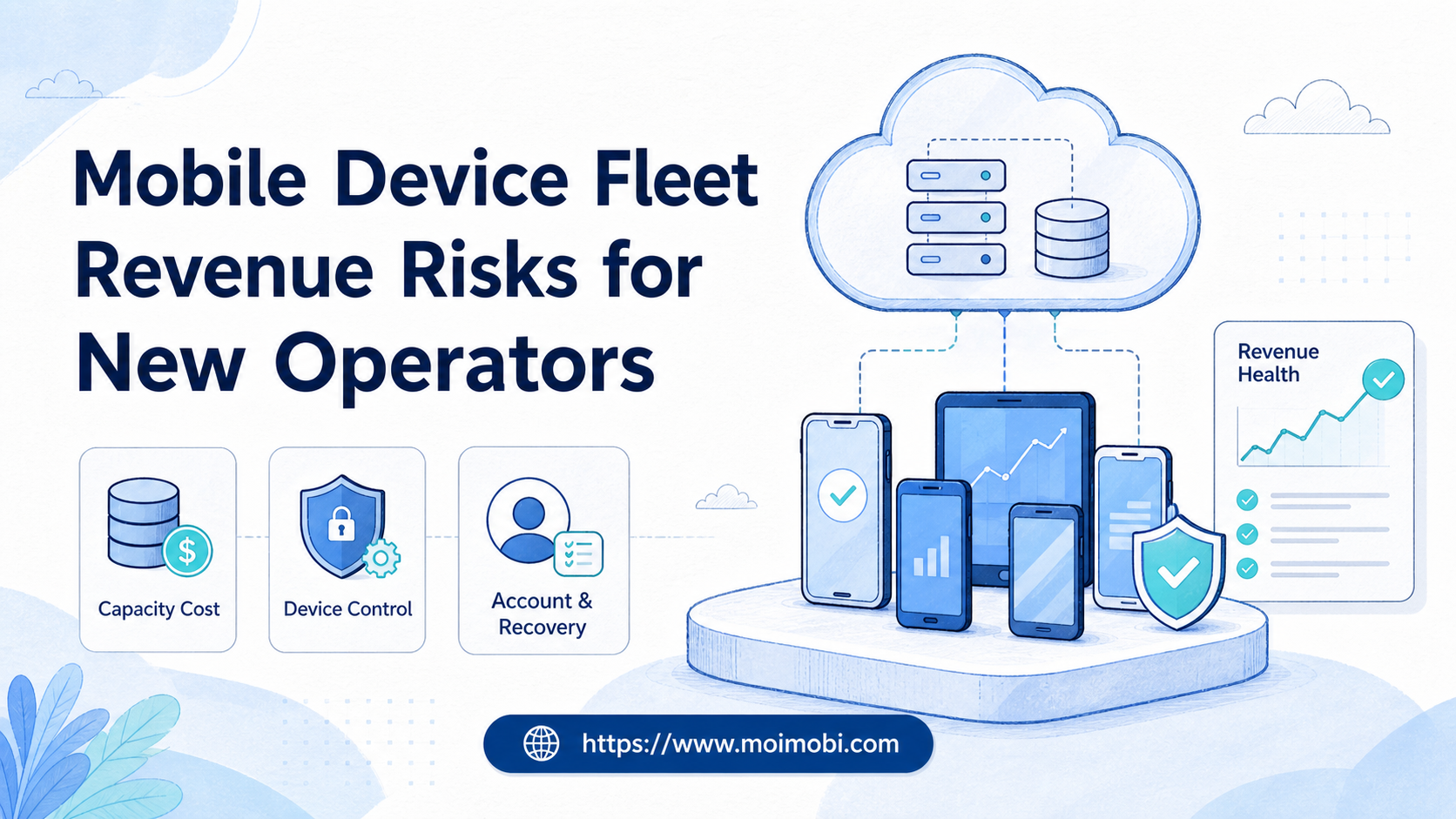
Mobile device fleet monetization is the attempt to earn revenue from a managed pool of phones, cloud phones, or Android devices by running repeatable mobile workflows. New operators should treat it as an operations business, not a shortcut to passive income.
The main risk is simple: device capacity costs money before revenue is proven. A fleet also needs account workflows, content input, routing, monitoring, recovery, and compliance checks. If those layers are missing, more devices only create more failure points.
This guide focuses on the practical risks behind a mobile farm business. It does not promise revenue. It gives new operators a framework for deciding whether their device fleet can support a real workflow with measurable demand.
Key Takeaways
- Device fleet revenue depends on utilization, workflow quality, and recovery speed, not only device count.
- Capacity has direct and indirect costs: devices, sessions, proxies, content, operators, monitoring, and failed runs.
- Mobile-first workflows may need cloud phones, but cloud phones still need account ownership and task records.
- New operators should pilot one workflow before buying large capacity.
- Revenue checks should include churn, rework, idle devices, and policy exposure.
The Core Idea Behind Mobile Device Fleet Monetization
The core idea is capacity resale or capacity use. An operator controls a device fleet, then applies it to client work, internal growth workflows, app operations, testing, publishing, monitoring, or customer engagement.
That model sounds simple until the operator counts the real constraints. Devices must be online. Accounts must be assigned. Content must be ready. Proxies and regions must be tracked. Tasks must finish with proof, not only a launch event.
AWS Device Farm pricing documentation is a useful benchmark for thinking about capacity. AWS describes metered billing by device minutes and unmetered billing by reserved device slots. The product is for testing, not social operations, but the pricing model shows a general truth: concurrency and device time are real economic inputs. See AWS documentation on Device Farm device slots.
New operators should evaluate revenue with this table:
| Risk area | What to measure | Why it affects revenue |
|---|---|---|
| Capacity | Active devices, idle devices, concurrent tasks | Idle capacity still creates cost. |
| Workflow | Completion rate, manual rescue, failed runs | Low completion turns device time into rework. |
| Accounts | Owner, platform, environment, review state | Unclear ownership slows recovery. |
| Revenue | Client demand, task price, churn, support load | Gross revenue can hide support cost. |
Why Teams Search for Mobile Device Fleet Monetization
Teams search for this topic when they see mobile execution as a business asset. They may already own devices, use cloud phones, run mobile accounts, or support clients who need repeated app-side work.
The demand usually comes from three places. First, mobile apps are central to social media, messaging, e-commerce, and customer engagement. Second, one human operator cannot manually repeat the same app task across many accounts all day. Third, clients often ask for outcomes, while operators pay for capacity, labor, and failures.
Android Enterprise documentation also shows why managed devices need policy thinking. Android's business device management material highlights control, deployment, and policy configuration for company-owned devices. Social operations differ from enterprise IT, but the same lesson applies: device scale needs management rules. See Android Enterprise management.
For operators using cloud phone execution environments, revenue planning should include device time, account mapping, content preparation, and support. A cloud phone is an execution layer. It is not a revenue model by itself.
Revenue Model Boundaries for New Operators
New operators should separate four different business models before they buy capacity. Each model has a different risk profile.
The first model is internal use. A team owns devices to support its own mobile publishing, monitoring, support, or QA work. The value comes from labor reduction and faster execution, not direct device resale.
The second model is managed service delivery. An operator sells a finished workflow, such as monitored accounts, prepared reports, app-side checks, or approved publishing support. The buyer pays for the result. The operator carries the capacity and recovery burden.
The third model is capacity rental. A customer pays for access to devices or sessions. This model needs usage rules, device cleanup, billing controls, and support boundaries.
The fourth model is workflow infrastructure. A provider sells a platform that helps other teams run mobile workflows with logs, account mapping, and operator roles. This is harder to build, but it can reduce the chaos that pure capacity rental creates.
Do not mix these models in one spreadsheet. A managed service may look profitable because the customer pays per task. A rental model may look profitable because devices appear booked. Both can fail when support requests, failed runs, or idle capacity are counted.
Use this quick boundary test:
- If the buyer pays for a business outcome, price the whole workflow.
- If the buyer pays for device access, define usage limits and cleanup rules.
- If the fleet supports your own team, measure saved labor and faster delivery.
- If the product is infrastructure, measure retention, not only device count.
This section is the key difference between revenue risk planning and a generic monetization overview. The operator is not only asking "how can this fleet make money?" The better question is "which revenue model can survive failure, support, and idle time?"
Who Benefits Most and In What Situations
Mobile device fleet monetization fits operators with a repeatable workflow and a buyer who understands the result. It is weak when the operator only has devices and no defined service.
Strong-fit examples include:
- agencies running approved client publishing workflows,
- e-commerce teams monitoring mobile app activity,
- support teams managing mobile inboxes,
- QA teams testing mobile app behavior,
- social media operators coordinating account groups,
- workflow providers selling execution capacity with reporting.
Weak-fit examples are more common for beginners. A person buys devices, assumes each phone will produce income, then discovers the hard parts: account sourcing, task design, customer support, policy limits, content supply, and failure recovery.
Meta's inauthentic behavior policy is relevant for social operators because platforms care about misleading activity and coordinated behavior. Operators should avoid business models that depend on deception, impersonation, or unclear account control. See Meta's Inauthentic Behavior policy.
Mobile Device Fleet Monetization Preflight Checklist
Start with preflight checks before buying more capacity. A new operator should prove that the workflow can run, recover, and produce measurable value.
- Define the payable workflow. Write the exact task, buyer, delivery proof, and pricing unit.
- Map device capacity. Count devices, sessions, concurrency, uptime, and idle time.
- Assign accounts. Give every account an owner, environment, platform, and review rule.
- Prepare content inputs. Confirm assets, captions, replies, or task data before execution.
- Track routing. Record proxy, region, device, account, and task assignment together.
- Log outcomes. Store completed, failed, skipped, and manual rescue events.
- Calculate recovery cost. Include operator time, retries, customer communication, and lost capacity.
MoiMobi's product direction is built around this execution view. A team may use mobile automation for repeated app tasks, device isolation for account workspaces, and multi-account management for ownership.
Common Revenue Risks That Reduce Results
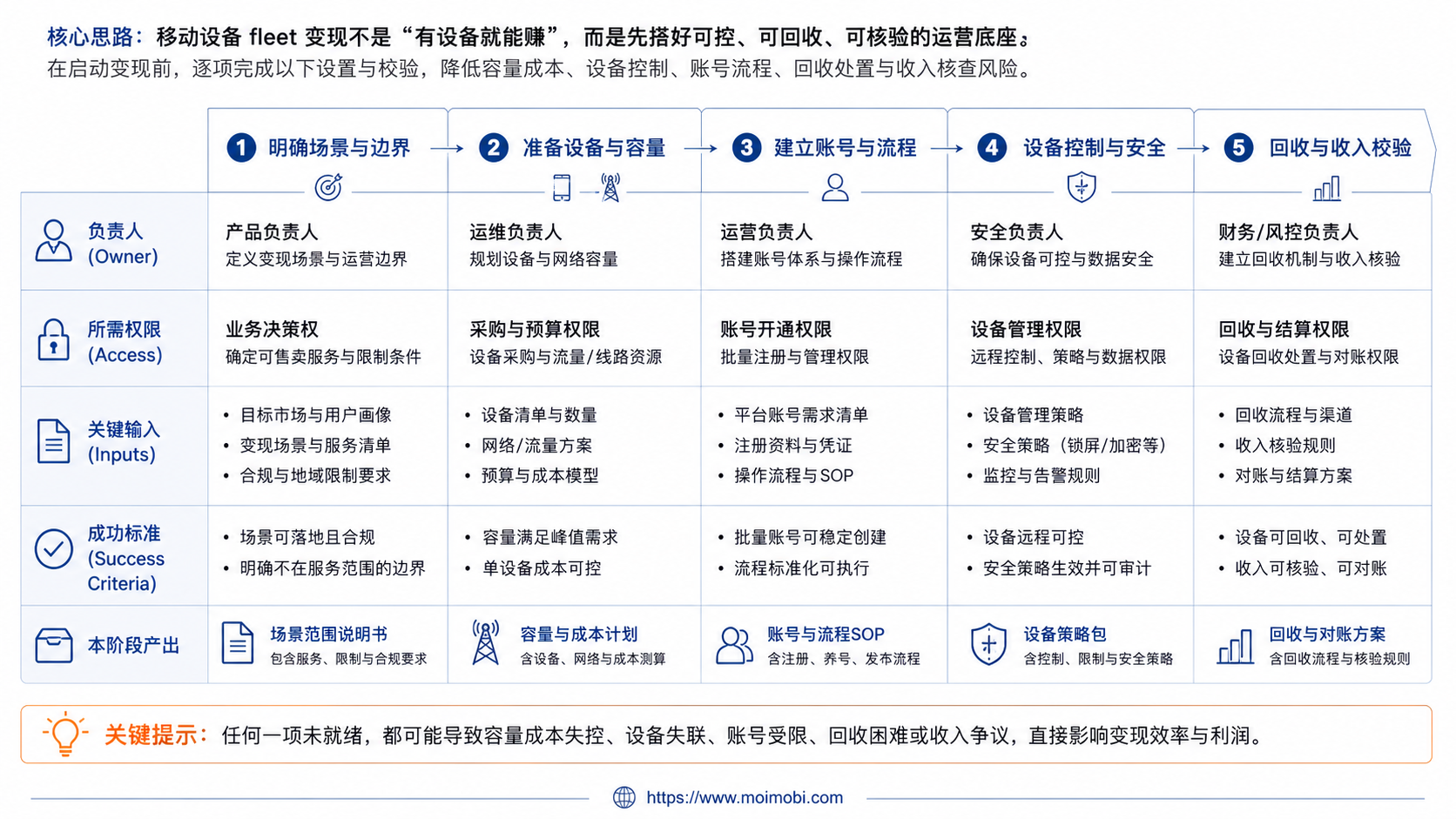
The first risk is idle inventory. Devices do not create revenue while waiting for work, content, login repair, or customer approval. A small fleet with high utilization may outperform a large fleet with poor scheduling.
The second risk is failure recovery. A failed mobile task can consume more labor than the original task. The operator may need to inspect the device, check account status, reload content, contact the client, and rerun the workflow.
The third risk is unclear unit economics. Revenue per task should be compared with device cost, proxy cost, operator time, support time, and failed-run rate. A service can look profitable before support and recovery are counted.
The fourth risk is platform exposure. Social and messaging platforms set rules against manipulation, spam, deceptive identity, and harmful coordination. A business model should not depend on hidden or misleading behavior. Policy-aware operators design workflows around legitimate account ownership, review, and records.
The fifth risk is content bottlenecks. A fleet cannot publish quality content if the content pipeline is empty. The content library and task assignment system should be planned before device scale.
Pilot Rollout and Revenue Validation
A pilot should test one service line, not the entire mobile farm business. Choose one workflow where the buyer, task, delivery proof, and pricing unit are clear.
Good pilots include:
- mobile app monitoring for a defined account group,
- approved content publishing for a client campaign,
- customer reply triage with human review,
- app-side QA checks on a fixed device set,
- weekly reporting from mobile account activity.
Measure these fields for two weeks:
- device utilization rate,
- task completion rate,
- manual rescue count,
- failed-run reasons,
- average recovery time,
- revenue per completed task,
- support time per client,
- idle capacity cost.
Do not expand if the pilot cannot produce a clean report. A clean report should show which devices ran, which accounts were used, which tasks finished, which tasks failed, and what recovery cost.
Add a cash-flow review before adding devices. The question is not only whether the pilot works. The question is whether the operator can pay for the next capacity block while waiting for customer revenue.
Track these early cash-flow checks:
- prepaid device or cloud phone cost,
- proxy and routing cost,
- content preparation cost,
- operator hours before billing,
- customer payment delay,
- refund or rework exposure,
- unused capacity after the pilot.
The safest expansion pattern is small and boring. Add one more account group, one more workflow, or one more capacity block. Then repeat the same report. Rapid expansion without clean unit economics usually hides the problem until support work spikes.
Recovery Plan Before Scale
A revenue plan needs a recovery plan. New operators often track success but ignore what happens after a task fails.
Write the recovery path before scaling:
- Identify the device or cloud phone.
- Identify the account and task owner.
- Classify the failure reason.
- Decide whether to retry, pause, or escalate.
- Notify the customer if delivery is affected.
- Record the recovery time and final result.
This process turns failure into operating data. It also prevents the same device or account group from failing quietly across several customer tasks. A fleet becomes easier to monetize when the operator knows which failures repeat and which ones are one-time setup problems.
For mobile execution teams, phone farm infrastructure planning should include this recovery layer. Capacity without diagnosis is just a larger surface area for errors.
How to Evaluate Mobile Device Fleet Monetization Software
Software should reduce uncertainty, not just show more devices. The best mobile farm software for a serious operator is the one that makes capacity, workflow, accounts, and failures visible.
Use this evaluation checklist:
- Does each device have status, owner, and task history?
- Can operators assign account groups to devices?
- Can the system separate browser and mobile execution paths?
- Are failed runs visible with reasons?
- Can content assets be prepared once and reused across tasks?
- Can the team pause, retry, or route to human review?
- Does reporting show idle capacity and recovery load?
If a platform only shows devices, it may be enough for simple remote access. If the operator sells a managed service, the platform also needs workflow records, account grouping, and review gates.
For social media operations, social media marketing should connect content, execution, and reporting. A device fleet without a workflow layer becomes hard to manage as soon as clients or account groups grow.
Frequently Asked Questions
1. What is mobile device fleet monetization?
It is the process of earning revenue from managed phones, cloud phones, or Android devices by running repeatable mobile workflows.
2. Is a mobile farm business easy to start?
The device setup may be easy. The hard part is paid demand, workflow design, account ownership, support, and recovery.
3. What costs should new operators include?
Include devices, cloud phone capacity, proxies, storage, accounts, content, labor, monitoring, failed runs, and customer support.
4. When should a team use cloud phones?
Use cloud phones when work depends on mobile apps, Android sessions, mobile inboxes, or device-level checks.
5. What is the biggest revenue risk?
The biggest risk is buying capacity before proving utilization, pricing, recovery speed, and client demand.
6. Can automation replace operators?
Automation can reduce repeated preparation and execution work. Operators still need to review exceptions, approve sensitive actions, and recover failed tasks.
7. How should a new operator price services?
Price from completed workflows, not raw device count. Include support time, failure rate, and idle capacity in the model.
8. Where does MoiMobi fit?
MoiMobi fits teams that need cloud phones, browser profiles, account workspaces, mobile automation, and execution records in one operating model.
Conclusion
Mobile device fleet revenue risks start when operators confuse capacity with a business. A fleet can support revenue only when the workflow, account ownership, content input, device routing, and recovery process are clear.
Start with one workflow and one account group. Measure utilization, completion, failure, recovery, and support cost before buying more devices. If the pilot cannot show clean unit economics, fix the workflow before expanding the fleet.