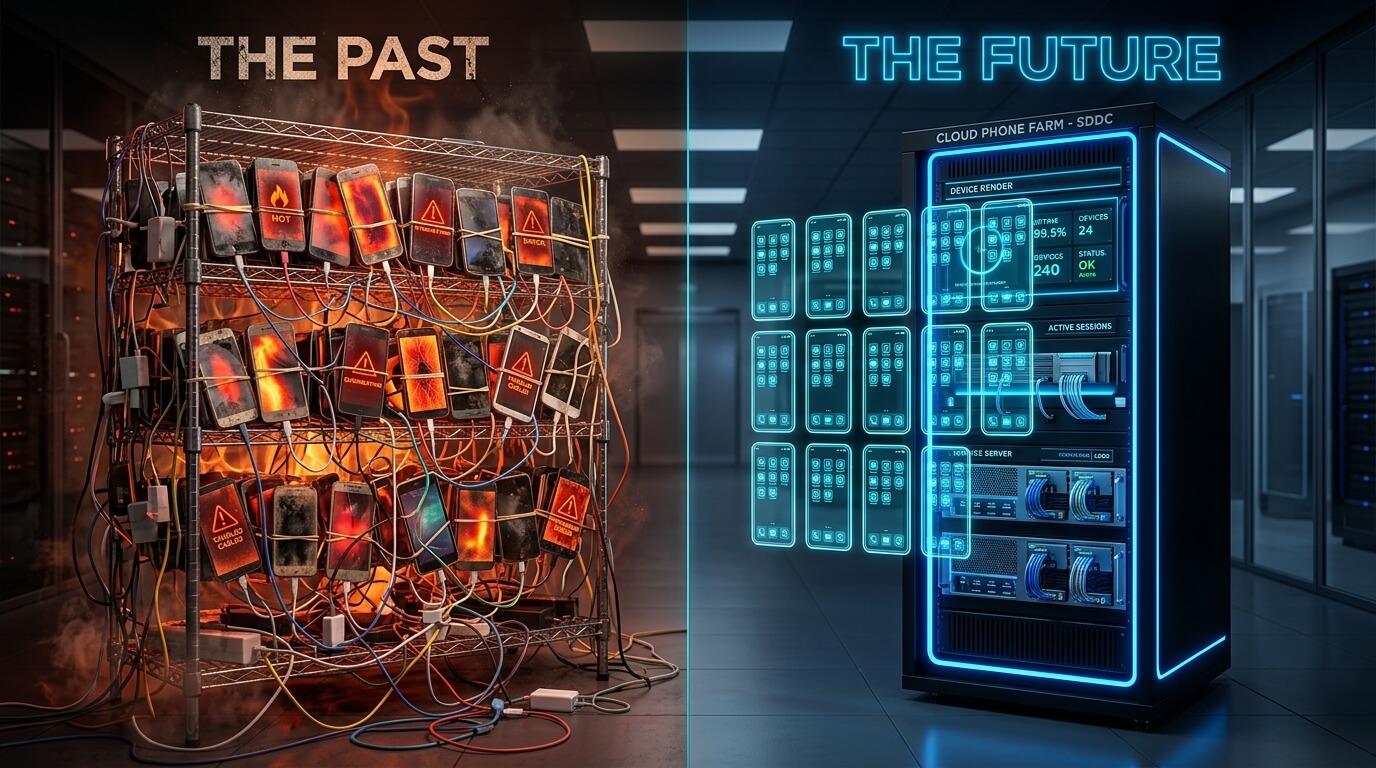
For over a decade, digital marketers, click farmers, and automation engineers relied on a very tangible, messy piece of infrastructure: the physical phone farm. Picture hundreds of cheap smartphones strapped to a wall, tangled in a massive web of USB cables, constantly overheating, and requiring 24/7 physical maintenance to keep operations running.
In this comprehensive infrastructure guide, we will break down what a cloud phone farm actually is, how its underlying server architecture works, the critical components required to run it safely, and why the transition to virtualization is the only sustainable way to scale mobile automation and digital marketing.
1. The Demise of the Physical Phone Farm
To understand the value of cloud infrastructure, we must look at why the physical model is failing. A traditional phone farm involves buying hundreds of budget Android devices, connecting them to massive USB hubs, and routing them through a single local network. This creates severe logistical nightmares:
- Hardware Degradation (Spicy Pillows): Running a lithium-ion battery 24/7 while plugged in causes the battery to swell and eventually catch fire—a massive hazard in physical server rooms.
- USB Hub Limitations: Data transfer and ADB connections frequently drop when funneling 50 devices through commercial USB hubs.
- Network Bleed: If one phone leaks its true local IP address due to a failing VPN app, social platforms will map your local network and ban all 50 phones on the rack simultaneously.
- Physical Maintenance: If a phone freezes, crashes, or updates unexpectedly, a human operator must physically walk over to the rack and tap the screen.
2. What is a Cloud Phone Farm? (Under the Hood)
A cloud phone farm is an enterprise data center solution that provides hundreds or thousands of virtual Android devices. You do not own the physical hardware; you rent the processing power and interface remotely.
At the architectural level, premium cloud phone providers do not use standard Intel/AMD (x86) servers running emulators, as this is inefficient and easily detected. Instead, they build massive server racks populated with ARM-based System-on-Chips (SoCs). These are the exact same microarchitectures found inside actual smartphones.
Because the server hardware matches the mobile software natively, the Android OS runs exactly as it would on a physical device. The visual output is encoded (typically using H.264 or H.265) and streamed to the user's web dashboard with ultra-low latency. Input commands (clicks and swipes) are sent back over TCP/IP.
3. Physical Phone Farm vs. Cloud Phone Farm
When enterprise managers evaluate their CapEx (Capital Expenditure) and OpEx (Operational Expenditure), the comparison heavily favors virtualization. Let's look at an exhaustive physical phone farm vs cloud phone breakdown.
4. Essential Components of a Cloud Phone Farm Architecture
Running a successful cloud phone operation requires more than just launching virtual machines. A true "farm" requires a robust infrastructure stack to maintain stealth and efficiency.
A. The Device Isolation Layer
If you are managing a massive matrix of social media or e-commerce accounts, you must ensure that no two virtual devices share the same digital footprint. Premium infrastructure relies on strict device isolation. This means the cloud provider modifies the Android kernel to generate entirely unique identifiers (IMEI, Android ID, MAC address, Build.prop) for every single instance. To external apps, a farm of 500 cloud phones looks like 500 distinct, unassociated citizens walking around a city.
B. The Proxy Network Integration
A unique hardware footprint is useless if all 500 phones connect from the exact same data center IP address. A scalable cloud phone farm must be integrated with a robust proxy network. Infrastructure managers route high-quality Mobile (4G/5G) or Residential proxies directly into the cloud device's system settings. This ensures the IP address perfectly matches the spoofed GPS location and timezone of the virtual device.
C. The Command and Control (C2) Dashboard
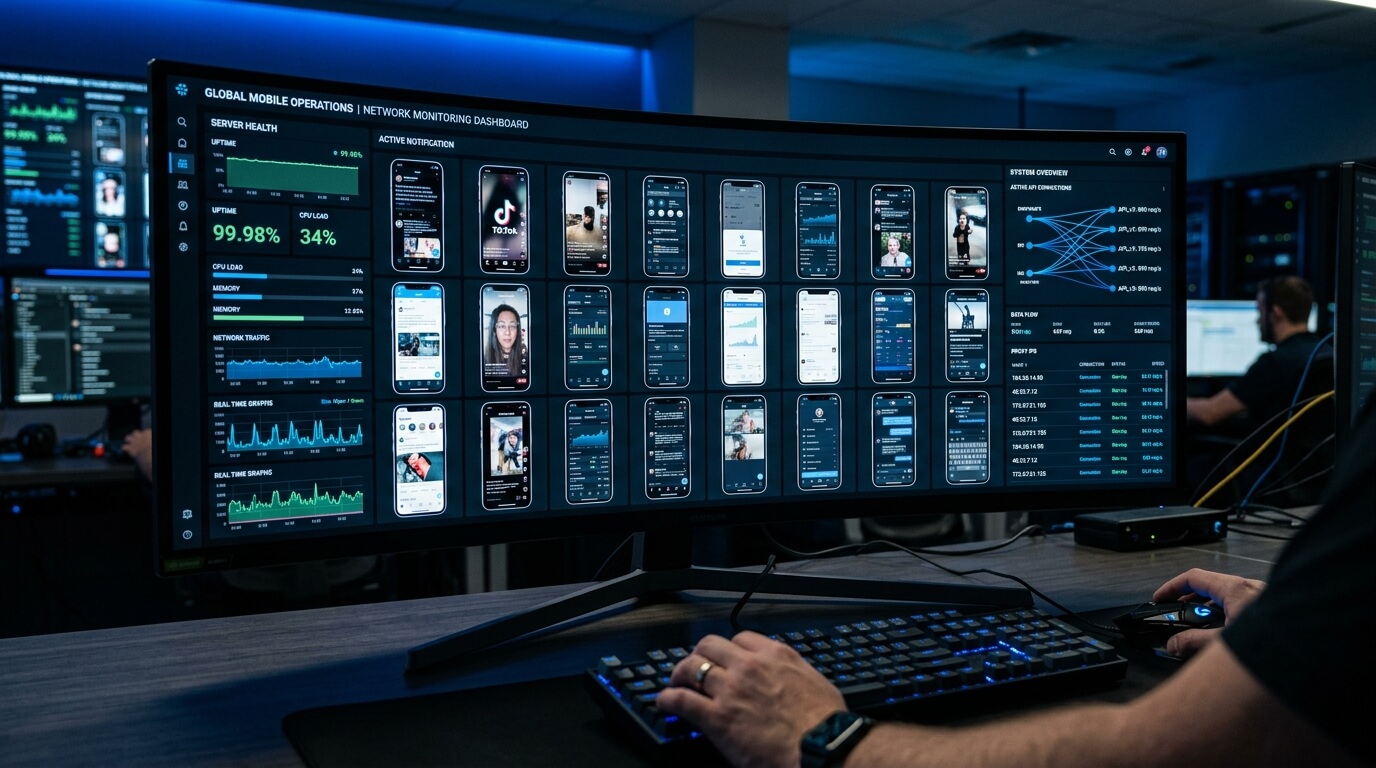
Managing hundreds of devices requires a specialized UI. A standard cloud phone farm dashboard allows operators to view a "grid" of live video streams—monitoring 50 active screens on a single monitor. Operators can group devices by campaign (e.g., "TikTok US Matrix," "WhatsApp Lead Gen Europe"), deploy APK updates in bulk, and monitor device health metrics.
D. Programmatic Control (ADB & API)
Manual management fails at scale. Modern farms are orchestrated via API. Developers use the provider's REST API to automatically provision devices, change proxy IPs, and reboot systems at scheduled intervals. Simultaneously, ADB (Android Debug Bridge) over TCP/IP is used to deploy UIAutomator or Appium scripts, turning the farm into a fully autonomous botnet of AI agents.
5. Core Business Use Cases: Who Needs This Scale?
The transition to cloud infrastructure unlocks massive opportunities for businesses that rely on digital volume.
- Global Social Media Matrix: Agencies running social media marketing use phone farms to manage thousands of TikTok or Instagram accounts. Cloud phones ensure absolute safety from association bans while allowing teams located in different countries to access the same secure device grid.
- Web3 and Airdrop Farming: Crypto operations requiring heavy mobile interactions (wallet generation, daily sign-ins, dApp engagement) use cloud farms to bypass strict Sybil-detection mechanisms.
- Cross-Border E-Commerce: Managing 100 Shopee or Amazon seller apps across 5 different Asian countries is logistically impossible with physical phones. Cloud farms allow operators to assign dedicated local IPs and devices to each storefront from a single office in London or New York.
- App Testing & QA Validation: Development studios use scalable cloud grids to test their applications across hundreds of different simulated network conditions, GPS locations, and Android versions simultaneously.
6. Frequently Asked Questions (FAQ)
Are cloud phone farms more expensive than physical phones?
In the short term (Month 1), buying used $40 Android phones might seem cheaper. However, when you factor in the cost of electricity, dedicated cooling, USB hubs, replacement batteries, and the massive human labor required to maintain a physical rack, the Total Cost of Ownership (TCO) of a cloud phone farm is significantly lower and far more predictable.
Can social platforms detect that I am using a server data center?
They can detect standard virtual machines and emulators. However, enterprise cloud phone farms use "Antidetect" technology. They spoof hardware sensors (faking battery drain, faking gyroscope movements) and, when paired with a pure Residential proxy, effectively disguise the data center origin, appearing as a standard physical mobile user.
How much internet bandwidth do I need to manage a farm?
The beauty of a cloud phone farm is that the heavy internet bandwidth (downloading APKs, streaming videos on TikTok) happens on the cloud server's gigabit connection. Your local computer only needs enough bandwidth to receive the video stream of the UI. A standard office internet connection can easily manage a dashboard monitoring 50 to 100 devices.
What happens if a cloud server goes down?
Top-tier cloud phone providers operate with high-availability architecture. Data is routinely backed up, and if an underlying hardware node fails, your virtual device instance can be migrated and spun up on a healthy server almost instantly, ensuring your 24/7 operations suffer minimal downtime.
Conclusion: The Only Way to Scale
The physical phone farm is a relic of the past. The heat, the cables, the bloated batteries, and the strict physical limitations make it an unsustainable model for modern digital operations.
As social media platforms deploy smarter AI to detect multi-account networks, your infrastructure must evolve to match them. A Cloud Phone Farm provides the ultimate combination of infinite scalability, perfect device isolation, and total programmatic API control. Whether you are automating marketing outreach, testing applications, or running a global social matrix, moving your operations to an ARM-based cloud infrastructure is the most critical investment you can make for the future of your business.