Key Takeaways
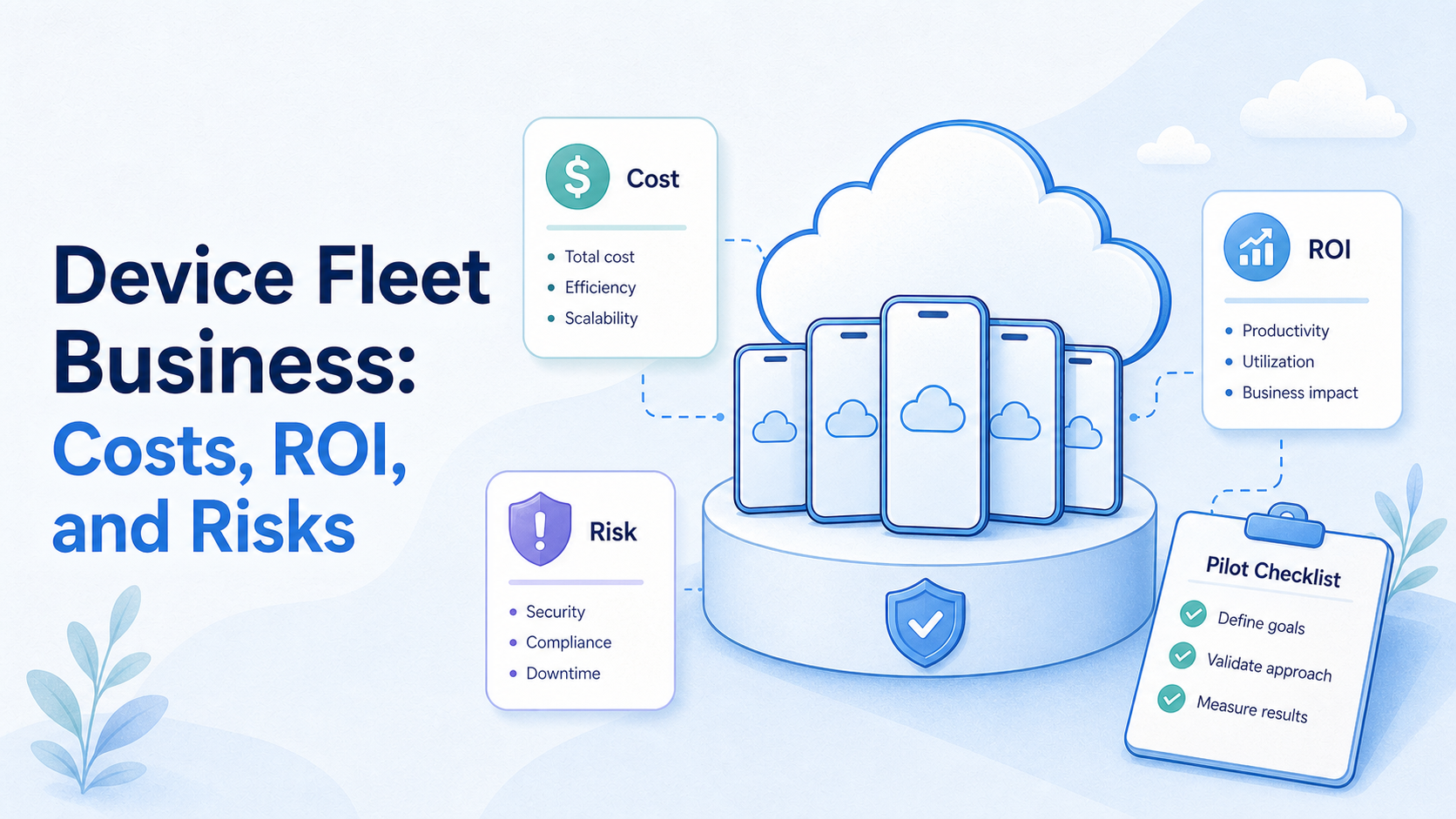
- A device fleet business is an operating model for managing many mobile environments, not only a pile of phones.
- ROI depends on throughput, recovery speed, operator time, account separation, and the cost of mistakes.
- The highest risks usually come from weak ownership, unclear routing, poor records, and policy blind spots.
- A small pilot should prove workflow control before a team buys more capacity.
- Cloud phones can reduce physical handling, but they still need process rules and review loops.
Introduction.
A device fleet business is a structured way to run many mobile devices or cloud mobile environments for repeatable business workflows. The goal is not simply to own more phones. The goal is to create reliable mobile capacity that can be assigned, operated, reviewed, and recovered by a team.
That distinction changes the cost model. A small physical phone farm may look cheap at first. It becomes expensive when operators spend hours charging devices, tracking account state, replacing broken hardware, or explaining handoffs. A cloud-based setup may look more expensive per lane. It can be more practical when the team needs remote access, separation, and faster recovery.
ROI also depends on the work being done. Social media checks, app operations, campaign review, marketplace support, and account maintenance all have different costs. Some workflows need high parallel capacity. Others need fewer lanes with stronger control. A useful device fleet business plan starts with workflow math, not with a device count.
Risk is the third part of the decision. Mobile platforms, app policies, account rules, and privacy duties still matter. Google publishes broad guidance through the Google Play Policy Center, and search teams can also learn from Google's guidance on helpful content. These sources do not validate any specific fleet model. They show why teams should avoid reckless automation claims and stay inside real platform boundaries.
MoiMobi treats device fleets as execution infrastructure. A team may combine cloud phone, phone farm, routing, device isolation, and workflow rules. The practical question is simple. Does the system make mobile work easier to control, measure, and recover?
The Core Idea Behind Device Fleet Business: Costs, ROI, and Risks
The common mistake is thinking the business is about device volume. A larger count can help only when each lane has a purpose. Without that purpose, more devices create more confusion, more maintenance, and more unexplained outcomes.
A workable model begins with lanes. A lane is one mobile environment assigned to a clear job. It may support a client account group, a campaign, a review workflow, or a test path. The lane has an owner, a backup, a route note, an app state, and a recovery path. That is the operational unit behind a device fleet business.
Costs fall into several groups. Hardware cost is visible when a team owns phones. Cloud capacity cost is visible when a team rents remote mobile environments. Labor cost is often less visible, but it can dominate the model. Operators spend time setting up devices, switching contexts, checking notes, fixing broken states, and explaining what happened.
Risk cost is also real. A poorly documented lane can cause duplicate actions, account mix-ups, missed reviews, and slow recovery. These failures may not appear in a vendor quote. They show up in support tickets, campaign delays, lost operator time, and urgent calls.
ROI should be measured against the current process. Ten physical phones may already support the work with little friction, so the return from changing systems could be modest. A process that depends on one person, one room, and handwritten notes creates a stronger case for managed lanes. The return comes from fewer handoff failures and faster recovery, not from a vague promise of scale.
Cloud phones can change the cost structure. They reduce physical handling and can make remote work easier. They do not remove the need for ownership, policy review, or workflow design. A mobile automation layer can help repeat tasks, but it should be introduced after the team understands the manual workflow.
The best starting question is not "How many devices can we get?" A stronger question is "Which mobile work should become a managed lane?" That question forces the team to define the job before it expands capacity.
Why Teams Search for This Topic
Teams usually research device fleet business models after the informal setup starts to strain. At first, a few phones on a desk may be enough. Then the team adds more accounts, more regions, more clients, or more operators. The old process stops scaling because the work is shared.
Three pressure points usually drive the search.
-
Throughput pressure. The team needs more parallel mobile sessions than one operator can handle locally. Work queues start backing up because a device is busy, missing, or locked.
-
Control pressure. Managers need to know which lane owns which account group. They also need a way to review state before changes are made.
-
Recovery pressure. A device breaks, an app state changes, or an operator leaves. The team needs a way to continue work without rebuilding context from memory.
These pressures are business problems, not only technical problems. Buying more devices can solve throughput for a short period. It does not solve unclear ownership. A cloud phone farm can add remote access. It still needs lane records and a review cadence.
The decision also depends on location. A distributed team may prefer cloud access because physical devices create shipping, storage, and office dependency. An in-house team may keep some physical phones when hardware-specific checks matter. A hybrid model is common in many operations because no single setup covers every task well.
Teams also search because the phrase "phone farm business" can sound attractive. That framing can be misleading. A serious device fleet business should avoid spam-like growth language and unsupported safety claims. The better frame is controlled mobile execution. It asks whether the fleet helps people do legitimate work with clearer records and fewer interruptions.
For MoiMobi users, the next evaluation often connects to multi-account management. Multi-account work needs separation, routing notes, review rules, and handoff discipline. The fleet is useful when it supports those controls.
One practical test is simple. Ask an operator to hand off a lane to another person in ten minutes. A second person who cannot understand purpose, account context, route, and next action is showing that the fleet is not yet a managed business system.
Who Benefits Most and In What Situations
The strongest fit appears when mobile work is repeatable, shared, and costly to interrupt. A device fleet business is less useful when one person performs occasional checks. It becomes more useful when several people need consistent access to many mobile environments.
Agencies are a common fit. They may manage client campaigns, social media checks, marketplace workflows, or app-based tasks. Each client or campaign needs separation. A shared device without clear records creates avoidable confusion. A managed lane can show who owns the work and what state it is in.
Operations teams also benefit when mobile apps are part of daily execution. Support, QA, content review, and regional checks may all need mobile environments. The value comes from keeping lanes available and documented. A team can avoid wasting time hunting for a phone, code, or state note.
Growth teams may need fleet capacity for legitimate testing and review. That does not mean uncontrolled activity is a good plan. The team should define what is being tested, which accounts are involved, and how results are measured. Google Search Central's SEO starter guide is not about mobile fleets, but its emphasis on useful, user-centered work is a useful constraint for marketing teams.
The model is not a fit for every workflow.
Good fit
- Shared mobile operations with several operators.
- Workflows that need account or client separation.
- Remote teams that need controlled access.
- Tasks where recovery time affects revenue or service quality.
Poor fit
- Occasional one-person mobile checks.
- Unclear workflows with no owner or review path.
- Projects built around unsupported platform claims.
- Teams that will not document lane state.
The fit boundary matters because device fleets can hide process problems. A team may buy more capacity when it really needs better rules. Before expanding, define one use case, one owner, one backup, and one recovery path. That small discipline exposes whether the fleet can become a business system.
Cost sensitivity also shapes fit. If operator time is cheap and physical access is simple, a local phone farm may be acceptable for a period. If coordination delays are expensive, remote cloud phones may justify a higher direct cost. The correct answer depends on the cost of friction in the current workflow.
How to Evaluate or Start Using Device Fleet Business: Costs, ROI, and Risks
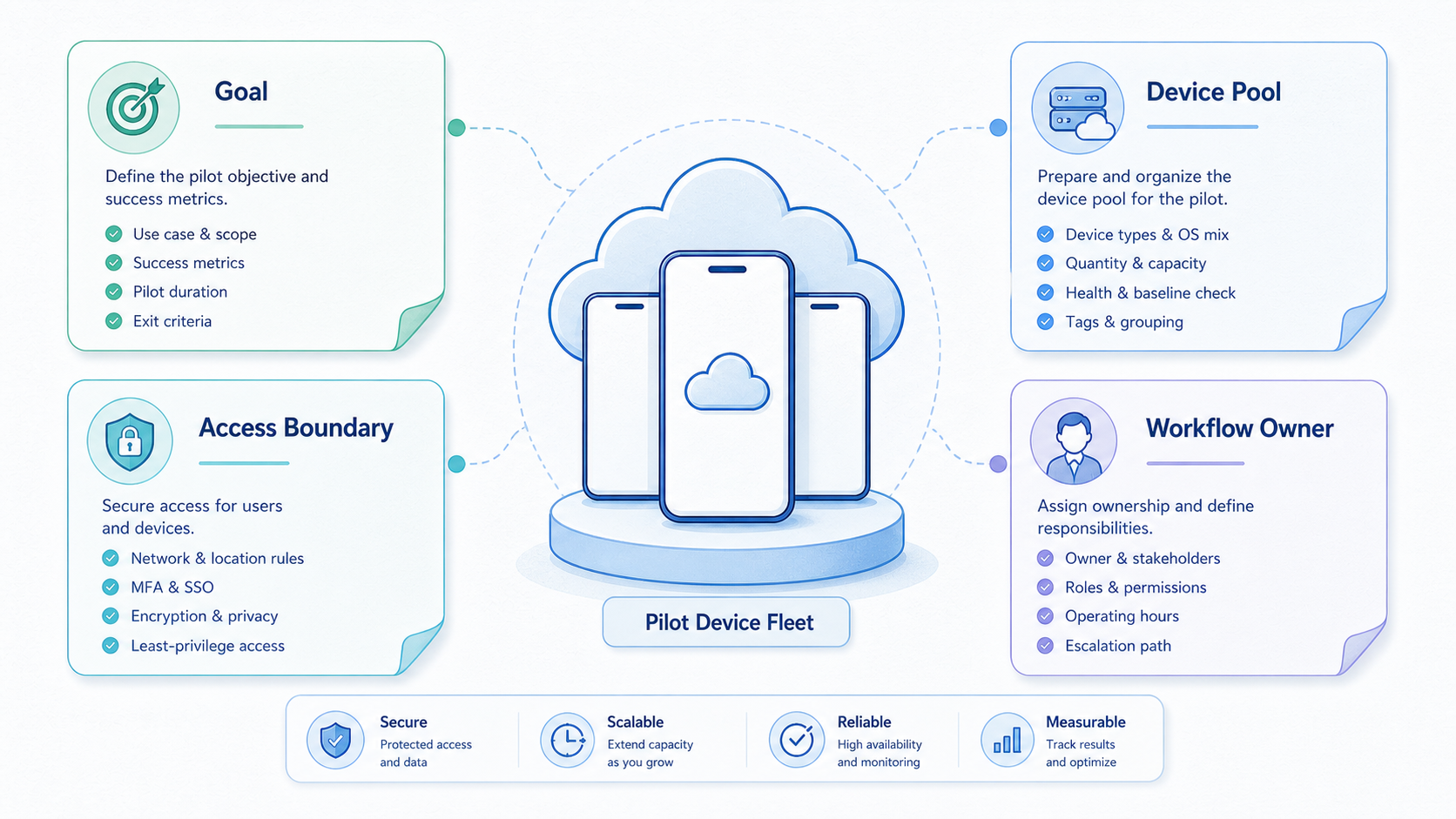
Start with a pilot, not a large purchase. A pilot turns the device fleet business idea into measurable operations. It also prevents the team from confusing vendor capacity with business readiness.
-
Define one workflow. Pick one use case with a clear owner and real demand. Examples include campaign checks, social media account support, app review, or client task queues. Avoid mixing several jobs in the first test.
-
Map current costs. Count device cost, cloud capacity cost, operator hours, recovery time, and coordination delays. Include the time spent finding devices, resetting states, and explaining handoffs. This baseline is the only way to judge ROI later.
-
Choose the lane model. Decide whether the pilot uses physical phones, cloud phones, or a hybrid. A cloud setup may be easier for remote teams. Physical devices may still matter for hardware-specific checks. The choice should match the workflow, not a trend.
-
Set ownership rules. Each lane needs a primary owner and a backup. The owner keeps notes current. The backup can continue work if the owner is unavailable.
-
Add separation and routing notes. Multi-account work should not casually mix clients, campaigns, or account groups. Teams can evaluate device isolation and proxy network controls when separation and routing are part of the task.
-
Measure output and recovery. Track completed tasks, blocked tasks, handoff time, recovery time, and operator interruptions. These metrics reveal whether the fleet improves work or only adds another tool.
-
Review policy and quality boundaries. Platform rules, app terms, privacy duties, and content quality expectations still apply. Use official sources where possible. Do not base the pilot on unsupported claims about avoiding risk.
-
Decide whether to scale. Expand only when the pilot shows stable lanes, cleaner handoffs, and measurable time savings. A confusing pilot needs an operating-model fix before the team adds capacity.
| Metric | Why it matters | Healthy signal |
|---|---|---|
| Handoff time | Shows whether lane notes are usable. | A backup can continue work without a long call. |
| Recovery time | Shows how fast the team handles broken states. | Common failures have a documented response. |
| Operator interruptions | Shows hidden coordination cost. | Operators ask fewer repeated status questions. |
| Lane utilization | Shows whether capacity matches demand. | Important lanes are used, reviewed, and retired when stale. |
Review ROI after the pilot has enough real work. A one-day test may prove access. It rarely proves recovery. Two to four weeks is often more useful because the team sees handoffs, app changes, and routine failures.
The pilot should also separate direct and indirect return. Direct return includes more completed mobile tasks, lower device handling time, or fewer blocked queues. Indirect return includes clearer accountability, fewer repeated questions, and faster manager review. Both matter because device fleet operations often fail through friction rather than one obvious cost line.
Good pilot notes stay simple. Record the lane purpose, owner, backup, route, last state, open issue, and next review date. Then compare the notes against real incidents. A record is too weak when the team still needs long calls to understand a lane. Another operator should be able to continue work from the record.
Device Fleet Business Mistakes That Reduce Results
The most damaging mistake is treating a device fleet as inventory instead of infrastructure. Inventory asks how many phones exist. Infrastructure asks whether each lane supports a defined workflow with controls.
Another mistake is ignoring labor. A cheap phone farm can become expensive when people maintain it manually. Charging, labeling, storing, resetting, and checking devices all consume time. A cloud phone farm can reduce physical labor, but it can still waste time if the team does not define lane records.
Weak documentation creates the next failure. A device may look active, but nobody knows which account group belongs to it. Another operator changes the setup, and the team cannot connect the later issue to the earlier action. Short notes are enough when they are current. Long documents are not needed for every lane.
Policy blindness is also risky. Teams sometimes describe device fleets as a way to avoid platform constraints. That framing is reckless. A better approach is to treat platform rules as operating boundaries. If a workflow depends on behavior that an app or platform disallows, the fleet design will not make it a sound process.
Measurement gaps reduce ROI. A team may feel faster after adding more devices, but feelings do not prove return. Track queue time, completed tasks, recovery time, and handoff quality. These numbers show whether capacity is solving the right problem.
Over-automation is another common issue. Automation can help with repetitive steps after the process is stable. It can also multiply errors when the process is poorly defined. Start with manual clarity. Then automate only the steps that are repeatable, reviewed, and reversible.
Finally, teams often forget retirement. Old lanes keep running because nobody owns cleanup. Stale devices increase cost and confusion. A monthly review should pause unused lanes, archive notes, and return capacity to the pool.
The practical fix is a simple operating checklist.
- Give every lane a purpose, owner, backup, and review date.
- Keep account groups and client work separated when needed.
- Record route, app state, and recovery notes in a shared place.
- Measure time saved, not only devices added.
- Review policy boundaries before scaling sensitive workflows.
- Retire stale lanes instead of letting them drift.
This checklist turns the fleet into a managed system. It also makes vendor comparisons more honest because the team can compare tools against real workflow needs.
Frequently Asked Questions
What is a device fleet business?
In practical terms, the model manages many mobile environments for repeatable work. It may use physical phones, cloud phones, or both. The important part is control over ownership, access, handoff, and recovery.
Is a phone farm the same thing?
A phone farm is usually a group of phones used for parallel mobile activity. A device fleet business is broader. It includes workflow rules, lane records, cost tracking, risk review, and decisions about when to scale or retire capacity.
How do cloud phones change the cost model?
Cloud phones can reduce physical handling, shipping, storage, and local access limits. They add cloud capacity cost and still require process design. The value depends on whether remote access and recovery reduce enough operational friction.
What should teams measure first?
Start with handoff time, recovery time, completed tasks, blocked tasks, and operator interruptions. These metrics show whether the fleet improves work. Device count alone does not prove ROI.
When is a mobile farm a poor fit?
It is a poor fit when the workflow is occasional, unclear, or owned by one person without coordination problems. It is also a poor fit when the business case depends on unsupported claims about platform safety.
Should automation come before fleet design?
Usually no. Teams should define the lane, owner, state record, and recovery path first. Automation is more useful after the manual workflow is repeatable and reviewable.
How many devices should a pilot use?
Use the smallest number that can prove the workflow. For many teams, a pilot with a few lanes is enough to test ownership, handoff, and recovery. Expand only after the metrics justify it.
What MoiMobi pages are most relevant next?
Teams comparing options can review MoiMobi's cloud phone, phone farm, and mobile automation pages. The best next page depends on whether the main issue is access, capacity, or repeatable execution.
Conclusion
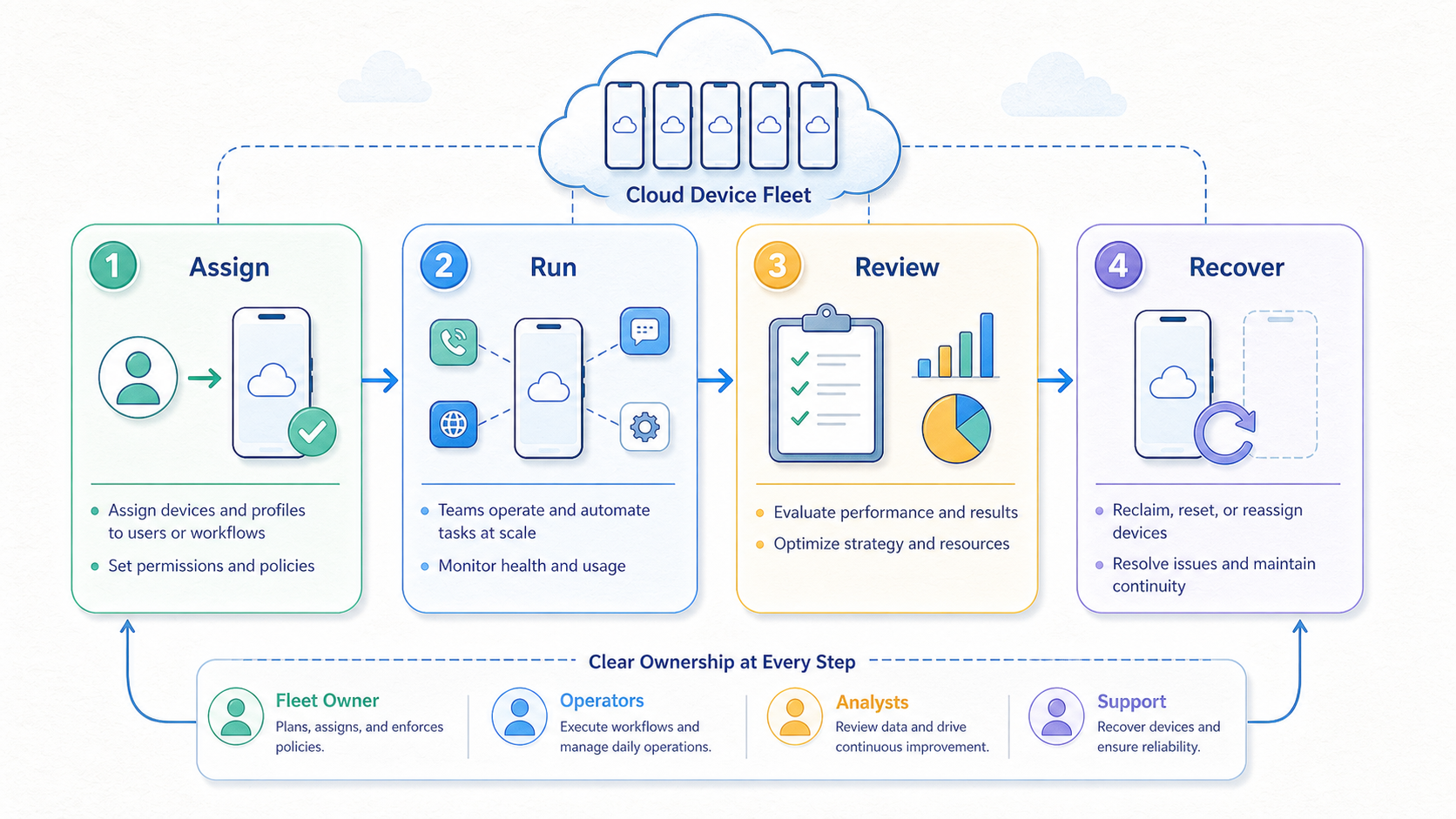
The model works when it turns scattered mobile work into managed execution lanes. The direct cost of devices or cloud capacity matters, but it is only one part of the model. The larger question is whether the system reduces handoff friction, protects separation, improves recovery, and gives managers a clear view of active work.
Judge ROI against the current process. A team with stable lanes, simple handoffs, and low recovery cost may not need urgent expansion. Operators who lose time finding devices, rebuilding context, and explaining state create a stronger case for testing a managed fleet.
Begin with one workflow and a short pilot. Define the lane owner, backup, route note, app state, and review cadence. Track handoff time, recovery time, blocked work, and operator interruptions. Then compare physical phones, cloud phones, and hybrid options against those results.
The final decision should include a stop rule. A fleet that cannot show cleaner handoffs, faster recovery, or lower coordination cost should not expand just because capacity is available. Pausing is a valid outcome. It protects the team from turning a weak workflow into a larger weak workflow.
The safest next step is operational, not promotional. Write the lane record for one real workflow today. Gaps in ownership or recovery rules should be fixed before scaling. Clear records and better pilot metrics make the device fleet business case easier to defend. That discipline also gives finance, operations, and team leads the same facts when they choose the next capacity step.