Key Takeaways
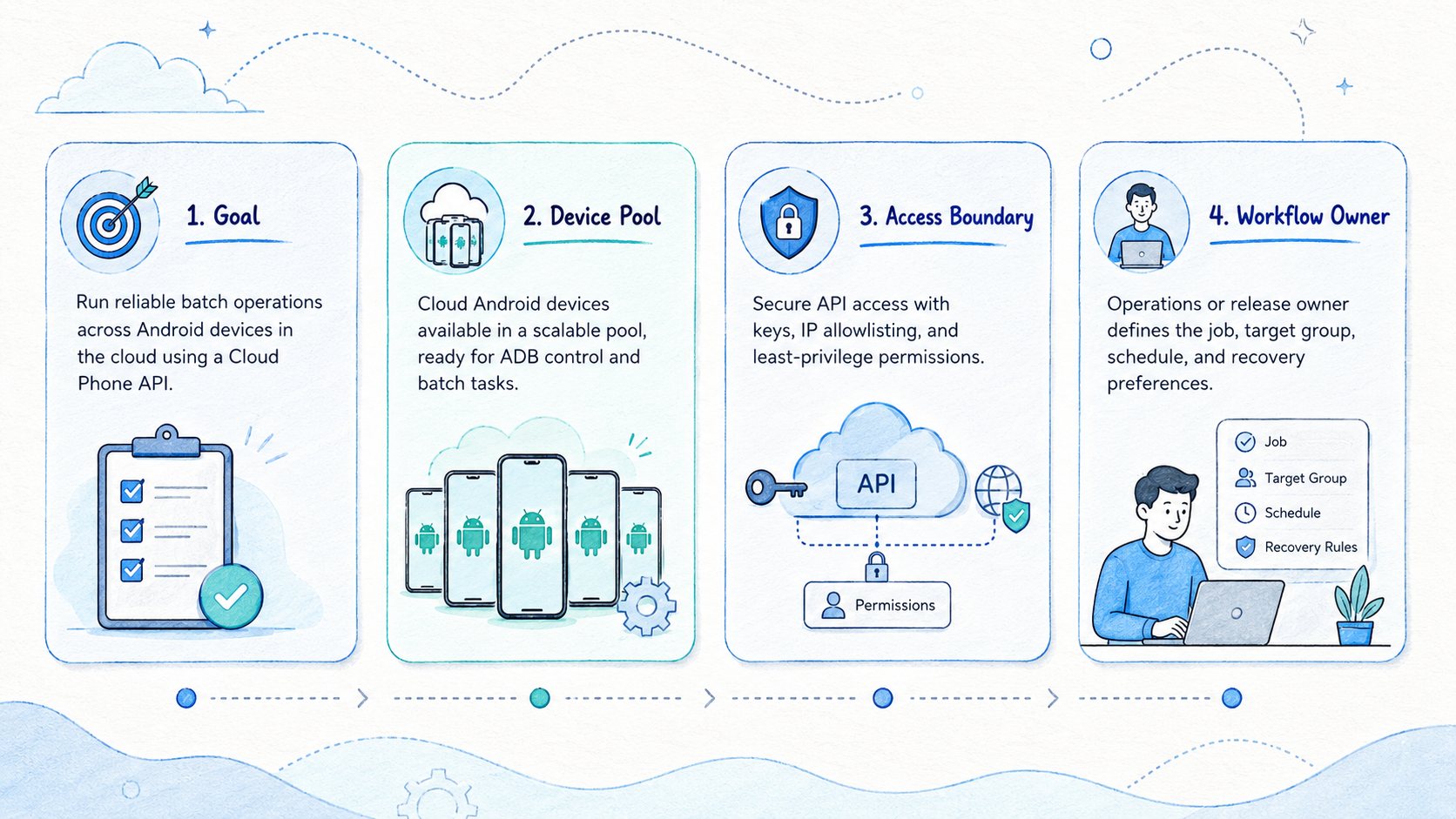
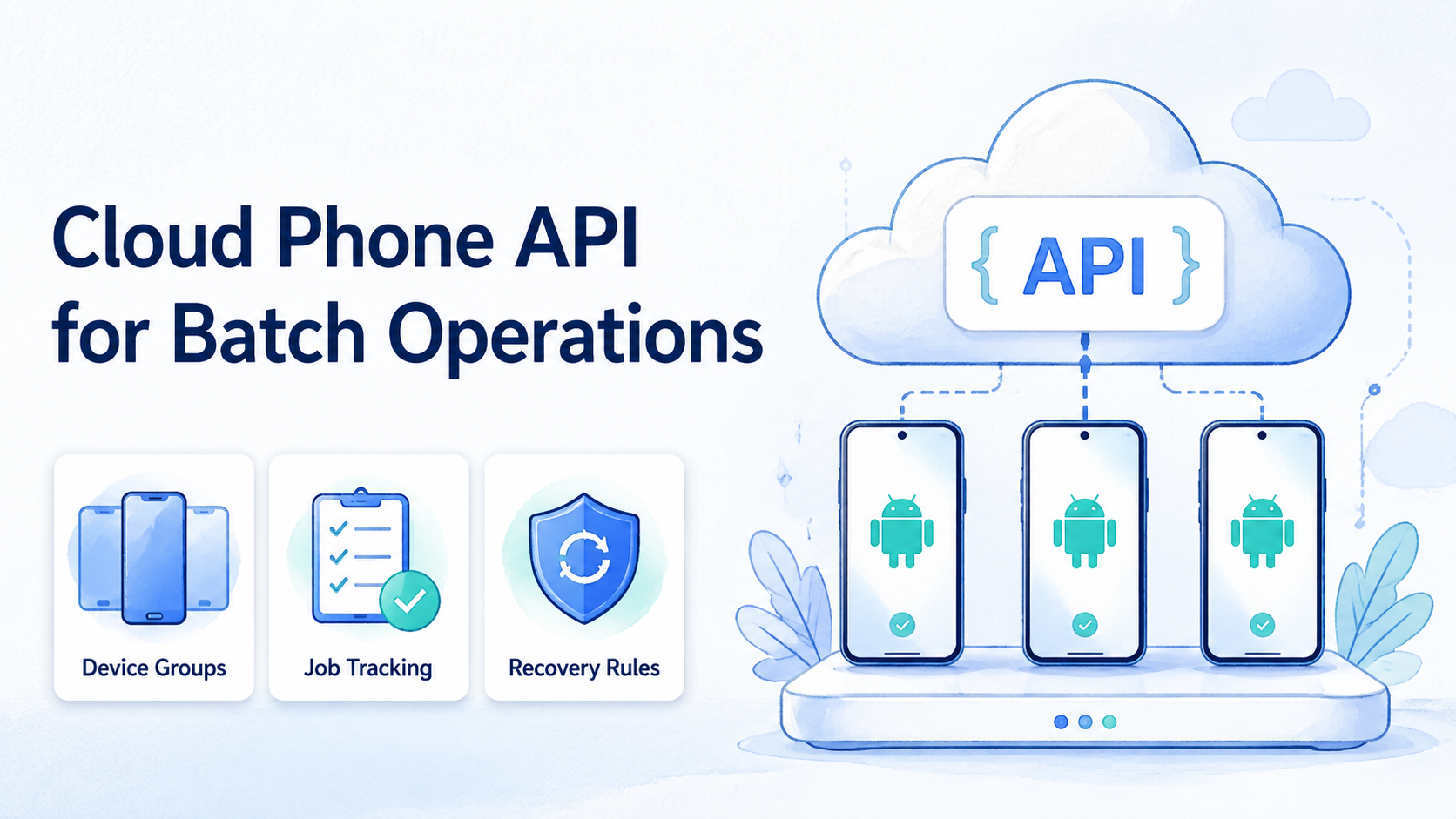
- A cloud phone api lets teams control remote Android device groups through repeatable commands, job queues, status checks, and audit records
- Batch operations work best when device identity, route, app state, operator role, and recovery owner are separated before automation starts
- ADB can be useful for low-level device control, but it should sit inside a permissioned workflow rather than become an unmanaged shortcut
- Strong pilots measure completion, failure reasons, retry behavior, device health, and review time before expanding the device pool
- The right fit is a team with repeatable mobile tasks, clear approval rules, and enough operational discipline to stop a bad batch quickly
A cloud phone api is an interface that lets a team manage remote Android devices through structured commands instead of manual screen-by-screen work. In batch operations, it connects many cloud phones to a queue, a script, a dashboard, or an internal tool. The value is not just speed. The value is repeatable control with enough logging to know what happened, which device ran the task, and where a failure needs review.
Batch mobile work becomes hard when every action depends on one operator clicking one device at a time. A support team may need to prepare app states, collect screenshots, reset sessions, install a build, or move accounts through a documented checklist. An agency may need consistent device groups for client workflows. A QA team may need the same action repeated across versions, regions, and accounts.
The answer is not to automate everything at once. The better path is to define the device fleet, the allowed commands, the job model, and the stop rules first. A cloud phone gives the team remote Android environments.
A controlled API layer turns those environments into a managed execution system. Android's official developer resources are still the right place to understand platform behavior and tooling boundaries, especially when a workflow touches the Android Debug Bridge.
The Core Idea Behind a Cloud Phone API for Batch Operations
The API layer turns device work into named operations. Instead of asking an operator to open twenty devices and repeat the same setup, the team defines a batch job. That job points to a device group, an action, a schedule, a result format, and a recovery rule.
The framework is simple: identity, command, state, and proof. Identity names the device and account, command limits the allowed action, state captures the before-and-after condition, and proof lets a reviewer inspect the result without relying on memory.
Those four parts matter more than the script language. A Python script can call an endpoint. A dashboard can trigger a job.
Control wins.
A mobile operations platform can wrap the same workflow in role controls. The operating question stays the same: can the team explain what happened without asking one person to remember it?
| Layer | What it controls | Common failure | Better operating rule |
|---|---|---|---|
| Device group | Which phones run the job | Wrong devices receive a task | Use named groups by workflow, client, or test lane |
| Command | What the API may do | Scripts drift beyond approved actions | Keep a small command set with review |
| State | Before and after condition | Failures hide inside silent retries | Record status, screenshots, and error codes |
| Owner | Who reviews exceptions | Nobody owns a failed batch | Assign a recovery owner before launch |
This structure also keeps API work from becoming a black box. The team does not need every operator to understand every endpoint. It does need every workflow owner to know which jobs are allowed, when they run, and what will happen if they fail.
Why Teams Search for a Cloud Phone API
Teams search for a cloud phone api when manual device work no longer scales. The trigger is usually not one dramatic incident. It is a pattern: repeated setup tasks, inconsistent screenshots, unclear device assignment, and slow recovery after a failed action.
Consider a mobile commerce team preparing device environments for multiple account groups. One operator installs apps. Another checks login state. A manager reviews proof.
If all work happens by hand, the process depends on private memory and chat messages. That does not hold when the team adds more accounts, regions, or shifts.
An API changes the decision from "who can click these devices today" to "which workflow should run on which device group." That is a different operating model. The team can queue work, inspect outcomes, rerun only failed items, and separate normal completion from exceptions that need a person.
The same logic applies to testing teams. Google's Android developer documentation explains the broader Android platform and development tools, but internal device execution still needs local rules.
A QA lead may use API-triggered device actions to prepare builds, collect logs, or reset conditions before a manual review pass. The API does the repeatable setup. The reviewer makes the product judgment.
A mobile automation layer can sit above this process when jobs need scheduling, operator handoff, or reusable workflow templates. The point is not to remove people from every step. The point is to reserve people for decisions while the system handles repeatable device control.
Who Benefits Most and Where It Does Not Fit
The strongest fit is a team with repeatable mobile work and enough volume to justify structured control. QA teams, marketplace operators, agency execution teams, support teams, and internal tooling groups all appear in this category when device work becomes a shared queue instead of a personal handset habit. They usually share three traits: multiple devices, recurring tasks, and a need to prove what happened.
Cloud phone API work is less useful when the process is still unclear. If a team cannot describe the manual workflow, the API will only make confusion faster. A script that repeats a weak process across fifty devices is not infrastructure. It is a larger failure surface.
Volume is not maturity.
Use this fit check before building endpoints:
| Good fit | Poor fit |
|---|---|
| Tasks repeat across device groups | The team wants blind volume without review |
| Jobs need logs, screenshots, or status records | Workflow rules change every day |
| Operators need handoff between shifts | No one owns failed jobs |
| Managers need exception review | Account, device, and route mapping is undocumented |
| Device identity and routing rules are defined | Compliance or platform requirements are ignored |
This boundary is important for multi-account work. A multi-account management workflow needs device isolation, account mapping, and operator roles before it needs more endpoints. Otherwise, the API may create speed without control.
Fit also depends on the team's tolerance for maintenance. APIs need version checks, permission reviews, and failure handling. A one-person team may prefer a managed interface. A larger team may need both an interface for operators and an API for tooling.
How to Evaluate or Start Using Cloud Phone API for Batch Operations
Start with one workflow, not the entire device fleet. A good first workflow has a clear input, a visible output, and a limited failure mode. App installation, device status checks, screenshot capture, account-state review, or log collection are easier pilots than complex multi-step account actions.
- Map the manual workflow. Name the action, result, and proof.
- Define the device group. Use known device names, app versions, routing rules, and account groups before any script runs, then freeze that group for the pilot so errors point to the workflow instead of a moving inventory.
- Choose the command surface. Pick the narrowest safe option.
- Set permissions. Keep this strict.
- Log every outcome. Capture job id, device id, start time, end time, status, error reason, proof artifact, and reviewer.
- Stop on patterns. Pause the batch if the same error appears across several devices.
- Review before scale. Expand only after failure reasons are understood and recovery time is acceptable for the owner who will carry the next run.
ADB deserves special care. The Android Debug Bridge is a powerful development tool, and the official ADB guide describes how it supports device communication. In operations, that power needs boundaries. A team should not expose raw ADB access broadly when a narrower API command would be safer to review.
For teams building internal tools, a python adb automation library may be useful for controlled tasks. The library is not the strategy. The strategy is a permissioned job model that prevents one script from becoming the only source of truth.
A device isolation layer becomes important when different account groups, clients, or regions should not share the same device context. Batch work should make that separation clearer, not blur it.
Use numeric pilot targets as internal controls, not public promises:
| Pilot control | Starting target | Why it matters |
|---|---|---|
| Device sample | 10-20 phones | Exposes variation without creating a recovery queue |
| Proof capture | 95% or higher | Shows whether success labels can be trusted |
| Retry ceiling | 2 retries | Prevents silent loops from hiding real failures |
| Review window | 24 hours | Keeps failed jobs close to the original context |
| Command list | 5-8 actions | Makes permission review practical |
| Expansion gate | 3 clean runs | Reduces the chance of scaling a one-off success |
Mistakes That Reduce Results
The first mistake is treating API access as a replacement for workflow design. A command endpoint cannot decide which account belongs to which device, which operator owns the result, or when a job should stop. Those decisions belong to the operating model.
The second mistake is allowing silent retries. Retries are useful when a network call fails once. They are dangerous when they hide a real device, app, or account-state problem. A batch system should count retry reasons and show the reviewer when a repeated error pattern appears.
The third mistake is mixing test devices, production accounts, and experimental scripts in the same pool. That creates unclear results. A team should separate device groups by purpose and use naming rules that make mistakes visible before a job starts.
The fourth mistake is storing proof after the work is finished. Screenshots, logs, and status records are strongest when they are captured during the workflow. After-the-fact proof depends on memory and manual cleanup.
One more failure mode is overbuilding too early. A team may design a complex mobile farm management api before it has proven the first five commands. Start smaller. A stable command list beats a broad interface that nobody can audit.
Google's helpful content guidance is about search quality, but the same discipline applies to operations writing and reporting. Output should help a person make a decision. A batch report full of vague success labels does not help a manager fix the next run.
Use a short preflight rule set before any new batch:
- Device group name matches the approved workflow
- Route and account context are visible to the reviewer
- Command set is limited to the current pilot
- Proof capture is configured before the job starts
- Retry count has a hard ceiling
- Exception owner is named in the run notes
- Rollback action is known before the first command runs
Pilot Rollout, Measurement, and Recovery Checks
The common myth is that a cloud phone api should prove itself by running the largest possible batch. A better pilot proves that the team can stop, inspect, and recover from a small batch. Scale comes after the review loop works.
Begin with 10 to 20 devices if that is enough to expose variation. Run one task type. Keep the command list short.
Do not mix new routes, new accounts, new scripts, and new operators in the same pilot. Too many changes make the result impossible to interpret.
Track five measurements:
- Completion rate by device group
- Median and slowest job time
- Failure reason by category
- Retry count before human review
- Recovery time after a stopped batch
Those metrics create a practical decision gate. If completion is high but recovery is slow, the team needs better exception ownership. If failures cluster by device group, the issue may be environment state. If failures appear randomly after each script change, the command wrapper may need stronger validation.
| Review signal | What it means | Next action |
|---|---|---|
| Same failure across many devices | Environment, route, or script issue | Pause and inspect shared setup |
| One device fails repeatedly | Device state issue | Remove device from the batch group |
| Proof missing after success | Logging or capture issue | Treat success as unverified |
| Retry count keeps rising | Hidden instability | lower batch size and review errors |
| Recovery owner changes mid-run | Process weakness | Freeze expansion until ownership is clear |
Recovery rules should be written before the first real run. A useful stop rule may say: pause the batch if three devices fail with the same reason, if proof capture is missing, or if a command tries to run outside the approved device group. The exact threshold depends on the workflow, but the rule should exist before pressure arrives.
For teams using a proxy network, routing changes should be logged as part of the same review model. Device action, route state, and account context should not be investigated in separate places when a batch fails.
Minimum job records should include:
- Job ID
- Device ID
- Device group
- Account group
- Route ID
- Command name
- Script version
- Start timestamp
- End timestamp
- Final status
- Error category
- Proof artifact URL
- Reviewer name
- Recovery action
Frequently Asked Questions
What is a cloud phone api?
A cloud phone api is a structured interface for managing remote Android devices. It may support device status checks, app actions, screenshots, job queues, or other workflow commands, depending on the platform.
Is cloud phone ADB the same as a cloud phone API?
No. ADB is a low-level Android tool for device communication. An API is usually a higher-level interface that can wrap approved commands, permissions, job records, and workflow logic.
Can batch operations replace manual review?
Not for every workflow. Batch operations handle repeatable setup, status, collection, and controlled execution; people still handle judgment, exceptions, policy decisions, and customer-facing actions that need context.
Keep people in the loop.
What should a first API pilot include?
Use one device group, one task type, one proof format, and one recovery owner. Measure completion, failure reasons, retry count, and review time before adding more devices.
Keep it narrow.
When should a team avoid API-driven device work?
Avoid it when the manual process is unclear, when account ownership is undocumented, or when nobody can stop a bad batch. API access will not fix weak operating rules.
Does a python adb automation library solve the whole workflow?
No. It may help with command execution, but the workflow still needs permissions, logs, device groups, exception handling, and review. The library is only one implementation detail.
How many internal tools should a team build first?
Build the smallest tool that proves the workflow. A job form, a device-group selector, a status table, and an exception report may be enough for the first pilot.
What matters more, speed or traceability?
Traceability usually matters first. Speed without logs makes failures harder to diagnose. Once the job model is visible and recoverable, the team can improve throughput with less risk.
Conclusion
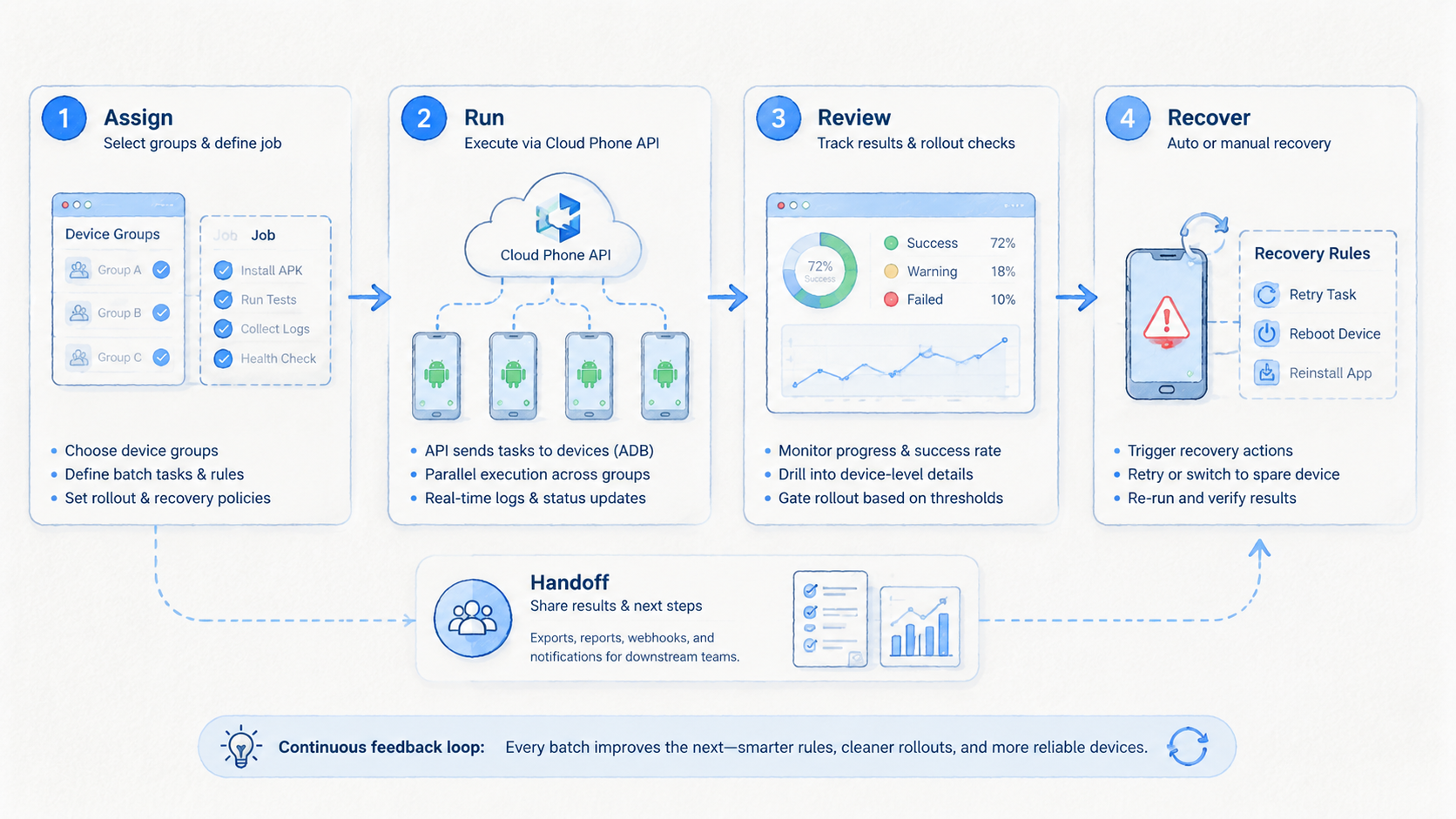
A cloud phone api is most useful when a team already understands the mobile workflow it wants to repeat. It gives batch operations a cleaner structure: device groups, approved commands, job status, proof, and recovery rules. That structure moves teams beyond manual clicking while still making every automated action visible enough for a manager, QA lead, or operations owner to challenge.
The practical next step is not a large rollout. Pick one workflow that wastes operator time or creates review gaps. Define the device group, command, proof artifact, owner, and stop rule. Run the pilot, inspect every failure, and expand only when the review loop is clear.
Then stop and review.
For MoiMobi-style mobile execution, the API layer should serve the broader operating system. Cloud phones provide remote Android capacity. Automation handles repeatable action.
Isolation and routing preserve boundaries. Judgment stays human. Documentation stays visible. Recovery stays owned.
That balance is what makes batch operations dependable enough to scale.