

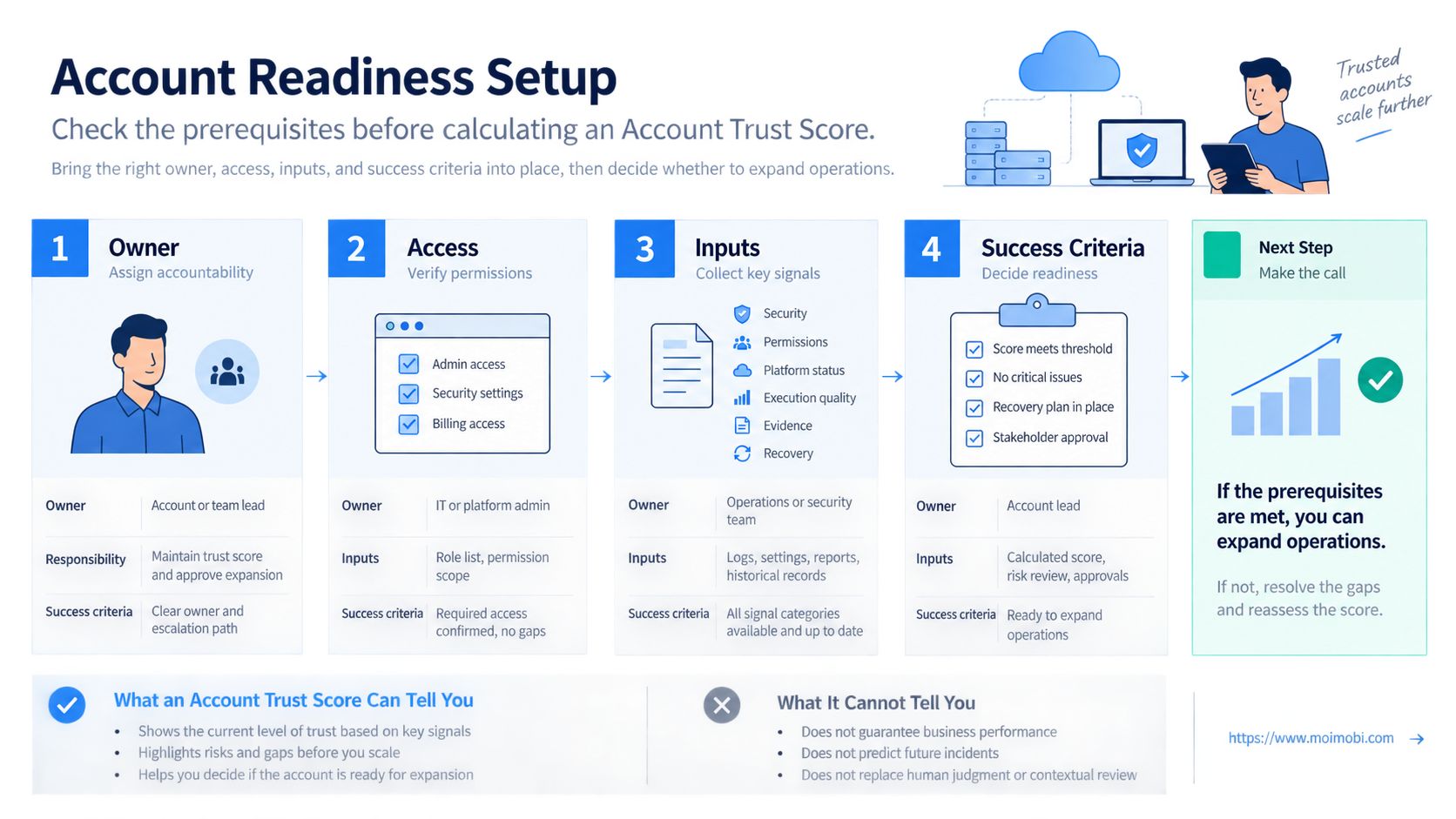
An account trust score is an internal operations readiness score, not a secret platform rating that predicts enforcement. Teams can use it to decide whether an account workflow is secure, correctly assigned, observable, and recoverable before adding volume, users, or automation.
The safest signals are facts the team can verify: official account-status notices, permission assignments, authentication controls, recent task failures, unresolved incidents, content-review results, and recovery tests. Do not invent proxy signals or claim that a device pattern makes an account “trusted” by a platform.
Key Takeaways
- Treat the score as an internal expansion gate, not an enforcement workaround.
- Use official status screens and notifications as authoritative platform signals.
- Score security, permissions, workflow quality, evidence, and recovery separately.
- A critical failure should block expansion even when the average score is high.
- Review the underlying facts; never let one number hide an unresolved incident.
What an Account Trust Score Can and Cannot Tell You
An internal score can summarize operational readiness. It can show whether access is controlled, tasks complete reliably, approvals are current, and failures receive action. It cannot reveal a platform's private detection systems, forecast moderation decisions, or prove that future actions will be accepted.
Use two labels to prevent confusion:
- Platform status: restrictions, warnings, appeals, and feature availability shown by the platform itself.
- Operational readiness: your own evidence about security, ownership, workflow, quality, and recovery.
TikTok's account status guidance documents checks for login, posting, commenting, profile editing, and direct-message restrictions. Those visible states are useful inputs. They should not be converted into claims about an unpublished universal score.
A readiness score supports one decision: whether the team should keep the current scope, pause and repair, or expand a controlled workflow. It should never recommend opening replacement accounts to avoid restrictions or spreading questionable activity across profiles.
Account Trust Score Categories That Matter
Keep categories independent. A strong publishing success rate should not cancel an access-control failure. Use a pass/fail gate for critical issues and a weighted score only after those gates pass.
| Category | Evidence to review | Critical stop condition |
|---|---|---|
| Platform status | Native status, warnings, restrictions, appeal state | Active restriction affecting planned work |
| Authentication | MFA, unique credentials, recovery owner, current sessions | Shared password or unknown recovery access |
| Permissions | Named users, roles, assigned accounts and assets | Excessive admin access or former user retained |
| Environment ownership | Account-to-browser/device assignment and route | Unassigned or conflicting environment |
| Content governance | Approved sources, claims, disclosure, final reviewer | Repeated unreviewed or unsupported content |
| Execution quality | Verified completion, duplicate rate, failure reasons | Wrong-account or duplicate action unresolved |
| Evidence | Task ID, final state, operator, timestamp, result | Success cannot be verified |
| Recovery | Incident owner, runbook, tested takeover | No path to pause and recover work |
Score each category from zero to five only after defining what each value means. For example, authentication may score five when phishing-resistant MFA, unique credentials, named recovery owners, and current access records are verified. It may score zero when account access is shared and ownership is unknown.
Avoid a single opaque formula. Store the source record, last check time, reviewer, and reason behind every category value. The score is a dashboard over evidence, not a substitute for evidence.
Security and Access Signals Before Expansion
Security comes before throughput. Expanding an account workflow adds users, tools, sessions, and recovery dependencies. Each new connection increases the need for clear ownership.
CISA and the FBI recommend phishing-resistant MFA, unique passwords, official business accounts, and direct verification of suspicious alerts in their account protection guidance. Convert that advice into preflight fields rather than a one-time checklist.
Record these items for every account:
- named business owner and backup owner;
- MFA method and last verification date;
- recovery email, phone, or key ownership;
- password-manager record owner without exposing the password;
- current connected applications and sessions;
- approved user list and role scope;
- last access review and removed-user check;
- incident contact and freeze procedure.
Meta's Facebook Page access documentation distinguishes Page access, task access, and community-manager access. The operational lesson is that a teammate who replies to messages does not automatically need full control over settings and access. Give people and automation only the permissions required for their assigned task.
Moimobi's role-bound account workspace can help maintain account, environment, task, and operator assignments. It should not be described as a way to conceal ownership or bypass platform access controls.
How to Build an Internal Account Trust Score
Use a transparent sequence and keep raw evidence attached to the result.
- Define the expansion decision. Specify the added accounts, task volume, operators, markets, tools, or execution windows under consideration.
- Set critical gates. Block expansion for active restrictions, unknown ownership, weak authentication, wrong-account incidents, or missing recovery controls.
- Create category rubrics. Describe what zero through five means for status, security, permissions, environment, content, execution, evidence, and recovery.
- Collect current evidence. Use native status screens, access lists, task logs, incident records, and verified execution results.
- Assign reviewers. Security, content, operations, and account owners should review the categories they understand.
- Calculate without hiding gates. Show category values and critical failures beside the total.
- Choose a decision. Approve a bounded pilot, keep the current scope, or pause for repair.
- Set an expiry date. Recheck the score after access, workflow, platform status, account ownership, or execution conditions change.
A simple model can weight operational categories, but it must remain explainable. For example, security, platform status, and recovery may carry more weight than output speed. Wrong-account execution should remain a hard stop rather than becoming a small deduction.
Tie every approved expansion to a scope record. Include accounts, allowed task types, daily limits, responsible operators, environments, start date, review date, and rollback trigger. This turns a score into a controlled decision.
Execution Signals Worth Tracking
Account health is not the same as content performance. Likes, reach, and followers may describe audience response, but they do not prove that the operating workflow is controlled. Use execution signals that connect directly to task quality.
Track:
- verified completion rate by task type;
- wrong-account, wrong-asset, and wrong-version incidents;
- duplicate actions and retry causes;
- session or authentication failures;
- approval bypass attempts;
- unresolved platform warnings;
- median recovery time;
- tasks completed by manual takeover;
- environment assignment conflicts;
- evidence missing after reported success.
Each metric needs a denominator and review window. “Two failures” means little without the number and type of attempted tasks. Separate platform rejection, connection failure, operator mistake, incomplete input, and verification failure.
For TikTok-focused work, connect native status checks with an assigned TikTok operations control path. Keep platform notices authoritative, and use internal execution records only to diagnose your workflow.
An isolated device-and-session ownership layer can reduce accidental session mixing when each account has a documented environment. An assigned cloud phone may serve as that mobile environment when the workflow requires Android. Neither isolation nor a device type is evidence that a platform will consider activity trustworthy.
Common Account Trust Score Mistakes
Inventing platform signals: Do not infer hidden ratings from reach changes, login friction, IP folklore, or unverified online claims. Use official notices and your own operations data.
Averaging away critical risk: Even a high aggregate result in a hypothetical internal rubric does not matter when account ownership is unknown or MFA is absent. Hard gates stay visible.
Scoring “stealth”: Measures such as hiding automation, imitating human behavior, or avoiding platform detection do not belong in a compliant readiness model.
Rewarding volume: More posts or messages do not make the workflow healthier. Track correctness, approvals, evidence, and recovery.
Ignoring permission drift: Team changes can leave old access in place. Recheck roles whenever staff, agencies, or account ownership changes.
Treating absence of warnings as approval: No visible restriction means only that no listed restriction is shown. It does not endorse every planned action.
Using stale evidence: Scores should expire. Authentication, policies, roles, sessions, and account status all change.
Applying one rubric to every task: Publishing, comment replies, direct messages, ads, and account administration have different risks and owners.
Who Should Use This Readiness Model
The model fits agencies, cross-border operations, multi-brand teams, customer-support groups, and mobile-first teams that need a repeatable expansion decision. It is most useful when several people, accounts, tools, or execution environments interact.
- Account ownership and roles change over time.
- Tasks run across browsers or mobile devices.
- Management needs a documented go/no-go decision.
- Failures require evidence and recovery ownership.
- The goal is to predict hidden enforcement systems.
- The team wants to bypass restrictions or open replacements.
- No one owns access reviews or incident recovery.
- The score has no attached evidence or expiry date.
Small teams can use the same model without complex software. A checklist with critical gates, named reviewers, and dated evidence is enough. Add weighted scoring only when it improves comparison across accounts or operating groups.
The model also works for vendor reviews. Ask whether a platform supports named ownership, scoped roles, account-to-environment assignment, audit records, task evidence, and recovery. Avoid vendors that promise invisible “anti-detection” outcomes rather than operational controls.
Pilot, Measurement, and Recovery Checks
Test the model on a small account group before using it for broad expansion. Choose accounts with known history and active owners. Score them independently, compare reviewer reasoning, and repair unclear rubrics.
Use this verification checklist:
| Check | Pass condition | Recovery action |
|---|---|---|
| Native status | Planned functions show no active restriction | Pause affected tasks and review notice |
| Authentication | Approved MFA and recovery ownership verified | Repair access before any expansion |
| Permissions | Current users have minimum required roles | Remove excess or stale access |
| Assignment | One account maps to the intended environment and owner | Resolve conflict and invalidate queued work |
| Workflow | Approvals and stop rules pass sample tasks | Fix task schema or routing |
| Evidence | Completed tasks retain verifiable results | Rebuild evidence capture |
| Recovery | Operator can pause and resume a failed task | Test runbook before scaling |
Run a bounded increase, such as one additional task type or one additional account group. Do not change volume, team, tools, and markets at the same time. A narrow pilot makes failure causes easier to identify.
Set rollback triggers before launch. Pause expansion when restrictions appear, wrong-account work occurs, duplicate actions increase, evidence disappears, or recovery time exceeds the team's limit. Preserve the last confirmed task state for manual continuation.
Moimobi provides an execution evidence and takeover framework for mobile workflows that need assigned environments and reviewable task states. The internal score remains owned by the operating team; it should reflect verified controls rather than marketing claims.
Frequently Asked Questions
Is an account trust score provided by social platforms?
Not as one universal public metric. Platforms may expose account status, restrictions, warnings, access roles, and other specific controls. Use those facts directly.
Can the score predict an account ban?
No. It should not claim to predict moderation or enforcement. It measures whether your own operation is secure, governed, observable, and recoverable.
Should IP address or device fingerprint be scored?
Score whether routing and environment ownership are documented and consistent with policy. Do not invent “safe” fingerprints or treat concealment as a readiness goal.
What should block expansion immediately?
Active restrictions, unknown ownership, weak authentication, stale privileged access, wrong-account incidents, missing approvals, and untested recovery should be hard stops.
How often should the score be reviewed?
Review it on a defined schedule and after material changes to access, staff, tools, platform status, account ownership, or workflow scope.
Can one score cover every social platform?
Use a shared operations framework, but keep platform-status checks and task rules specific to each service. Available notices and permissions differ.
Does device isolation improve the score?
It may improve assignment and session-separation controls when correctly managed. It does not prove platform trust or eliminate the need for compliant behavior.
Who should approve the final expansion decision?
The accountable business owner should approve it after security, content, account, and operations reviewers sign off on their categories.
Conclusion
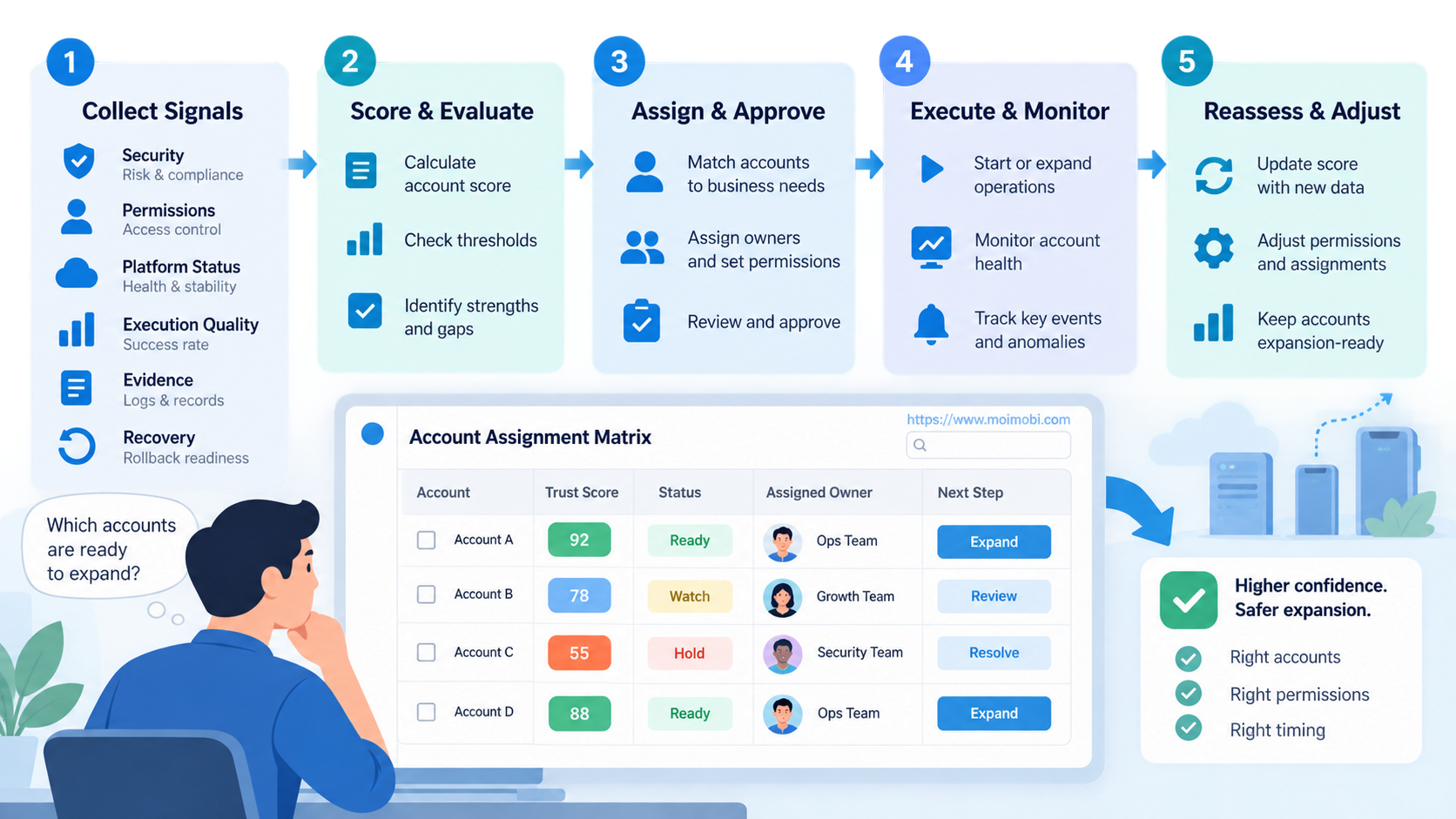
An account trust score should answer an internal question: is this operation ready to expand without losing control of access, accounts, approvals, evidence, and recovery? Build it from official platform status, verified security controls, scoped permissions, task quality, and tested incident handling.
Start with critical gates, then add transparent category scores. Pilot one bounded expansion and define rollback triggers before launch. If the team cannot explain a score, verify its evidence, or recover a failed task, the operation is not ready to scale.