The term "AI workers for social media teams" means software-operated roles that prepare, route, execute, verify, or report recurring tasks under defined permissions and human controls. These workers belong inside a daily operating system, not inside unsupervised accounts that publish and reply without review.
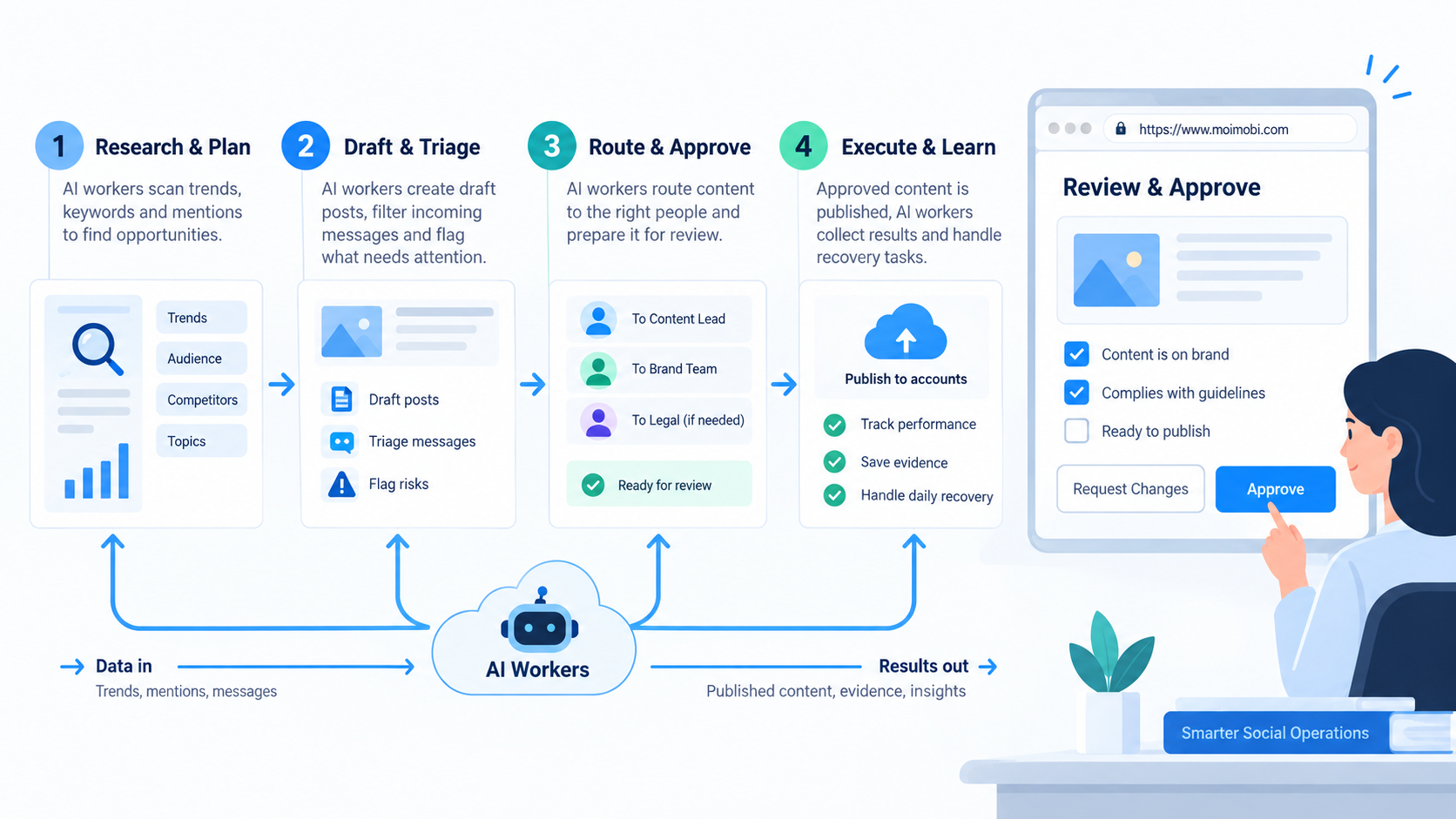
A practical setup starts with narrow responsibilities. One AI worker may collect approved research. Another can draft channel variants. A third can triage comments and create tasks. Human owners still approve sensitive content, control account access, handle exceptions, and decide when a workflow must stop.
Key Takeaways
- Give each AI worker one role, input contract, and completion test.
- Bind execution tasks to an account, environment, and responsible person.
- Keep content approval separate from publishing or reply execution.
- Record evidence after an action, not just the generated output.
- Start with one daily workflow and expand only after recovery works.
What AI Workers for Social Media Teams Actually Do
An AI worker is not simply a chatbot with a schedule. It receives a bounded task, uses approved data and tools, returns a structured result, and follows escalation rules. The result could be a research brief, caption set, reply draft, assigned task, execution record, or exception report.
The distinction between thinking and acting is essential. Content generation can happen without account access. Publishing, moderation, and messaging require the correct account permission and execution path. Meta's Facebook Page access documentation separates full or partial Page access from task access for content, messages, comments, ads, and insights. Your internal workflow should preserve comparable boundaries.
A daily team can divide work into five lanes:
| Lane | AI worker output | Human control |
|---|---|---|
| Research | Trend notes, source summaries, content gaps | Source approval and relevance check |
| Content | Drafts, hooks, variants, briefs | Brand, claim, and rights approval |
| Engagement | Intent labels and suggested replies | Sensitive-reply approval and escalation |
| Execution | Assigned publish or response task | Account permission and final action policy |
| Reporting | Status, evidence, exceptions, next actions | Interpretation and priority changes |
This division keeps the AI role observable. It also lets a team replace one weak step without rebuilding the entire operation.
Why AI Workers for Social Media Teams Need Role Boundaries
Permissions should follow job responsibilities. A research worker does not need publishing access. A content worker does not need billing controls. A reporting worker usually needs read access, not the ability to change account settings.
TikTok's Business Center role guidance illustrates this principle. It distinguishes Admin and Standard roles, and Standard members work only on assigned accounts and assets. AI task design should be equally explicit, even when execution happens outside Business Center.
Create a role card for every worker:
- Purpose: the business result this role supports.
- Accepted inputs: the fields, files, and sources it may use.
- Allowed tools: the systems and actions available to it.
- Account scope: the brands, regions, and profiles it may touch.
- Approval gate: the conditions that require a person.
- Completion evidence: the fields proving the task finished.
- Stop rule: the condition that pauses work and opens an exception.
The account environment is part of the permission model. A team operating several profiles should route each execution task into the assigned browser or Android workspace. Moimobi's account-bound operations framework helps connect accounts, environments, tasks, and owners without treating shared credentials as workflow design.
Daily Use Cases That Benefit From AI Workers
Begin with repetitive work that has clear inputs and review rules. Avoid starting with crisis communication, legal claims, pricing disputes, or open-ended customer conversations.
Morning research and planning: A worker can gather approved sources, group developments by campaign, and produce a brief. The content lead chooses which ideas become tasks.
Content preparation: Another role can turn an approved brief into channel variants, alt text, shot lists, and localization notes. It should preserve source references and flag unsupported claims.
Queue preparation: A routing worker can validate required fields, detect missing media, assign due times, and send incomplete tasks back. It should never guess the target account.
Engagement triage: An AI worker can classify messages or comments by intent and urgency. Routine questions may receive draft replies, while complaints, refunds, and sensitive topics go to a person.
Execution support: Approved tasks can enter an assigned web or mobile environment. Moimobi's controlled social task workspace is designed around this handoff between content, account context, execution, and evidence.
End-of-day review: A reporting worker can summarize completed tasks, failures, unresolved conversations, approval delays, and tomorrow's queue. The team lead decides what changes.
A Daily Cadence for AI Workers for Social Media Teams
A reliable day has explicit handoff points. Workers should not poll every system continuously or create new tasks whenever they find something interesting. Use scheduled intake windows, queue owners, and a visible cutoff for work that must move to the next shift.
| Operating window | Worker responsibility | Human checkpoint | Required record |
|---|---|---|---|
| Start of day | Check account, asset, source, and queue readiness | Operations lead accepts the day's scope | Readiness status and blocked inputs |
| Research window | Collect approved developments and campaign context | Strategist accepts or rejects briefs | Sources, rationale, and assigned campaign |
| Production window | Prepare copy, media notes, and channel variants | Content owner reviews claims and brand fit | Approved version and revision history |
| Execution window | Route approved tasks to assigned environments | Account owner confirms exceptional actions | Account, environment, action, and result |
| Engagement windows | Triage new comments and messages at set times | Support owner handles sensitive cases | Intent, priority, draft, and disposition |
| Close of day | Reconcile completed, failed, and open tasks | Team lead assigns recovery work | Evidence, failure reason, next owner, due time |
Batching creates two benefits. First, reviewers know when decisions are expected. Second, incomplete work cannot silently drift between roles. A rejected brief returns to research; a missing asset returns to production; an unavailable account enters recovery rather than remaining in the execution queue.
Use service levels that match the task. A public complaint may require fast escalation, while a weekly content brief can wait for the next review window. Store the due time and escalation class on the task instead of asking the AI worker to infer urgency from emotional language alone.
Shift changes need a compact handoff. The outgoing owner should provide open task IDs, account state, last confirmed action, unresolved error, and the next allowed step. The incoming owner should not repeat an action unless the evidence shows that it did not complete. This simple rule reduces duplicate posts and replies during distributed operations.
Keep a manual lane available throughout the day. When confidence is low, source data conflicts, or the interface changes, route the task to that lane with its context intact. Human takeover is a designed state, not a failure of the system.
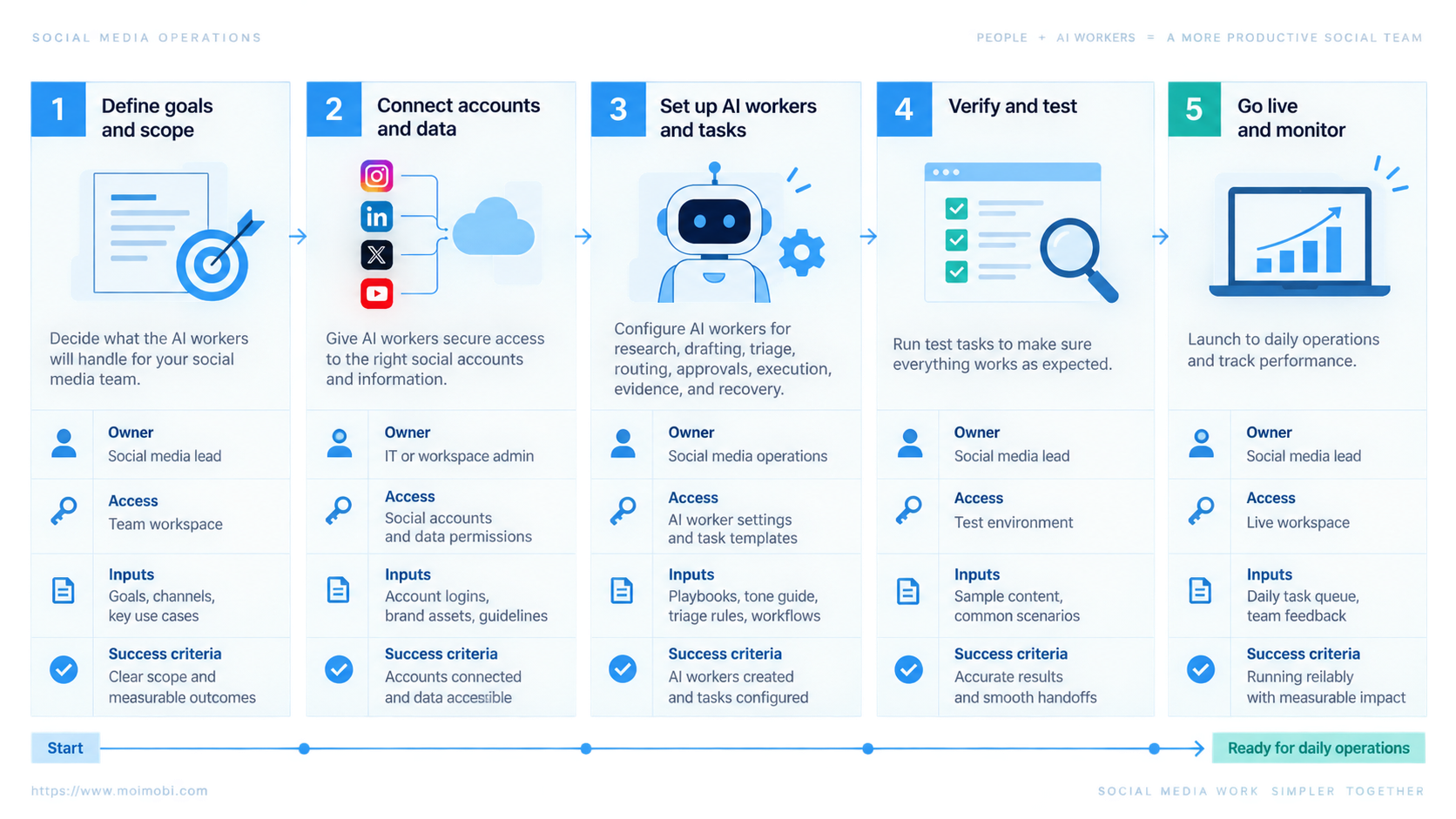
How to Set Up AI Workers for Daily Social Operations
Do not automate the entire calendar at once. Choose one workflow with predictable inputs, such as preparing and approving a daily post package for one brand.
- Name the outcome. Define the final state, such as “approved package ready for one assigned account.”
- Map current steps. Record who researches, drafts, approves, executes, verifies, and recovers the task.
- Define worker roles. Give each role one input schema, output schema, tool set, and stop rule.
- Fix account ownership. Assign the target profile, browser or mobile environment, route, and responsible operator.
- Add approval gates. Require human review for claims, offers, sensitive replies, unfamiliar sources, and account changes.
- Specify evidence. Store the approved version, execution time, account, result, and returned error when applicable.
- Create recovery paths. Decide who handles expired sessions, missing assets, changed interfaces, and rejected actions.
- Run a small pilot. Use one account, one content type, and one daily cycle before adding channels.
Before launch, confirm that every stage has an owner. The worker should not invent missing campaign IDs, account names, destination links, or approval states. Missing required data is a stop condition.
Native app execution needs extra controls. An assigned mobile task evidence layer can coordinate Android-side tasks and results when the approved workflow genuinely needs the app. Use official platform interfaces when they already cover the action.
Common Mistakes to Avoid
The first mistake is assigning an outcome without defining the task. “Grow the account” is not an executable instruction. “Prepare three reviewed caption variants from this approved brief” is measurable.
Other recurring failures include:
- One worker has every permission. Separate research, content, execution, and administration.
- Generated means completed. A caption draft is not a published post, and a reply draft is not a sent response.
- No source boundary exists. Require approved sources and retain their links with the output.
- Every task uses the same account session. Bind work to the intended account and environment.
- Retries are unlimited. Set a retry count, pause condition, and recovery owner.
- The team measures volume only. Include approval time, correction rate, failure rate, and unresolved exceptions.
- Automation hides responsibility. Every task still needs a business owner.
AI governance is not limited to regulated industries. NIST's AI Risk Management Framework gives organizations a voluntary structure for managing AI risks. For a social team, the practical translation is simple: document purpose, limits, monitoring, responsible roles, and response plans before scaling.
Who This Operating Model Fits
This model fits agencies, multi-brand teams, cross-border commerce operations, and distributed marketing groups with repeatable daily queues. It is particularly useful when work crosses content systems, approval roles, browser sessions, and mobile applications.
- Several people manage several assigned accounts.
- Tasks repeat with predictable fields and review gates.
- Native browser or mobile execution is part of the process.
- The team needs task evidence and exception ownership.
- One person manages one small account manually.
- Most work is novel strategy with no repeatable input.
- The team has no owner for approvals or recovery.
- The goal is unrestricted mass posting or messaging.
Start smaller when the workflow is still undocumented. Standardize the manual process first, then assign stable pieces to AI workers. Automation amplifies unclear ownership as easily as it amplifies a good procedure.
Pilot Rollout, Measurement, and Recovery Checks
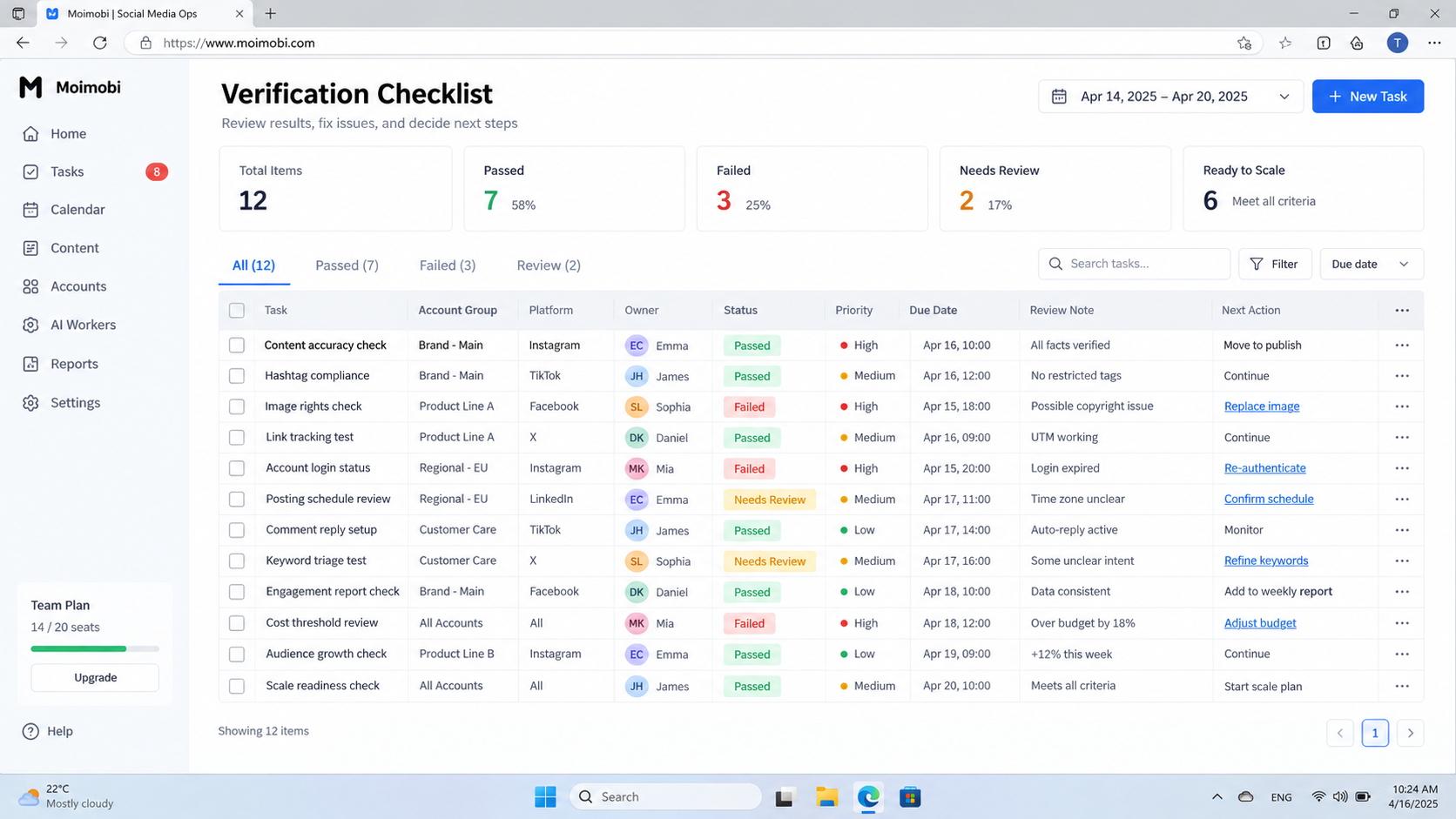
A pilot proves that the operating model works, not that the AI can produce attractive text. Use ten to twenty real tasks from one account group. Keep the existing manual path available during the test.
Track these measures:
| Measure | Question | Recovery trigger |
|---|---|---|
| First-pass approval | Was the draft usable without major correction? | Repeated unsupported or off-brand output |
| Handoff time | How long did each review stage wait? | Queue stalls without an owner |
| Verified completion | Did the approved action occur in the correct account? | Missing or contradictory evidence |
| Exception rate | How many tasks left the standard path? | One failure type repeats |
| Recovery time | How long until an operator resolved failure? | No owner or deadline |
| Duplicate actions | Was the same task executed twice? | Duplicate source or task ID |
Review failed tasks every day. Update the input contract or stop rule before increasing volume. Do not hide exceptions inside a generic “failed” status; keep the stage, error, account, attempted action, and next owner.
When mobile execution is required, a dedicated cloud phone can keep the Android session tied to its assigned work. The device is only one component. The queue, permissions, approval, evidence, and recovery process determine whether the operation is controlled.
Frequently Asked Questions
What is an AI worker for a social media team?
It is a software-operated role with defined inputs, tools, permissions, outputs, and escalation rules. It may research, draft, route, execute, verify, or report a bounded task.
Which social media task should a team automate first?
Choose a frequent task with stable inputs and low consequence when paused. Research briefs, content packaging, field validation, and reporting are common starting points.
Should AI workers publish without approval?
Only narrowly defined, tested tasks should qualify for automatic execution. New campaigns, sensitive claims, customer disputes, pricing, and unfamiliar exceptions should retain human review.
Can AI workers manage multiple social accounts?
They can coordinate tasks across accounts when each task has explicit account, permission, environment, and owner fields. Avoid a shared queue that lets the worker choose an account implicitly.
Do teams need a cloud phone for every AI worker?
No. Research and drafting roles need no mobile device. Use browser or Android environments only for tasks whose approved execution path requires them.
How are AI workers different from scheduled automations?
A scheduled automation follows a fixed trigger and action. An AI worker may classify context or prepare a decision, but it still operates inside defined boundaries and checks.
What should happen when an AI worker fails?
The workflow should stop the affected task, record the stage and error, assign a recovery owner, and preserve enough context for manual completion. Avoid blind repeated retries.
How should teams measure success?
Measure approved output, verified completion, handoff time, exception rate, correction rate, duplicate actions, and recovery time. Content volume alone misses operational quality.
Conclusion
AI workers for social media teams are most valuable when they turn documented daily work into visible, reviewable task flows. Research, drafting, triage, execution, and reporting should remain separate roles with clear permissions and completion evidence.
Pick one daily workflow and map it from input to recovery. Assign account ownership, add approval gates, define proof of completion, and run a bounded pilot. Expand only after the team can explain every failure and identify who resolves it.