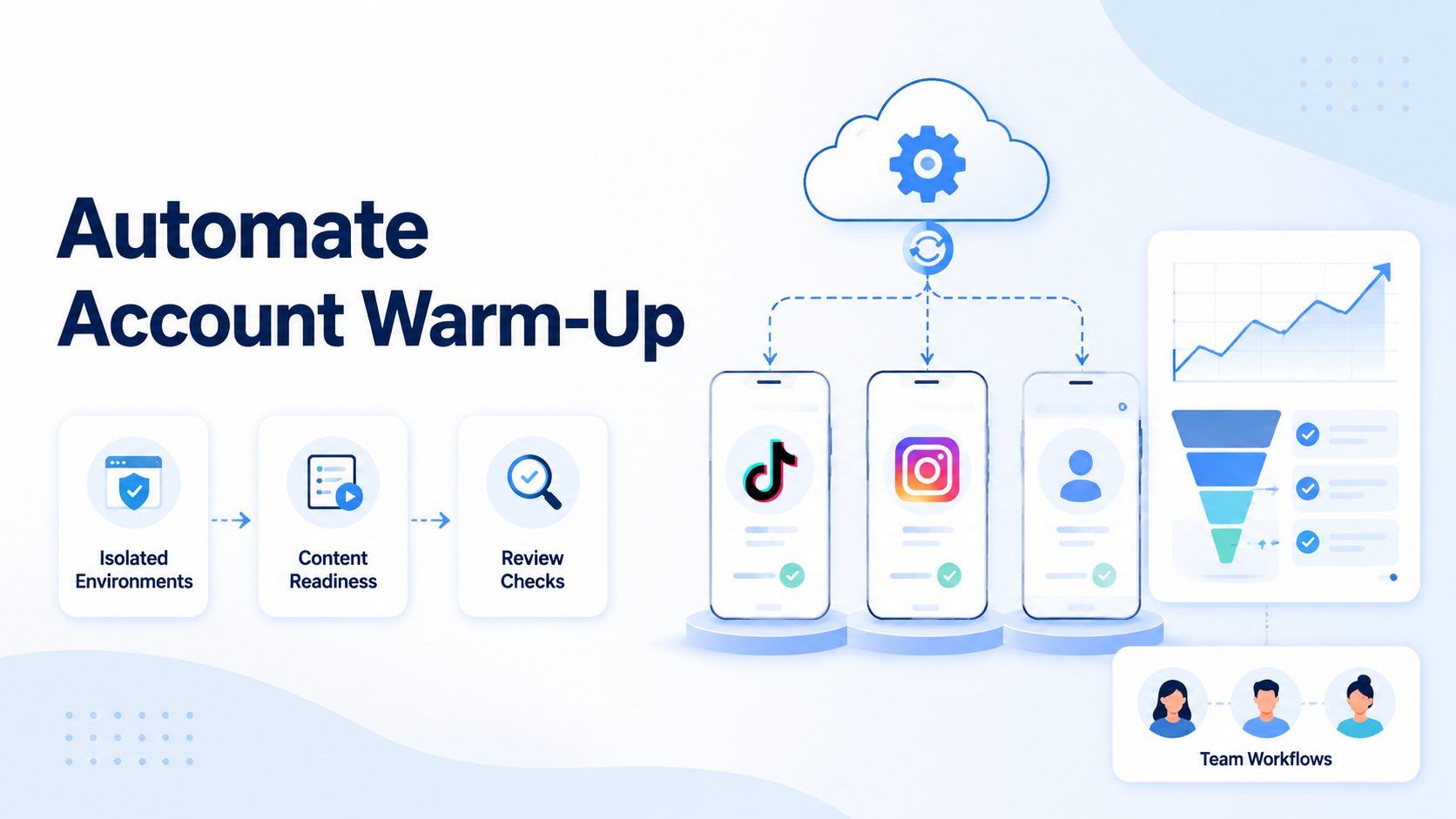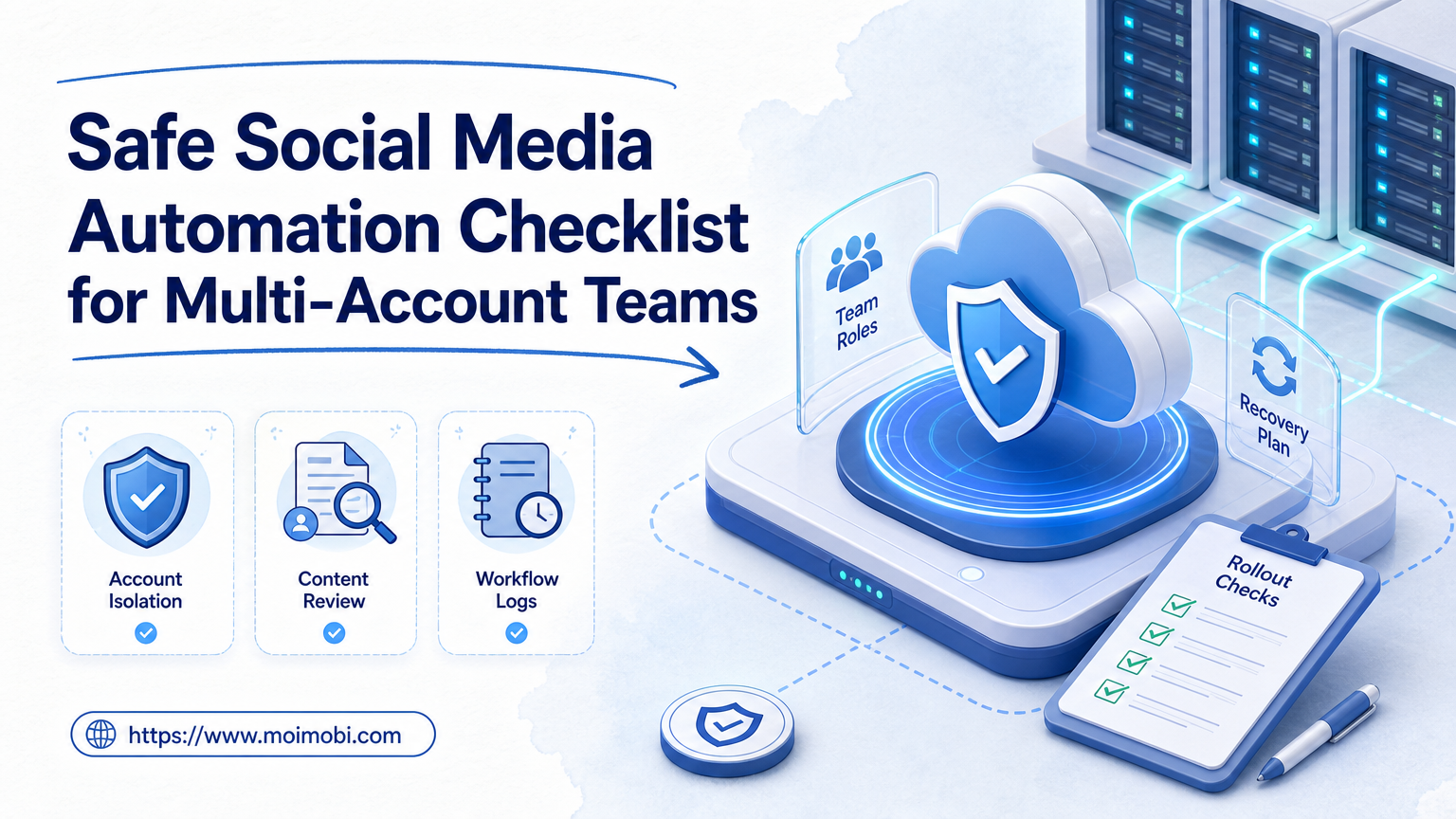
Key Takeaways
- TikTok automation software should be judged by workflow control, not only feature count.
- Multi-account teams need ownership, review, and recovery before they scale volume.
- The best pilot is narrow and easy to inspect.
- App-side workflows may still need cloud phone support.
TikTok automation software is software that helps teams run repeated TikTok workflows across many account lanes. In real operations, that usually includes publishing support, moderation routing, reporting checks, queue handling, and operator handoff.
The hard part is not starting a run. The hard part is keeping the run stable after more accounts, more reviewers, and more repeated tasks enter the queue. TikTok’s own business materials make it clear that social operations still involve content workflows, business tools, and account-side checks. See TikTok for Business, TikTok Creative Center, and TikTok Support.
That is why teams comparing cloud phone for TikTok, multi-account management, and social media marketing workflows are usually solving an operations problem, not just buying a posting tool.
What Is TikTok Automation Software for Multi-Account Operations?
For multi-account work, TikTok automation software is workflow software plus execution discipline. A light scheduler may help with timing. A stronger setup also supports task routing, account ownership, queue review, and recovery.
That distinction matters because the workload changes once a team stops operating in a single lane. The system must keep one account group separate from another. It must also let one operator stop, review, and hand over work without losing context.
Why TikTok Automation Software for Multi-Account Operations Matters
The category matters when manual browser or app-side work starts to drift. One person may remember the correct order. Another may remember which accounts need extra checks. That can work for a while. It usually gets weaker when task volume rises.
Stable automation software reduces that dependency on memory. It gives the team a reusable lane for repeated work. That can mean fewer queue mistakes, cleaner handoff, and better visibility into what completed and what stalled.
Key Benefits and Use Cases
The strongest benefits are operational.
| Use case | What automation helps with | What still needs review |
|---|---|---|
| Publishing prep | Queue handling and repeated execution | Final content approval |
| Moderation routing | Sorting and assigning repeated tasks | Escalation decisions |
| Competitor monitoring | Repeated collection and logging | Strategic interpretation |
| Account checks | Routine review tasks | Exception handling |
This is also why a cloud phone farm infrastructure model may become relevant. Some TikTok workflows remain app-native and repeated enough to need a stronger mobile lane.
How to Get Started with TikTok Automation Software for Multi-Account Operations
Start with one workflow lane, not the whole stack.
First-pilot checkpoints
- Scope: Choose one repeated task family.
- Ownership: Map one owner to one account lane.
- Review: Define where a human must verify the output.
- Logging: Record each run in a shared queue or system.
- Recovery: Test pause and restart before scale.
The first pilot should stay small enough to inspect. When too many account types or task paths enter the same test, the team cannot tell whether the software failed or the process was never clear.
Common Mistakes to Avoid
The first mistake is treating TikTok automation software like a bulk-posting shortcut. That view is too narrow for multi-account operations.
The second mistake is skipping account ownership rules. A queue with no owner often creates repeated rework. The third mistake is scaling before recovery rules are tested. A workflow that runs once is not yet a stable operating lane.
Who It Fits and When It Is a Strong Match
This category is a strong match when repeated TikTok work already spans several accounts or several operators.
Strong match
- Agencies managing many TikTok account lanes
- Growth teams with repeated publishing and moderation work
- Operations groups that already track queue outcomes
- Teams that need clean handoff across roles
Weak match
- One-account solo workflows
- Teams with no stable task queue yet
- Workflows that still change shape every day
- Setups with no recovery owner
Pilot Rollout, Measurement, and Recovery Checks
The first rollout should prove control, not scale.
Track:
- completion rate
- manual takeover rate
- wrong-account incidents
- review delay
- recovery time
These signals tell the team whether the lane is actually reusable. They also show whether the workflow should remain browser-led or move deeper into a mobile lane such as cloud phone.
How Teams Usually Organize TikTok Automation Lanes
The cleanest TikTok setups separate work by lane instead of by tool alone. One lane may own publishing preparation. Another may own moderation review. Another may own reporting checks and queue health. The software is useful when it makes those lanes easy to see and easy to resume.
That matters because multi-account operations often fail in the handoff, not in the first execution step. When the same queue can be picked up by another reviewer with the same notes, the software is doing real operational work. A queue that still depends on one operator's memory is still weak.
| Lane | Main job | Owner question | Review point |
|---|---|---|---|
| Publishing prep | Prepare queued assets and timing checks | Who owns the account group today? | Final content approval before publish |
| Moderation routing | Sort repeated comments or issue queues | Who handles escalation? | Escalation threshold review |
| Competitor monitoring | Collect repeated reference signals | Who validates collection quality? | Weekly insight review |
| Health checks | Review account-side routine tasks | Who signs off on anomalies? | Exception review before retry |
Teams that skip this lane model often buy more software but still operate informally. The result looks automated on paper while the real queue still lives in chat messages and memory.
Browser Lane or Mobile Lane: What TikTok Software Should Connect To
Not every TikTok workflow belongs in the same environment. A browser lane is often enough for dashboards, queue review, and parts of reporting. A mobile lane becomes more important when the team depends on app-native actions or repeated in-app checks.
That is why the evaluation should ask where the workflow actually breaks. When mistakes happen in account routing or dashboard review, the browser workspace may need improvement first. When the work depends on repeated app-side steps, the next layer may be a cloud phone for TikTok.
Environment decision rule
- Use browser-led execution when the repeated task mostly lives in web tools and reporting views.
- Use mobile-led execution when the critical step happens inside the app itself.
- Use both lanes when review happens in the browser but the final task must finish in mobile.
What a Good Weekly Review Looks Like
A strong pilot produces a weekly review that can be understood in five minutes. The review should not only show how many runs completed. It should show where the queue slowed down, where manual takeover happened, and which account lanes created repeat exceptions.
The weekly review should answer a small set of operational questions:
- Which lane had the highest restart rate?
- Which account group needed the most manual intervention?
- Which review point delayed the queue the most?
- Which task should stay manual for another week?
When the team cannot answer those questions, the workflow is still too loose. At that point the fix is usually better lane design, not more feature breadth.
What an Approval Model Should Look Like
Approval logic is where many TikTok teams quietly lose control. A queue may be well organized, but the approval path is still vague. One reviewer assumes publishing is approved. Another thinks the account owner still needs to check the asset. The software should make those states visible instead of leaving them to chat.
| Approval state | Meaning | Allowed next action |
|---|---|---|
| Draft ready | The task has enough information to enter review | Route to the assigned reviewer |
| Needs revision | The content or routing data is incomplete | Return to the lane owner with a note |
| Approved | The lane can continue to execution | Run the next scheduled step |
| Escalated | An exception needs human judgment | Pause the lane until a decision is made |
That model sounds basic, but it prevents one common failure mode: different operators acting on different assumptions. Approval rules are valuable because they slow the queue down in the right places instead of forcing emergency cleanup later.
A Thirty-Day Rollout Plan Usually Works Better Than a Big Launch
Most teams do not need a large launch plan. They need a steady month that proves whether the workflow can survive repetition. The first week should validate lane ownership. The second should validate review timing. The third should validate recovery. The fourth should show whether the operating notes are good enough for another person to take over cleanly.
Thirty-day rollout sequence
- Week 1: confirm queue fields, ownership, and baseline task time.
- Week 2: review where delays appear and tighten approval points.
- Week 3: run a restart and handoff drill on active lanes.
- Week 4: expand only the lanes that passed review and recovery.
This approach keeps the team from mistaking first-run success for operating maturity. A system that behaves well for one week can still fail when more account groups, more reviewers, and more repeated tasks arrive.
What Good Documentation Looks Like Inside the Lane
Good TikTok automation software does not remove the need for operating notes. It makes those notes easier to keep close to the workflow. Each active lane should explain what success looks like, what exception forces a pause, and what the next operator should review first. That note can be short, but it should be explicit enough that a handoff does not become a guessing exercise.
Teams usually benefit from documenting three small things: the normal run path, the stop condition, and the recovery path. When those are missing, the software may still look organized while the real process remains fragile. When they are present, even a narrow pilot starts to behave like a repeatable operating system instead of a one-time automation test.
Frequently Asked Questions
What does TikTok automation software include for teams?
Usually queue support, repeated execution support, review structure, and logging.
Is this the same as a scheduler?
No. Scheduling is one part. Multi-account operations need more control than timing alone.
When should a team evaluate this category?
When repeated TikTok work already spans many accounts or many operators.
What is the biggest operational risk?
Weak ownership and weak recovery rules usually create more damage than lack of features.
What should the first pilot automate?
A narrow repeated task such as moderation routing or publishing preparation.
Does this replace cloud phones?
Not always. App-side TikTok work may still need a mobile execution lane.
What should a team evaluate next?
Check whether the workflow should connect to broader resources comparisons or a stronger mobile infrastructure.
Conclusion
TikTok automation software for multi-account operations is useful when the team needs repeatable execution with review and recovery. Start with one lane, measure control, and scale only after the queue becomes easy to inspect and easy to restart.