Key Takeaways
- A fingerprint browser for social media is a session-isolation tool, not a complete operations stack by itself.
- The real job is to separate account state, routing, and ownership before automation is added.
- Teams get better results when browser profiles map to account groups and review rules.
- A small pilot should measure session clarity and recovery quality before scale.
Fingerprint Browser for Safe Multi-Account Social Media Automation is an operating model that uses separate browser profiles to keep social account work isolated, reviewable, and easier to scale. A fingerprint browser for social media is not only about changing browser signals. The practical value is cleaner account separation, clearer ownership, and lower workflow confusion when several operators handle many accounts.
That distinction matters because the failure mode is usually operational before it is technical. Teams lose control when several accounts share one browser state, when routing changes are not documented, or when one operator leaves hidden work inside a private profile. Stable multi-account work comes from repeatable separation rules, not from one headline feature.
Primary browser automation standards describe this same idea in plain terms. Playwright documents browser contexts as isolated sessions, and the W3C WebDriver specification treats browser actions as explicit session-bound commands.1 2 Chrome DevTools documentation also shows how teams inspect storage, cookies, and session state when they debug browser behavior.3
The Core Idea Behind Fingerprint Browser for Safe Multi-Account Social Media Automation
The common myth is that a fingerprint browser solves multi-account automation by itself. The workable model is narrower. The browser profile is only one control point inside a wider workflow.
A fingerprint browser for social media is most useful when the team needs one profile lane per account group or per operator lane. That profile then becomes the place where cookies, local storage, extension state, routing choices, and account-specific history stay contained.
| Layer | What it controls | Why teams care |
|---|---|---|
| Browser profile | Cookies, local storage, browser state | Reduces mixed sessions |
| Routing | Proxy or network path | Keeps account environments consistent |
| Operator rule | Who uses the lane and for what task | Prevents hidden profile reuse |
| Review rule | What must be checked before public action | Protects account-facing workflows |
| Recovery path | What happens after a block or pause | Stops the team from guessing |
That is why a profile tool should be evaluated together with multi-account management, social media marketing, and the broader Android fingerprint browser alternative. The browser profile only matters when it stays tied to a controlled workflow.
Why Teams Search for This Topic and Fingerprint Browser for Social Media
Most teams search for this topic after they hit three problems: mixed sessions, unclear account ownership, and automation added before the environment model is stable.
The search intent often sounds technical, but the buying problem is operational. Teams are really asking how to keep account work separated while still letting people publish, review, reply, or monitor at scale.4 5
Fingerprint Browser for Social Media: What It Helps With
The strongest use cases are tied to repeated account work, not one-off browsing.
- Account review lanes: one profile lane per client or per market.
- Publishing workflows: profile-based staging, review, and final browser-side checks.
- Inbox and comment operations: teams separate support or moderation lanes by account set.
- Research and monitoring: competitor review or campaign observation inside controlled sessions.
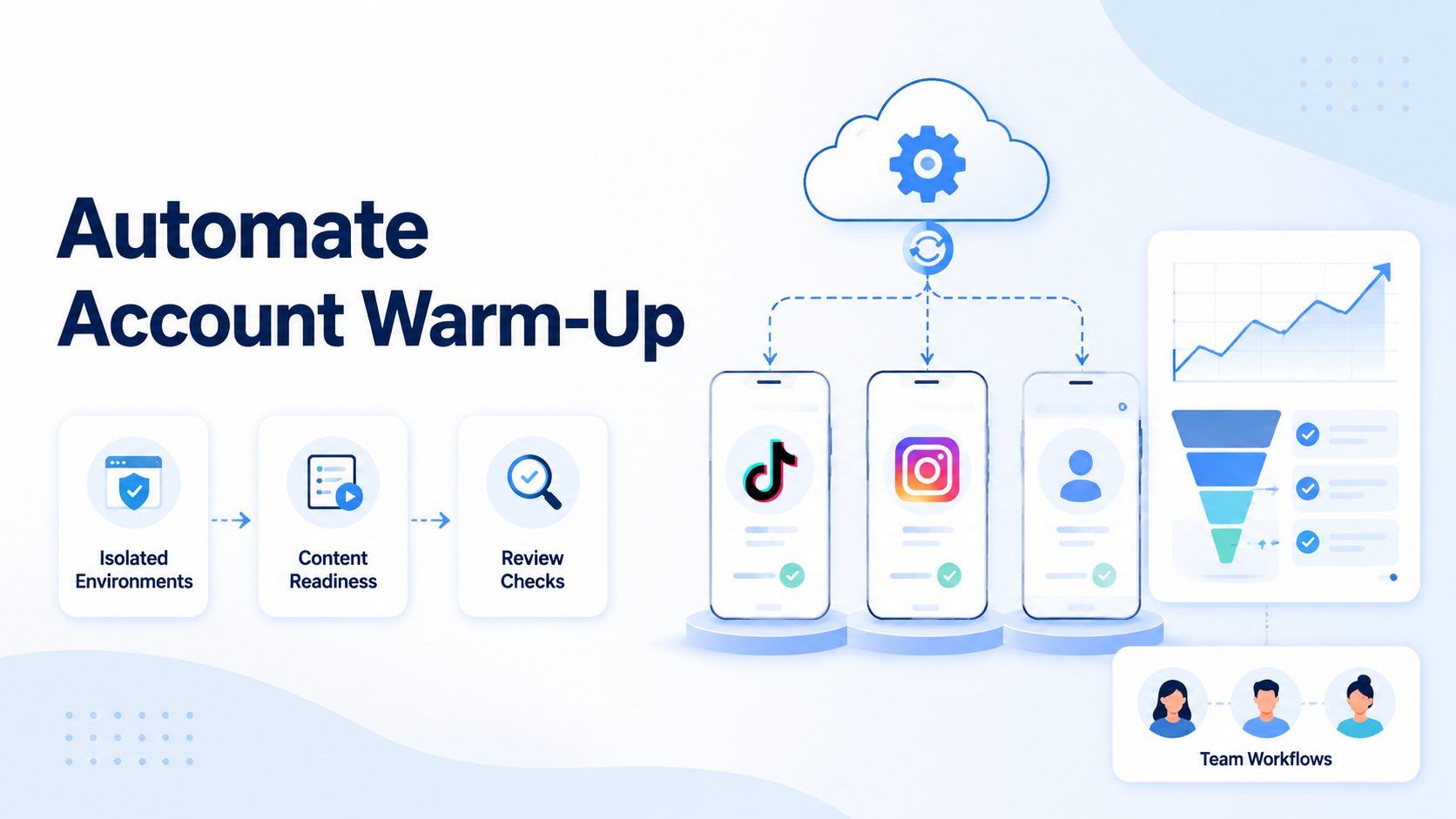
Some teams keep browser-side review inside a fingerprint browser, then hand off mobile actions to cloud phone or mobile automation.
Who Benefits Most and In What Situations
The best fit is a team that already has repeated account work and clear account boundaries. Agencies, cross-border operators, moderation teams, and growth teams with several account clusters usually benefit first.
Strong match
- Several account groups with different owners or clients.
- Workflows that already need profile-level routing or session persistence.
- Teams that review, publish, or reply in browser surfaces every day.
- Operations that need browser-to-mobile handoff later.
Weak match
- One-off social browsing with no repeated workflow.
- Teams that still share one browser login across everyone.
- Setups with no account owner and no recovery model.
- Work that depends on app-only actions most of the time.
The simplest fit test is this: can the team map one profile lane to one account cluster and one owner? If the answer is no, adding more profiles rarely fixes the deeper workflow problem.
How to Evaluate or Start Using Fingerprint Browser for Safe Multi-Account Social Media Automation
Start with one profile family and one repeated task path.
- Pick one account cluster, such as one brand, one region, or one client.
- Create dedicated profile lanes and document which operator can use each lane.
- Lock a routing rule and avoid mixing proxies or environments inside the same cluster.
- Define one repeatable workflow, such as review, publishing prep, or inbox triage.
- Add a pause rule and a named owner for blocked or suspicious runs.
This is where Playwright browser contexts are a useful mental model even if the team is not using Playwright directly.1 Separate sessions are easier to reason about, easier to review, and easier to recover when something breaks.
For social platforms that still need mobile-backed actions, the next evaluation step is usually device isolation or an Android antidetect layer, not simply more desktop profiles.
Mistakes That Reduce Results
The first mistake is using one profile as a catch-all workspace. That usually destroys the very separation the team was trying to buy.
The second mistake is changing routing rules without updating the account map. A profile lane stops being useful when nobody can explain which account group it still belongs to.
The third mistake is adding automation before the profile lane is clean. Browser automation only scales after the session model is already understandable.
What not to do
- Do not let operators reuse the same profile for unrelated account groups.
- Do not move profiles between owners without a handoff note and task log.
- Do not add a new proxy or extension layer in the middle of an active workflow with no review window.
- Do not count profile quantity as progress if session clarity keeps dropping.
Pilot Rollout, Measurement, and Recovery Checks
The pilot should prove that account lanes are easier to explain after the change.
Use a compact scorecard:
| Check | Pass condition | Failure sign |
|---|---|---|
| Profile mapping | One profile lane maps to one account cluster | Operators guess which lane is current |
| Routing stability | Each lane keeps one documented route model | Routing changes are hidden in chat |
| Task clarity | Each lane has one known workflow job | The same lane handles unrelated tasks |
| Recovery speed | Blocked runs move to a named owner fast | Issues sit with no next action |
| Scale readiness | The same design works for the next account set | Manual rescue grows faster than usage |
Chrome DevTools storage inspection is a practical recovery tool here because it helps teams confirm whether cookies and local state still match the expected profile lane.3
- Pass: the lane still maps to one account cluster.
- Pass: blocked runs still move to one named owner.
- Fail: operators start reusing the lane for unrelated accounts.
Fingerprint Browser for Social Media and Browser-to-Mobile Handoff
The clean version is simple:
- The browser profile records the exact next action.
- The mobile lane reopens the same account cluster, not a shared fallback device.
- The same owner can review both sides of the handoff.
- The recovery log stays attached to the workflow, not to one tool.
That is why teams that outgrow pure browser lanes often compare profile workspaces with cloud phone vs emulator or cloud phone for TikTok workflows. The question stops being "which browser is best" and becomes "which execution layer fits this step."
Frequently Asked Questions
Is a fingerprint browser for social media enough on its own?
No. It is one environment layer. Teams still need routing rules, ownership, and recovery checks.
What should a team isolate first?
Start with the account cluster that already has repeated work and shared operators.
Does this replace mobile execution?
No. Some workflows stay browser-first, while others need a mobile lane for the final action.
Is this only for agencies?
No. Cross-border teams, brand operations teams, and moderation teams also use profile isolation.
What is the first warning sign?
The first warning sign is profile reuse across unrelated accounts.
When should a team stop expanding?
Pause expansion when blocked runs rise and no one can explain lane ownership clearly.
What should the next evaluation step be?
Review whether the workflow needs only profile isolation or also device isolation and mobile execution.
Conclusion
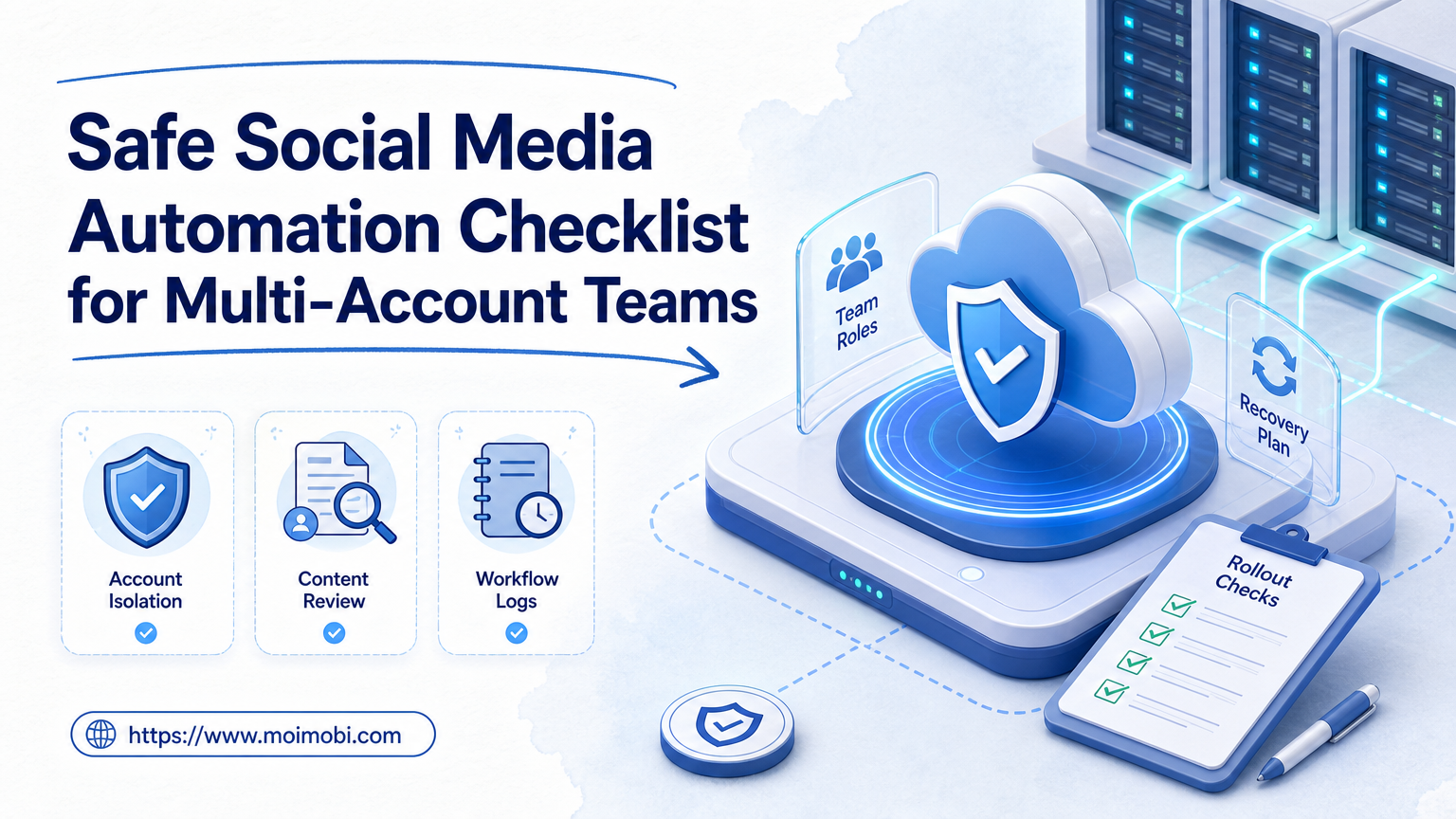
Fingerprint Browser for Safe Multi-Account Social Media Automation works when the browser profile is treated as an account lane, not a generic desktop shortcut. The strongest setups separate state, routing, ownership, and recovery before they automate more steps.
The next practical check is narrow. Pick one account cluster, map one browser lane to one owner, and inspect whether the team can explain every pause, route, and handoff after a short pilot. If that answer gets clearer, the profile model is helping.
Sources
- Playwright browser contexts
- W3C WebDriver
- Chrome DevTools storage documentation
- Instagram for Business
- TikTok for Business
-
Playwright documentation explains browser contexts as isolated sessions, which is directly relevant to profile-based workflow design. ↩↩
-
W3C WebDriver defines automation around explicit browser sessions and commands rather than vague background state. ↩
-
Chrome DevTools storage documentation shows how browser-side state such as cookies and storage can be inspected during debugging and review. ↩↩
-
Instagram for Business documents platform workflows for business use, which is relevant when teams manage repeated account work. ↩
-
TikTok for Business documents business workflow surfaces that support structured account operations. ↩