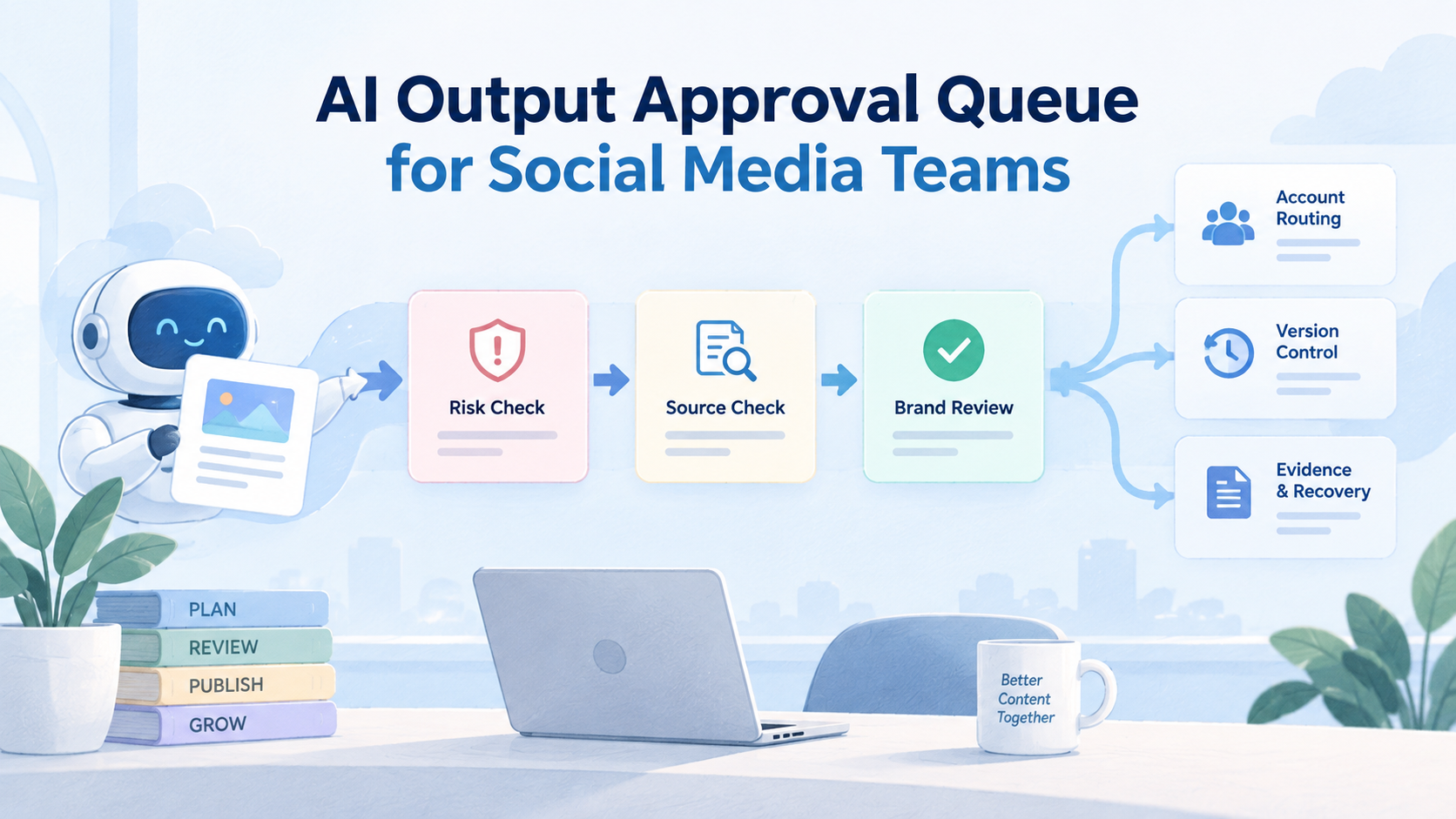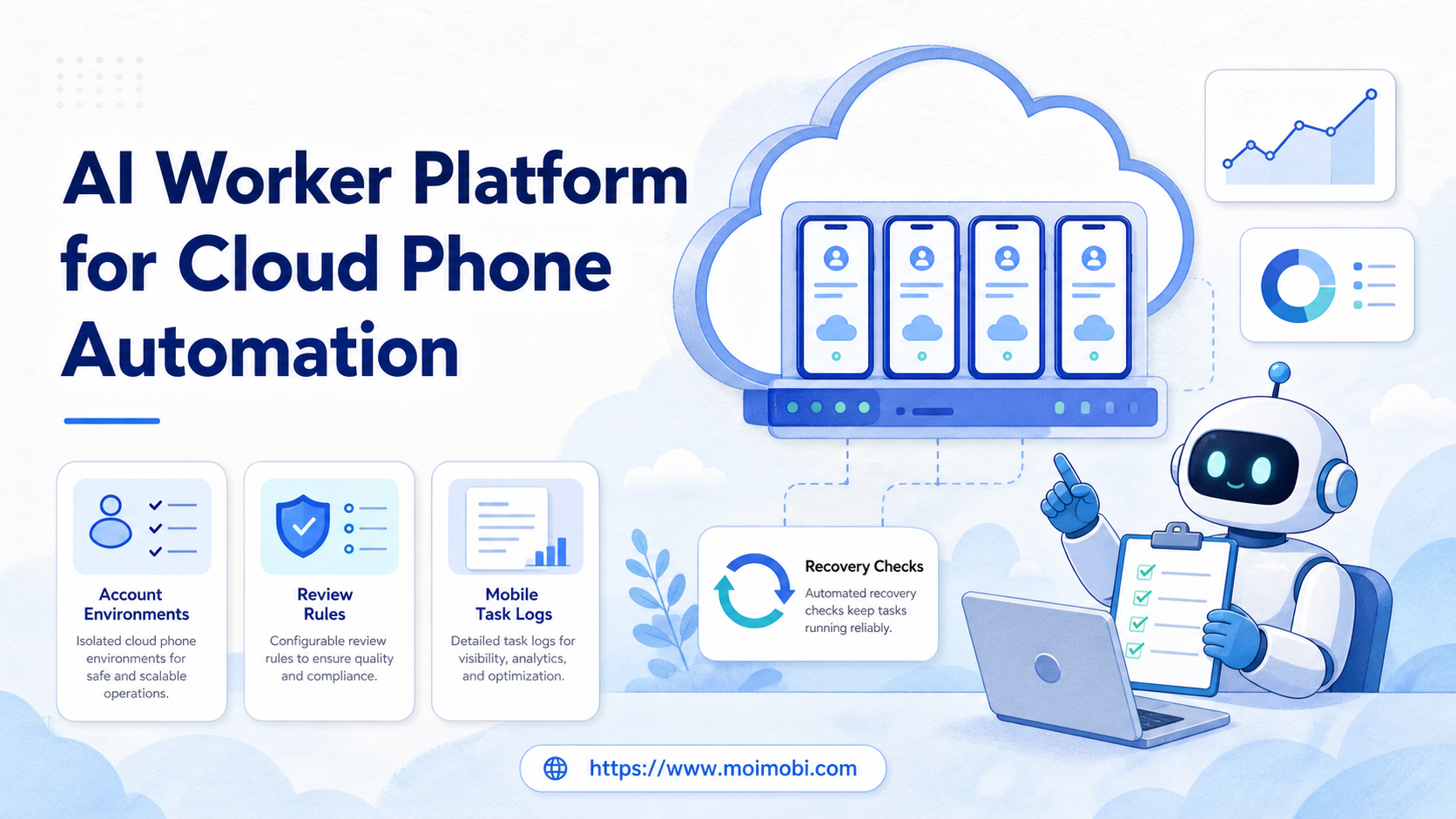
Title: AI Worker Platform for Cloud Phone Automation
Cloud phone automation is the use of remote Android environments to run repeatable mobile tasks with clear account ownership, task rules, and execution records. An AI worker platform adds planning, routing, review, and recovery logic so teams can use cloud phones as controlled workspaces instead of simple rented devices.
The core problem is not only access to a remote phone. Teams also need to decide which account runs on which phone, which task is allowed, who reviews the result, and what happens when an app state changes. Without that structure, automation becomes hard to audit.
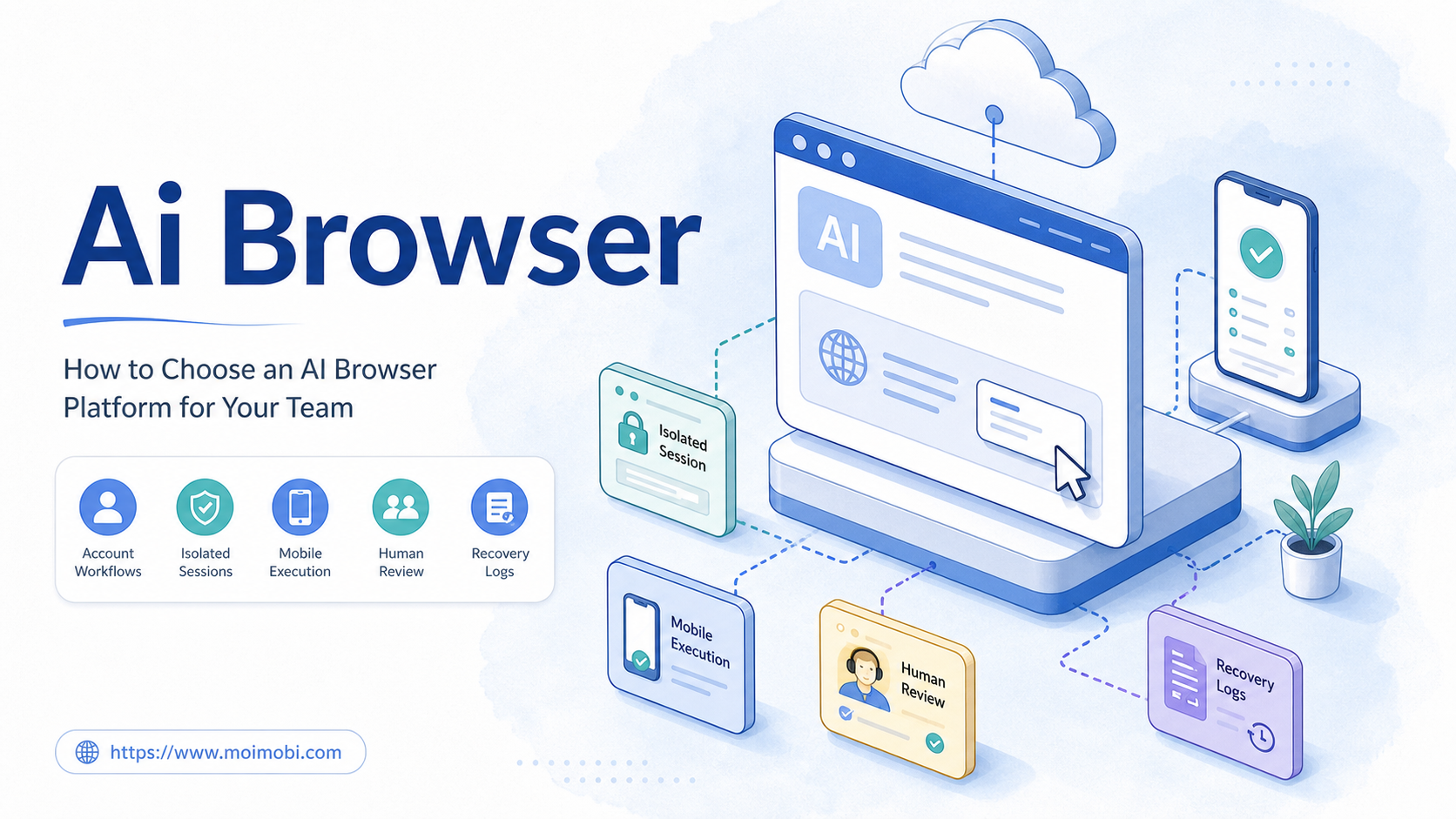
Moimobi treats cloud phones as one layer inside a broader execution system. A cloud phone and AI execution platform should connect AI workers, browser profiles, Android environments, account workspaces, and task logs into one operating model.
Key Takeaways:
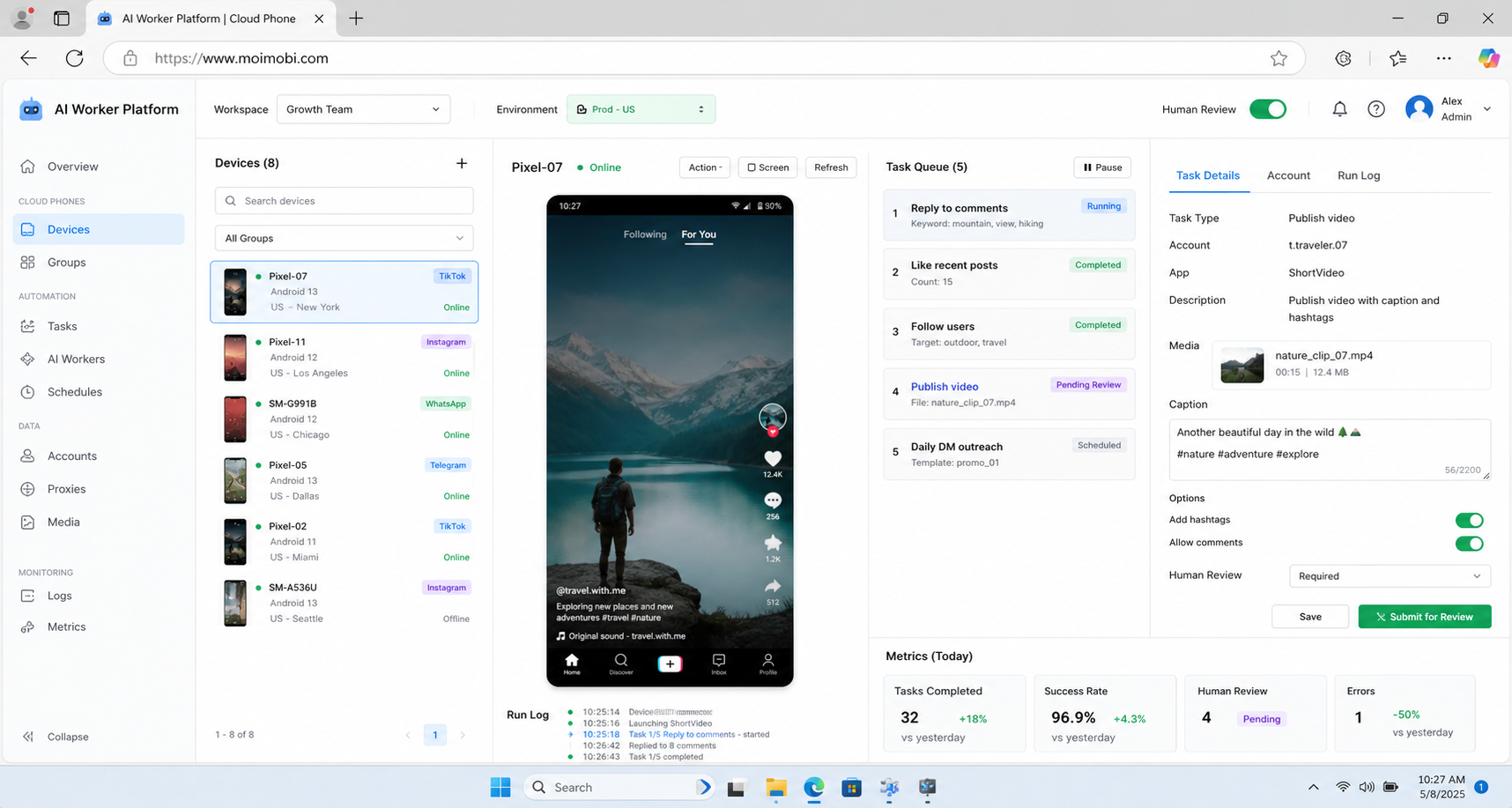
- Cloud phone automation works best when each task has a clear account, device, owner, and review rule.
- An AI worker platform should separate planning, mobile execution, human approval, and recovery.
- Cloud phones are useful for app-based workflows that cannot be completed from browser dashboards alone.
- Teams should start with one narrow mobile workflow before expanding to many accounts.
- Success depends on account accuracy, task completion, failure logs, and reviewer trust.
What Is AI Worker Platform for Cloud Phone Automation?
An AI worker platform for cloud phone automation assigns AI-assisted work to controlled mobile environments. The worker may prepare a task, open the right account workspace, follow a workflow, record the result, and stop when a review rule is triggered.
The platform has three layers. First, AI interprets the task and prepares the next action. Second, the cloud phone provides a persistent Android environment for app-based work. Third, the operations layer records status, account context, approvals, and failures.
This structure matters because a cloud phone alone is only an execution surface. It gives the team a remote Android device, but it does not define task ownership. The AI worker platform defines the work model around that device.
Cloud phones are most useful when the task belongs inside a mobile app. Examples include social app publishing, messaging app replies, mobile marketplace checks, app notifications, and account-specific app workflows. A browser dashboard can support planning, but the actual action may still require Android app state.
Official Android and device-testing documentation also points to the importance of environment state. Android Enterprise discusses managed work profiles and device control. AWS Device Farm and Firebase Test Lab describe app testing through real or virtual device environments, app state, and repeatable runs. Operations teams are not building test labs, but the same lesson applies: mobile execution depends on device context.
| Cloud phone workflow | AI worker role | Environment rule | Review signal |
|---|---|---|---|
| Social content publishing | Prepare caption, verify asset, guide publishing checklist | One cloud phone or workspace per account group | Correct account, correct asset, approved publish record |
| Customer message replies | Classify message, draft reply, route sensitive cases | Mobile inbox with account-specific session | Edit rate, escalation accuracy, response completion |
| Marketplace app monitoring | Check alerts, collect repeated questions, summarize issues | Cloud Android environment with saved app context | Source-backed notes and follow-up owner |
| Multi-account mobile operations | Assign tasks by account, app, owner, and risk level | Separated device workspace for each account lane | Wrong-account prevention and clean task logs |
Why AI Worker Platform for Cloud Phone Automation Matters
The common misunderstanding is that cloud phone automation means pushing as many mobile actions as possible through remote devices. That model is too shallow. The stronger model is controlled execution with account mapping, human approval, and recovery.
Teams search for this topic when manual mobile operations start to break down. Operators may switch between several phones, accounts, apps, content assets, and reply queues. AI can help prepare the work, but the system still needs a safe place to run it.
An AI worker platform matters because it adds operating structure. It can assign a worker to a task type, choose a mobile environment, keep the account context, log the result, and surface exceptions. That turns a remote phone into part of a team workflow.
This also helps teams avoid confusing cloud phones with emulators. A cloud phone is usually evaluated for persistent mobile operation, app access, team control, and account-specific execution. For readers comparing mobile environments, Moimobi's cloud phone vs emulator comparison is a useful adjacent reference.
Cloud phone automation becomes more valuable when it connects to browser work. A manager may plan campaigns in a web dashboard, assign assets from a content library, then run the app task on a cloud phone. The platform should keep those steps linked.
Key Benefits and Use Cases
The first benefit is controlled mobile capacity. A team can run repeated app tasks without relying on a pile of physical phones or unclear handoffs. The benefit is not just remote access; it is a more inspectable execution model.
The second benefit is account separation. In multi-account operations, one account should not casually share the same mobile session as another. Moimobi's device isolation layer helps teams think in account workspaces instead of shared devices.
The third benefit is workflow memory. When a mobile task succeeds, the team can save the steps, inputs, and review notes. When it fails, the team can record whether the issue came from app state, login, media access, network route, or task design.
Common use cases include:
- TikTok or Instagram app publishing workflows.
- WhatsApp, Telegram, or social DM reply preparation.
- Marketplace app monitoring and follow-up checks.
- Mobile content review before public posting.
- Agency account operations across client workspaces.
- Customer engagement workflows that need app context.
For mobile-first social operations, Moimobi's mobile automation page is the closest product layer. For broader account orchestration, the multi-account management use case is the natural next step.
Teams should also define the task contract before scaling. The contract should name the account, app, device workspace, task owner, allowed actions, source asset, approval rule, and stop condition. Those fields make the workflow easier to review after the run, especially when several cloud phones operate in parallel.
How to Get Started with AI Worker Platform for Cloud Phone Automation
Start with one app workflow and one account group. A small pilot gives the team enough visibility to learn without creating a hard-to-debug account fleet.
- Pick one workflow: choose publishing, reply preparation, app monitoring, or follow-up.
- Assign the account lane: map each cloud phone to an account group, app, owner, and reviewer.
- Define task permissions: separate draft, inspect, collect, click, send, publish, and delete actions.
- Prepare mobile state: confirm login, app version, media access, network route, and task source.
- Run a small batch: test a limited number of tasks and inspect every output.
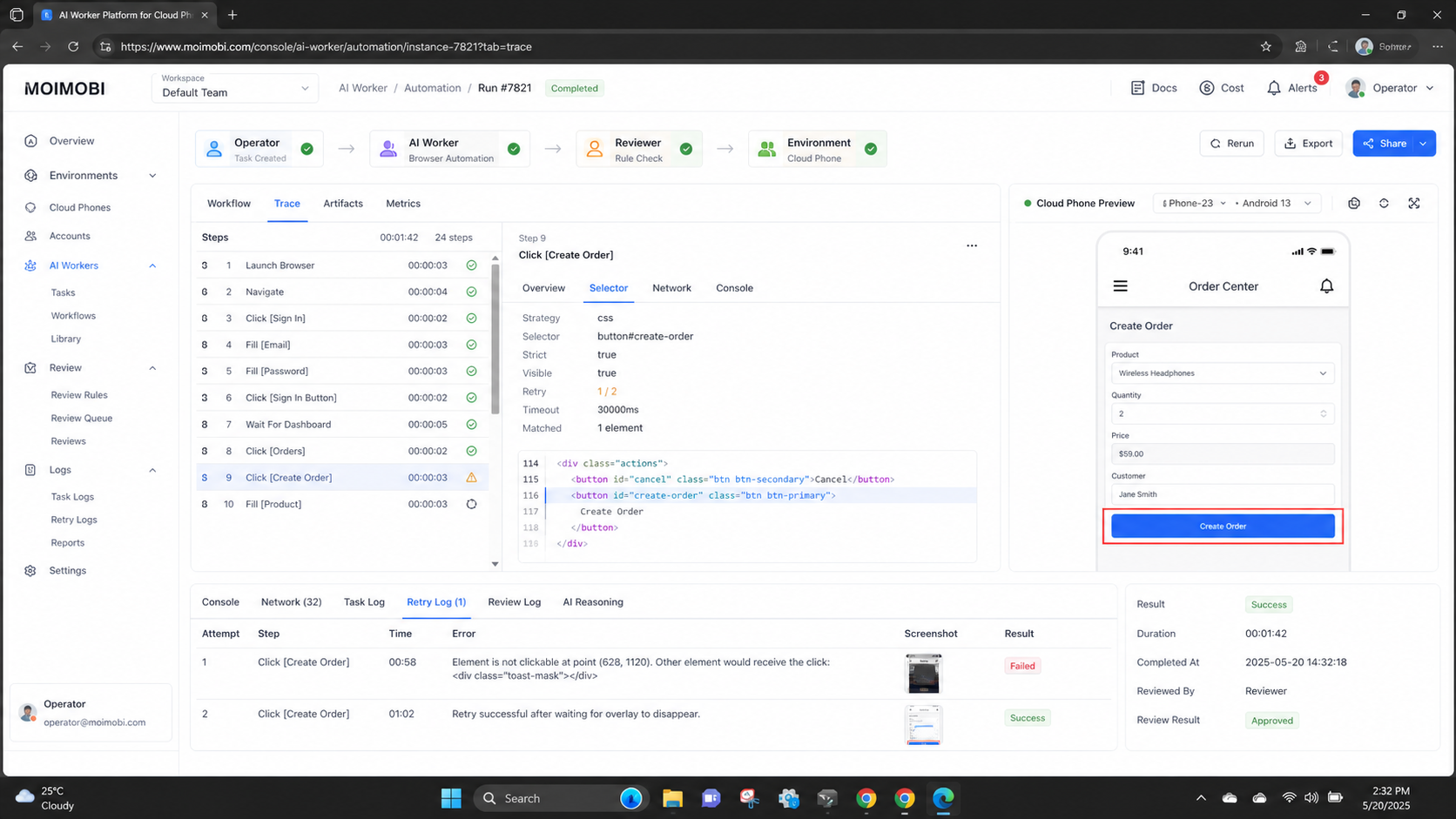
- Record evidence: save task status, account, app, worker action, reviewer, and failure reason.
The highest-risk step is the final app action. Publishing a post, sending a customer reply, changing settings, or deleting content should usually require stronger review than drafting or collecting information.
Teams with technical workflows may also need device control interfaces. Android Debug Bridge is the official Android command-line tool for communicating with devices. For cloud-phone-specific implementation planning, Moimobi's cloud phone API guide is a useful internal resource.
Operational teams do not need to expose every technical control to every operator. A better setup keeps low-risk task preparation visible to more users, while final execution rights stay with trained owners. This reduces confusion between planning, device control, and customer-facing action.
Common Mistakes to Avoid
The first mistake is starting with too many accounts. A large launch hides problems. A small pilot makes account mapping, app state, and failure categories easier to inspect.
Another mistake is giving one AI worker too much authority. A worker that can draft, publish, reply, change settings, and delete content becomes hard to control. Split roles by task type and review level.
Teams also forget that mobile apps change state. A workflow may meet a login prompt, notification overlay, permission dialog, unexpected update, or missing media file. The correct response is to stop and report the condition, not push forward blindly.
Shared cloud phones can create a final problem. One device used for several unrelated accounts may seem efficient. Later, the team may struggle to prove who did what, from which account, and under which workflow rule.
Cloud phone automation should not be framed as a way to bypass platform rules. Safer language is about separated workspaces, repeatable workflows, review controls, and task records.
Who It Fits and When It Is a Strong Match
Cloud phone automation is a strong match when the team already performs repeated mobile app work. The task has a known input, a known account, a known app, and a clear success condition.
It is also a strong match for teams that manage several mobile-first accounts. Social media agencies, cross-border sellers, creator teams, and customer support groups often need app-specific execution with account-level separation.
Strong fit
- Repeated app workflows with clear account ownership.
- Mobile tasks that require Android app state or mobile inbox access.
- Teams that can review task logs before scaling.
- Operations where account separation matters.
Weak first fit
- Unclear tasks with no owner or review rule.
- High-risk actions that require judgment at every step.
- Large account fleets with no naming or assignment rules.
- Workflows that cannot capture useful failure evidence.
The practical test is simple. If a human can describe the task, the account, the app state, the allowed actions, and the stop rule, the workflow is ready for a small pilot. If not, define the operating model first.
This fit check should happen before buying more device capacity. Extra devices do not fix missing ownership. They only multiply the number of places where the same weak process can fail.
Pilot Rollout, Measurement, and Recovery Checks
A pilot should prove control before scale. The team should see what happened, where it happened, and why a task stopped.
Track five metrics during the first cycle:
- Account accuracy: whether the correct cloud phone and account were used.
- Completion rate: whether the task reached a reviewed outcome.
- Human edit rate: how much the AI-prepared output changed after review.
- Failure category: app state, login, permission, media, network, or workflow.
- Recovery time: how quickly the team diagnosed and closed the issue.
Recovery checks protect the workflow from silent errors. Stop the task when the account is unclear, the app screen is unexpected, the media file is missing, or the requested action exceeds the worker's permission.
The review meeting should include both successful and failed runs. Successful runs show whether the workflow is repeatable. Failed runs show whether the platform captured enough evidence to fix the next run.
Frequently Asked Questions
What is cloud phone automation?
Cloud phone automation means running repeatable mobile tasks through remote Android environments with defined task rules, account ownership, and execution records.
How does an AI worker platform change cloud phone automation?
It adds task planning, worker roles, review rules, logs, and recovery checks around the cloud phone environment.
When do teams need a cloud phone for AI agents?
Teams need it when the task depends on mobile apps, persistent Android sessions, app notifications, or account-specific mobile workflows.
Is cloud Android for AI agents the same as an emulator?
Not exactly. Teams usually evaluate cloud Android environments for persistent mobile operation, remote access, account context, and workflow control.
What should be automated first?
Start with preparation and collection tasks. Examples include app monitoring, reply drafting, asset checks, and publishing checklist preparation.
Which actions should remain reviewed?
Public publishing, customer replies, account settings, deletion, payments, refunds, and dispute handling should stay under human review.
How should teams assign cloud phones?
Assign cloud phones by account group, app workflow, owner, and review rule. Avoid unclear shared-device setups.
What metrics matter most?
Account accuracy, completion quality, failure category, review time, and recovery time matter more than raw action volume.
Conclusion
The priority order is environment, workflow, review, and then scale. Cloud phone automation works best when teams treat remote Android devices as controlled workspaces, not as anonymous execution slots.
Start with one app workflow and one account group. Define the allowed actions, assign the reviewer, and track every result. Expand only after the pilot shows clean account mapping and useful recovery logs.
For Moimobi users, the next practical step is to choose which tasks belong on cloud phones, which stay in browser profiles, and which actions need human approval. That map turns AI workers and cloud phones into a manageable operations system.
References