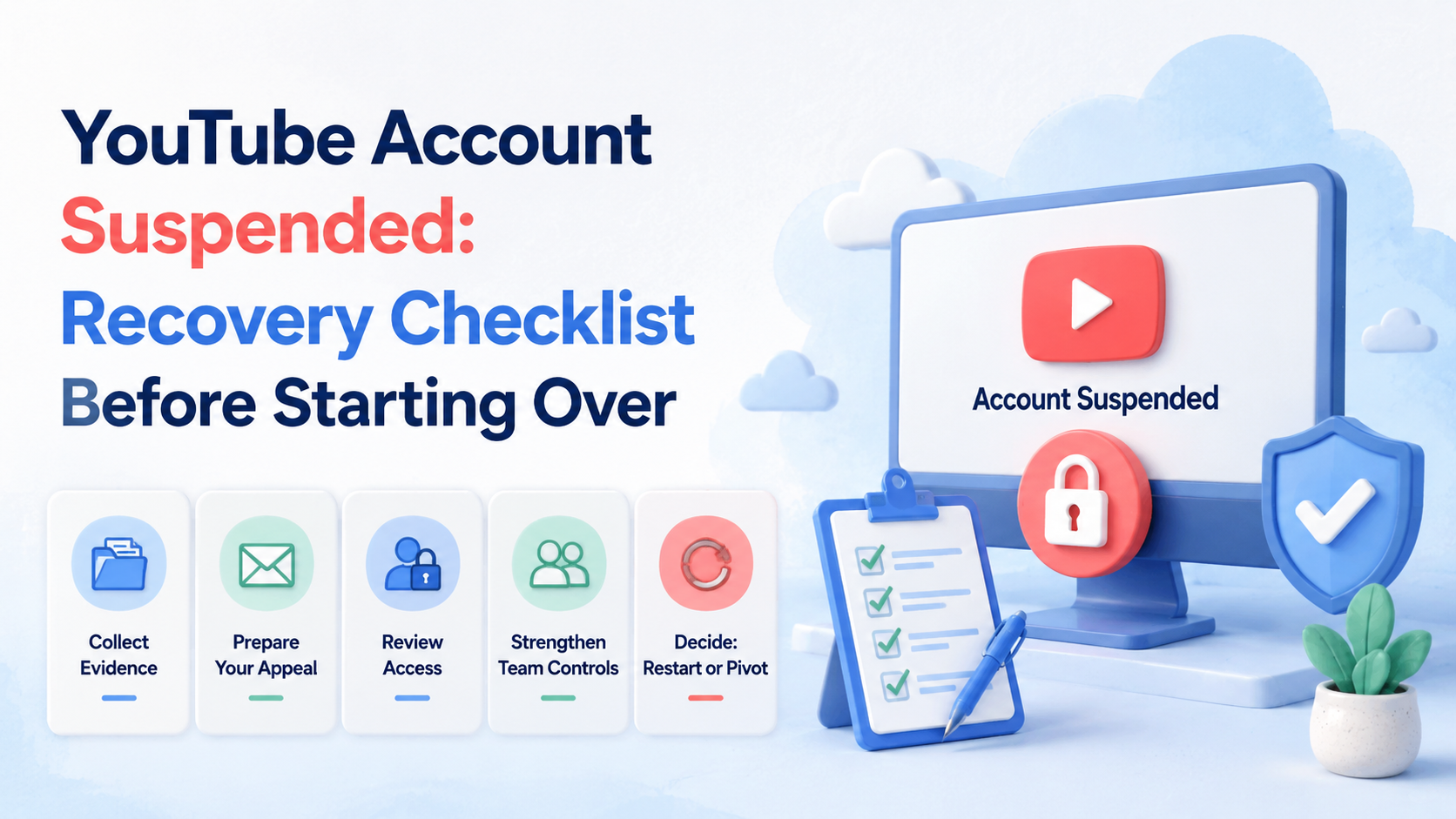
A YouTube account suspended case is a channel or account access problem that must be handled through policy review, evidence collection, and the official appeal path before any team starts over. The first move is not to create a new operating plan around the same mistakes. The first move is to understand what happened, who owns the channel, what policies may be involved, and whether an appeal is still available.
For teams running content, commerce, creator partnerships, or social media operations, suspension is not only a creator issue. It can affect publishing schedules, customer communication, ad plans, affiliate links, product launches, and reporting. A calm recovery process protects the team from deleting evidence, repeating risky behavior, or assigning blame before facts are clear.
This guide treats recovery as an operations workflow. It does not explain how to evade platform enforcement. It explains how to review the issue, prepare a responsible appeal, decide whether to pause related workflows, and rebuild controls if the team needs a new channel strategy.
Key Takeaways
- Do not rush into a new channel before reviewing the suspension notice, channel ownership, policy history, and appeal options.
- YouTube has official help pages for channel or account terminations, Community Guidelines strikes, spam policy, appeals, and copyright strikes.
- Teams should freeze scheduled publishing, automation, and account handoff until the root cause is understood.
- A recovery checklist should include account access, responsible owner, content history, third-party tools, linked channels, and proof that risky workflows were stopped.
- If the team restarts, the new plan should be based on corrected operating rules, not a copy of the old process.
The Core Idea Behind a YouTube Account Suspended Recovery Checklist
A recovery checklist gives the team a controlled path from surprise to decision. It separates three questions that are often mixed together: what happened, whether an appeal is appropriate, and what must change before any future publishing resumes.
YouTube explains that channels or accounts can be terminated for repeated violations, a single case of severe abuse, or channels dedicated to policy violations. That official framing matters because the team should not assume the problem is always a technical login issue. Start with the notice and the policy category before making operational changes.
Use the checklist as a stop-work process:
- Preserve the suspension notice, emails, screenshots, and channel URLs.
- Identify the channel owner, brand owner, agency operator, and anyone with publishing rights.
- Pause scheduled uploads, comment workflows, replies, and external promotion tied to the channel.
- Review recent uploads, Shorts, descriptions, links, comments, and community posts.
- Decide whether the issue looks like policy, copyright, account access, or team process.
- Prepare an appeal only after the facts are clear.
This is also where operations teams should check their execution environment. If multiple people shared devices, browser sessions, or unmanaged credentials, the root problem may be poor account governance. Teams that already use separated workspaces, browser profiles, or cloud phone environments should still check whether those environments were assigned cleanly and logged properly.
| Recovery Area | What to Collect | Why It Matters |
|---|---|---|
| Official notice | Email, dashboard message, strike notice, appeal link | Defines the policy path and available next action |
| Ownership | Brand owner, manager, agency, publishing operator | Prevents duplicate appeals and unclear responsibility |
| Recent activity | Uploads, descriptions, links, comments, live streams | Finds the likely operational trigger |
| Tools and access | Devices, browser profiles, mobile environments, automation logs | Shows whether the issue came from workflow design |
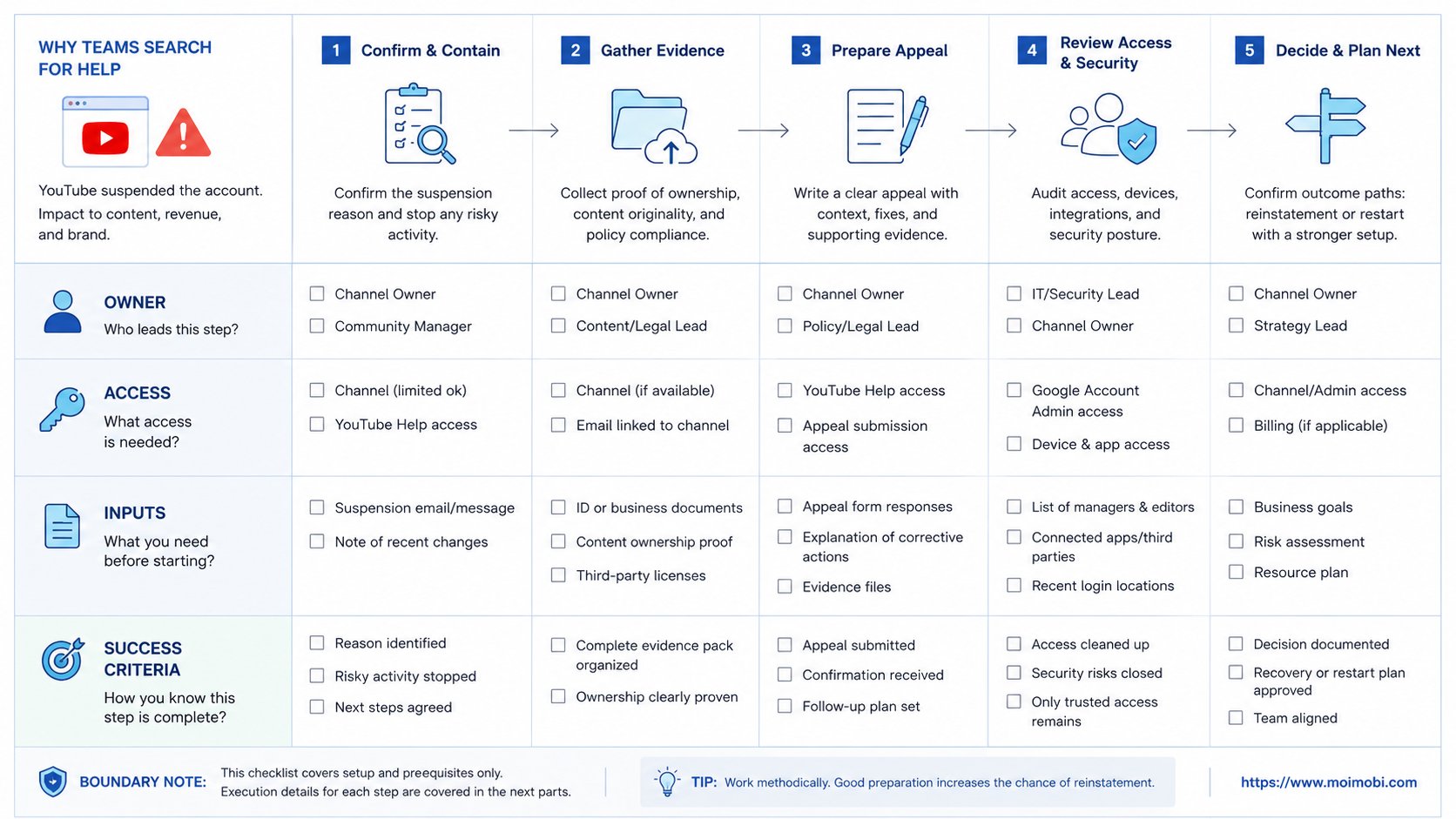
Why Teams Search for YouTube Account Suspended Help
Teams search for youtube account suspended guidance because the business impact is immediate. A single channel can be the place where product videos, creator content, support explanations, reviews, and paid traffic all meet. When it disappears, the team needs a process that is faster than a meeting and safer than guesswork.
The pressure is worse when several people operate the same channel. One person may handle uploads, another may reply to comments, and an agency may maintain descriptions or links. Without a shared record, the team may not know which workflow changed before the suspension.
YouTube's Community Guidelines strike basics explain the concept of warnings and strikes for guideline violations. Its spam policy also covers misleading metadata, scams, and repetitive or unwanted activity. These sources are useful because they push the review toward specific behavior, not vague theories.
Operationally, teams usually need four answers:
- Was the issue tied to content, metadata, copyright, comments, links, or account access?
- Did the problem come from one operator or a repeated team workflow?
- Is there a valid appeal path, or does the team need a corrected restart plan?
- Which related accounts, tools, and campaigns should pause while the review runs?
For multi-platform teams, YouTube is rarely isolated. The same content calendar may feed TikTok, Instagram, and YouTube Shorts. If the team runs broader social workflows, a central social media marketing workspace can help separate publishing, review, and reporting responsibilities.
Who Benefits Most and In What Situations
This checklist is most useful for teams with shared responsibility. Solo creators can still use it, but the biggest value appears when a suspended channel affects multiple roles, clients, or campaigns.
Agencies benefit because they need evidence before reporting to a client. E-commerce teams benefit because product pages, launch videos, and support clips may depend on the channel. Social media operators benefit because they often manage short-form workflows across several platforms. Support teams benefit because tutorial videos may be part of the customer journey.
The checklist is not a shortcut for reopening a channel. It is a way to avoid a second operational failure. If the team starts a new channel without changing review rules, metadata checks, ownership, or publishing approvals, the same workflow risk remains.
Use this fit boundary:
- Good fit: the team has a legitimate channel, an official notice, and a need to diagnose before appealing.
- Good fit: multiple people or tools touched the channel, and the team needs an activity review.
- Poor fit: the goal is to bypass YouTube policies or continue the same behavior under a new identity.
- Poor fit: nobody can identify who owns the account, who published recent content, or what changed.
When account separation is part of the issue, teams should inspect their operating setup. A device isolation model can help define which account runs in which environment, but it should be paired with policy training and human review.
How to Evaluate a YouTube Account Suspended Case Before Appealing
Start with the official path. YouTube provides a help page for appealing a Community Guidelines strike or video removal. Copyright issues have their own path, and YouTube's copyright strike guide explains the difference between a copyright strike and other channel problems.
Follow this sequence before submitting anything:
- Read the notice carefully. Copy the exact language, dates, affected channel, and appeal instructions.
- Classify the issue. Separate Community Guidelines, copyright, spam, impersonation, security, and access problems.
- Freeze related work. Stop uploads, scheduled posts, comment tasks, and link changes connected to the channel.
- Build the evidence file. Add URLs, upload dates, descriptions, thumbnails, third-party tool logs, and operator notes.
- Review recent changes. Check the last seven to thirty days of uploads, edits, comments, and permissions.
- Write a factual appeal. Explain what you believe happened, what evidence supports it, and what corrective steps are already in place.
- Assign one owner. Only one responsible person should manage the appeal record and follow-up notes.
Keep the appeal short and specific. A vague appeal that says the team did nothing wrong is weaker than a factual appeal that identifies the channel, the disputed item, the policy category, and the corrective actions taken.
Common Mistakes That Make Recovery Harder
The most common mistake is creating a new channel before the old one is understood. That may feel productive, but it can hide the original problem. If the team repeats the same metadata pattern, upload workflow, comment behavior, or third-party tool setup, a restart may only move the issue forward.
Another mistake is mixing policy categories. A copyright strike, Community Guidelines strike, and account termination are not the same workflow. They may require different evidence and different appeal routes. Treating every notice as a generic "ban" leads to poor decisions.
Teams also lose time when they do not know who had access. Shared passwords, unmanaged browser sessions, and unclear contractor permissions make it hard to reconstruct activity. A multi-account management process should define account owners, environments, handoff rules, and review logs before a crisis.
Avoid these recovery errors:
- Submitting multiple emotional appeals without new information.
- Deleting content, messages, or logs before the review is complete.
- Letting several team members contact support separately.
- Restarting uploads from the same unreviewed content pool.
- Treating automation volume as the only issue while ignoring content and policy fit.
For mobile-first operators, a mobile automation workflow should include review checkpoints. Automation is not a substitute for policy understanding, content approval, or ownership clarity.
Success Metrics for a YouTube Account Suspended Recovery Review
A recovery review works when the team can explain the case without guessing. The best signal is not a fast restart. The best signal is a clear decision record that shows what happened, what was paused, what was appealed, and what changed in the workflow.
Track these measures before the team resumes channel work:
| Metric | Pass Condition | Owner |
|---|---|---|
| Notice classification | Policy category, date, channel, and appeal path recorded | Channel owner |
| Workflow pause | Uploads, replies, edits, and promotions linked to the channel are stopped or reviewed | Operations lead |
| Access audit | All managers, devices, sessions, and tools are listed | Account admin |
| Corrective action | At least one concrete workflow rule changed before restart | Team lead |
Verification Checklist Before Starting Over
Starting over may be necessary in some business situations, but it should be a controlled decision. The team should first prove that it has fixed the operating conditions that created the issue.
Use this verification checklist:
- The official notice and appeal status are documented.
- The team knows whether the issue involved guidelines, copyright, spam, account access, or another category.
- Recent content and metadata have been reviewed by a responsible owner.
- Third-party tools and access permissions have been audited.
- Scheduled workflows connected to the old channel are paused or corrected.
- New publishing rules include review, approval, and escalation steps.
- Related social accounts have been checked for the same risky pattern.
Teams that manage several brands or creators should also review their workspace design. Use separate owners, separate environments, and clear task records. If the team uses phone farm infrastructure for mobile workflows, the important question is not only capacity. It is whether each account has a clear purpose, owner, and audit trail.
Frequently Asked Questions
What should I do first when a YouTube account is suspended?
Save the notice, pause related workflows, and identify the policy category. Do not delete evidence or start a new channel before reviewing the facts.
Can I appeal a suspended YouTube account?
In some cases, YouTube provides an appeal path. Use the instructions in the official notice and keep the appeal factual, specific, and tied to evidence.
Is a Community Guidelines strike the same as account suspension?
No. A strike, video removal, copyright strike, and account termination can follow different rules. Read the notice before choosing the next action.
Should an agency submit the appeal or the channel owner?
The responsible owner should control the appeal record. If an agency helps, it should provide facts, logs, and content history instead of sending separate messages.
Can automation cause YouTube account problems?
Risk depends on the behavior, content, metadata, and tools involved. Teams should review both human actions and automated workflows when diagnosing a suspension.
What evidence should a team collect?
Collect the notice, channel URL, affected videos, upload history, metadata changes, access logs, tool logs, and any internal approval records.
When is it reasonable to start over?
Only after the team understands the issue, documents appeal status, fixes workflow problems, and sets new publishing controls. A restart without correction is weak operations.
How can MoiMobi help in this situation?
MoiMobi helps teams structure account environments, mobile execution, task assignment, and operating records. It does not replace YouTube's appeal process or platform rules.
Conclusion
A YouTube account suspended case should be handled like an operational incident. Slow down, preserve evidence, read the official notice, classify the policy path, and assign one responsible owner. The goal is not to argue louder. The goal is to understand the cause and make the next action defensible.
Before starting over, ask one final question: can the team explain what changed in its workflow? If the answer is no, keep reviewing. If the answer is yes, rebuild with cleaner ownership, safer review steps, and separated execution records across the accounts and environments your team manages.