Key Takeaways
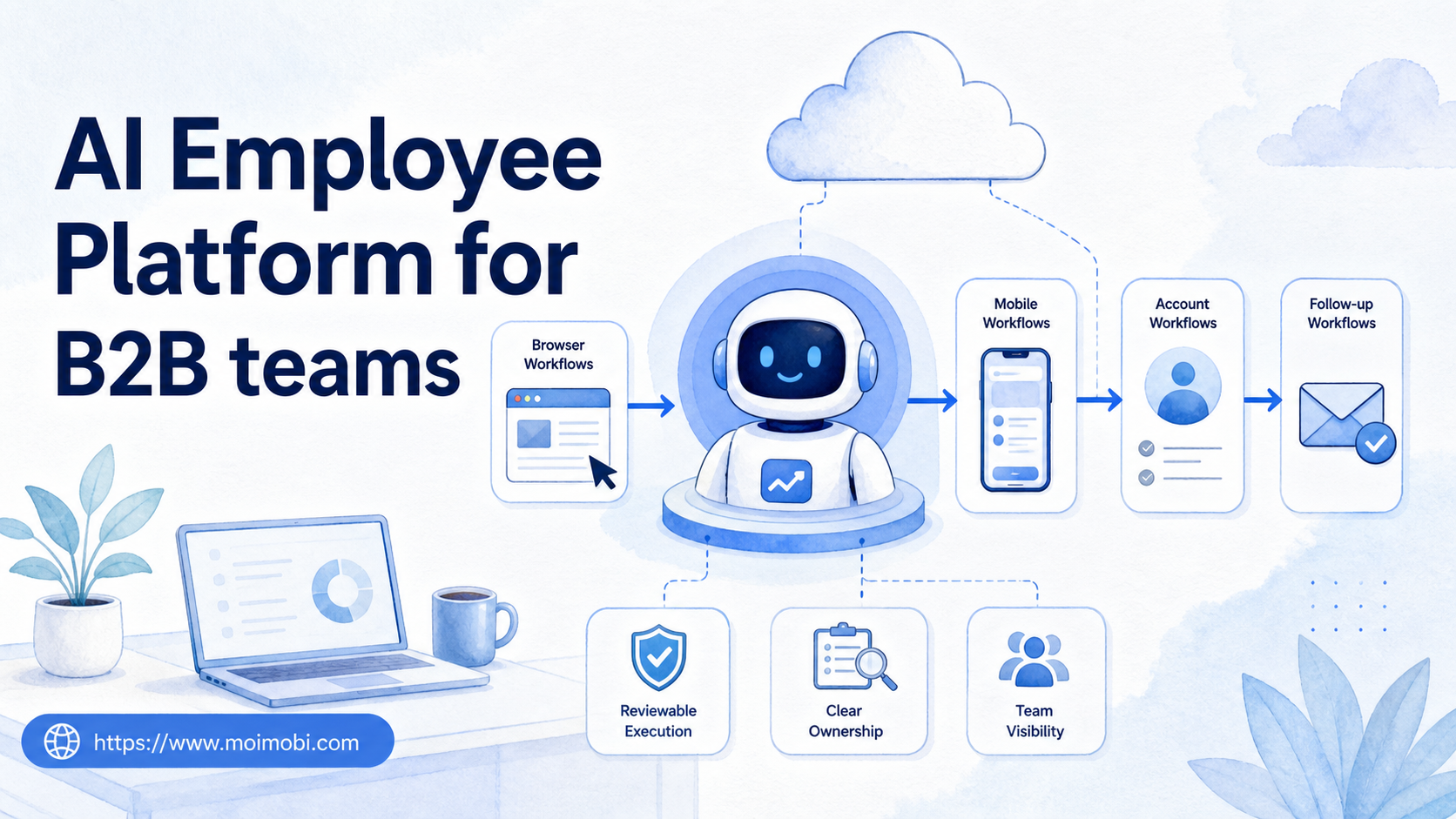
- An AI employee platform gives B2B teams a way to assign repeated digital work to AI workers with roles, environments, logs, and human review.
- The best early use cases are narrow workflows such as lead research, CRM updates, inbox triage, account checks, and content preparation.
- Browser and mobile execution matter when work must happen inside logged-in accounts, dashboards, apps, or account-specific workspaces.
- B2B teams should measure completion rate, review load, exception rate, handoff quality, and account-environment accuracy before expanding.
An AI employee platform is a system that lets teams assign repeatable business tasks to AI workers and track how those tasks are executed. For B2B teams, the value is not another chatbot. The value is a controlled operating layer for work that crosses browsers, accounts, mobile apps, CRMs, inboxes, and team handoffs.
Most B2B workflows do not fail because the team lacks ideas. They fail because follow-up, research, reply preparation, account checks, and reporting are spread across too many tools. A good AI employee workflow reduces that operating drag without removing human judgment.
Moimobi fits this category as an AI execution platform for browser and mobile work. It connects AI-assisted planning to execution environments, account workspaces, task records, and review points. That distinction matters because B2B teams need repeatable execution, not only generated text.
What Is AI Employee Platform for B2B teams?
For B2B teams, the platform is a workflow system for assigning digital operating work to AI workers under defined rules. The worker may research accounts, prepare replies, update records, monitor dashboards, or collect signals. The platform should define what the worker can do, where it can operate, when it must stop, and what record it leaves behind.
The common myth is that an AI employee is a general-purpose digital worker that can own a full business function. That is too broad for a serious B2B rollout. A more workable model is narrower: one worker, one role, one task lane, one review rule, and one execution environment.
That model changes the implementation. B2B teams do not only need a language model that writes a reply. They need the right account context, browser session, CRM record, mobile workspace, and approval path. When those pieces are missing, the AI output may look useful while the actual workflow still depends on manual copying and checking.
This is where AI employees software becomes different from a simple assistant. The software layer should help a team control assignments, account access, task logs, exception handling, and review queues. The AI worker prepares or executes defined work. The human owner keeps authority over sensitive decisions.
Why AI Employee Platform for B2B teams Matters
B2B operations have a high coordination cost. A sales team may need account research, lead scoring, CRM hygiene, follow-up preparation, and meeting notes. A support team may need inbox triage, customer context, escalation routing, and reply drafts. A marketing team may need content research, campaign monitoring, and social account checks.
Without a shared execution layer, every team solves those tasks with a mix of spreadsheets, browser tabs, chat threads, and individual memory. That works for a few accounts. It becomes harder when the company adds more markets, channels, roles, or customer segments.
The decision framework is simple:
- Work frequency: choose tasks that repeat daily or weekly.
- Decision sensitivity: keep pricing, legal, refunds, and strategic calls under human control.
- Environment need: identify whether the task needs a browser profile, mobile app, dashboard, or account workspace.
- Review evidence: require logs that show input, action, result, exception, and next step.
Browser automation standards and tooling show why structured execution matters. The W3C WebDriver specification defines remote browser control as a structured protocol, not a loose prompt. Playwright's documentation also organizes browser work around contexts, pages, and repeatable actions. Those patterns support the same operational idea: execution needs state, boundaries, and observable results.
Sources:
B2B Scenario Map: Roles, Workflows, and Review Points
B2B teams should map AI workers to operating lanes before choosing features. The map below shows practical lanes where an AI employee platform can reduce repeated work while keeping review visible.
| B2B Role | AI Worker Lane | Execution Environment | Human Review Point |
|---|---|---|---|
| Sales development | Account research and lead preparation | Browser dashboards, CRM, spreadsheets | Qualification logic and outreach approval |
| Customer support | Inbox triage and reply preparation | Support inbox, knowledge base, customer records | Escalations, refunds, complaints, and sensitive replies |
| Marketing operations | Content preparation and campaign checks | Content library, social accounts, analytics dashboards | Brand voice, publishing approval, and campaign priority |
| Revenue operations | CRM updates and report collection | CRM views, spreadsheets, BI dashboards | Field mapping, data quality, and next-step ownership |
| Partnerships | Partner monitoring and follow-up reminders | Browser sessions, email, partner portals | Relationship judgment and commercial terms |
The table also shows why account environments matter. A B2B workflow may touch several customer records, several social accounts, or several regional workspaces. Moimobi's multi-account management use case is relevant when teams need separated workspaces instead of one shared login path.
Key Benefits and Use Cases
The first benefit is reduced coordination overhead. An AI worker can prepare repeated work before a human reviews the result. That shifts the team from manual collection to exception review.
The second benefit is cleaner handoff. B2B work often crosses sales, support, marketing, and operations. A task log gives the next owner a record of what was checked, what changed, and what still needs approval.
The third benefit is controlled account execution. Many B2B teams manage social channels, customer accounts, partner portals, or regional environments. A separated workspace makes it easier to avoid session confusion and role overlap. Teams that need mobile-app execution can also use the cloud phone execution environment as a foundation for app-based workflows.
Useful early use cases include:
- Lead research: collect company context, decision-maker signals, and qualification notes.
- CRM hygiene: identify missing fields, stale records, and follow-up gaps.
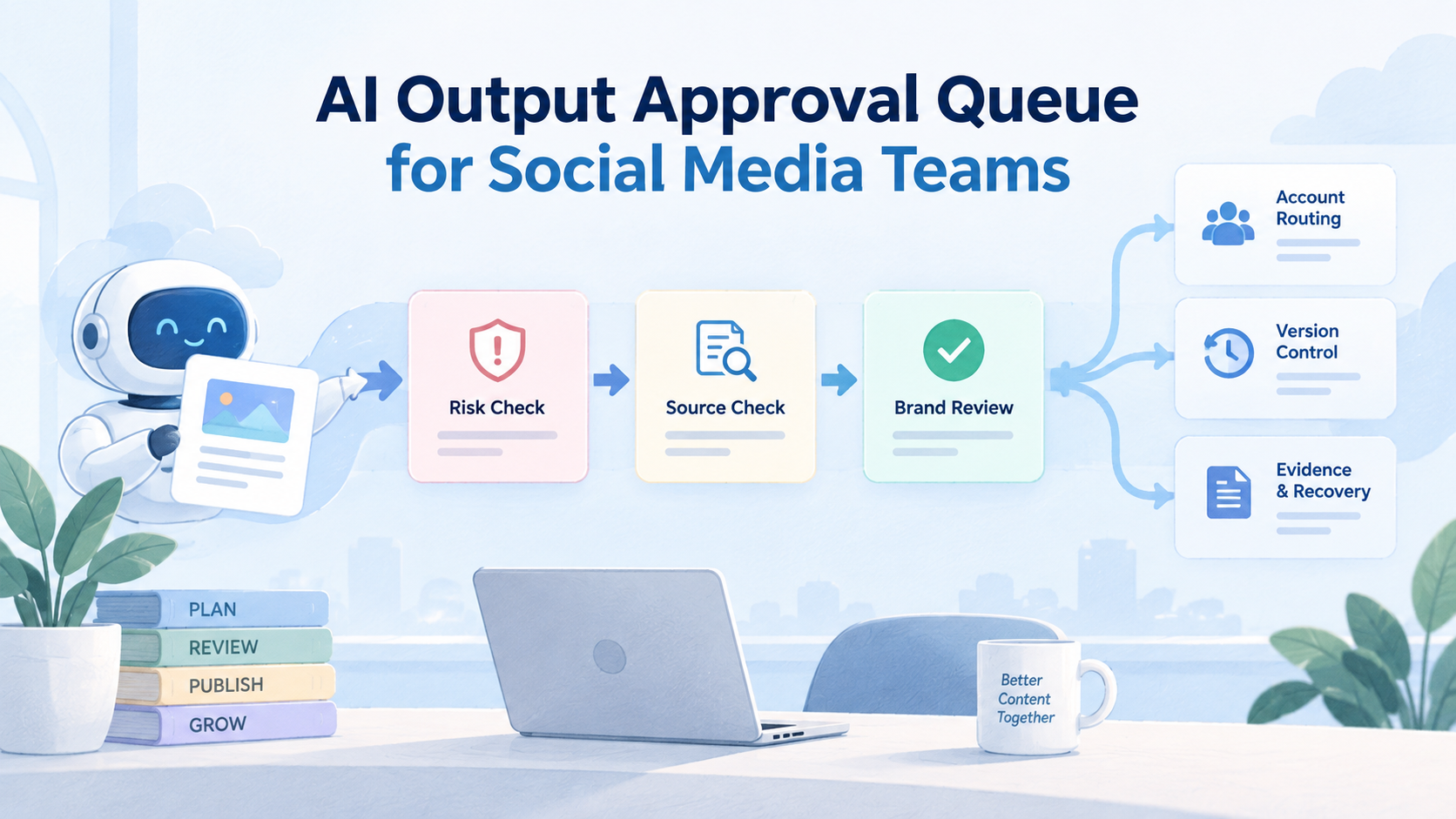
- Inbox triage: classify incoming messages before a human approves replies.
- Content operations: prepare social drafts, captions, campaign notes, and asset checks.
- Customer follow-up: create reminders, summarize account context, and flag exceptions.
- Monitoring: review dashboards, competitor signals, campaign changes, or customer mentions.
Social and customer workflows can connect naturally to Moimobi's social media marketing use case when the team needs account-specific publishing, replies, or monitoring across platforms.
How to Get Started with AI Employee Platform for B2B teams
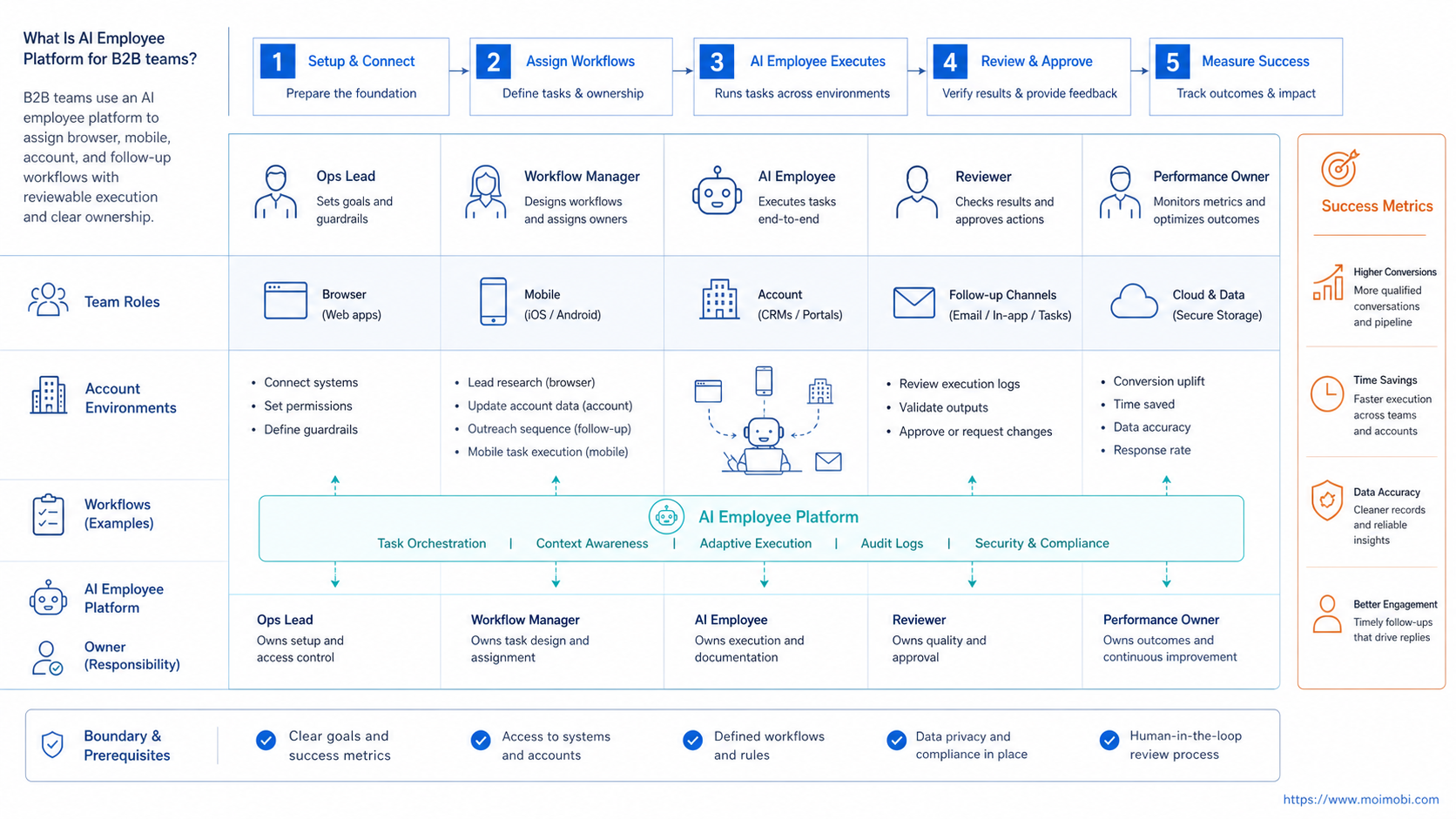
Begin with a pilot that can be reviewed in one weekly meeting. The objective is not to automate a department. A better first target is proving that one task lane can be assigned, executed, logged, and improved.
- Pick one repeated workflow. Choose lead research, inbox triage, CRM cleanup, content preparation, or monitoring.
- Define the worker role. Give the worker a narrow job, allowed inputs, allowed outputs, and a clear stop rule.
- Assign the environment. Select the browser profile, account workspace, dashboard, or mobile environment required for the task.
- Set approval boundaries. Mark which outputs can be prepared automatically and which actions need human confirmation.
- Run in review mode. Let the AI worker complete preparation or low-risk execution while the team reviews results.
- Measure the pilot. Track completion rate, correction load, exception rate, review time, and handoff quality.
- Expand by evidence. Add a second lane only after the first one produces clear logs and lower manual effort.
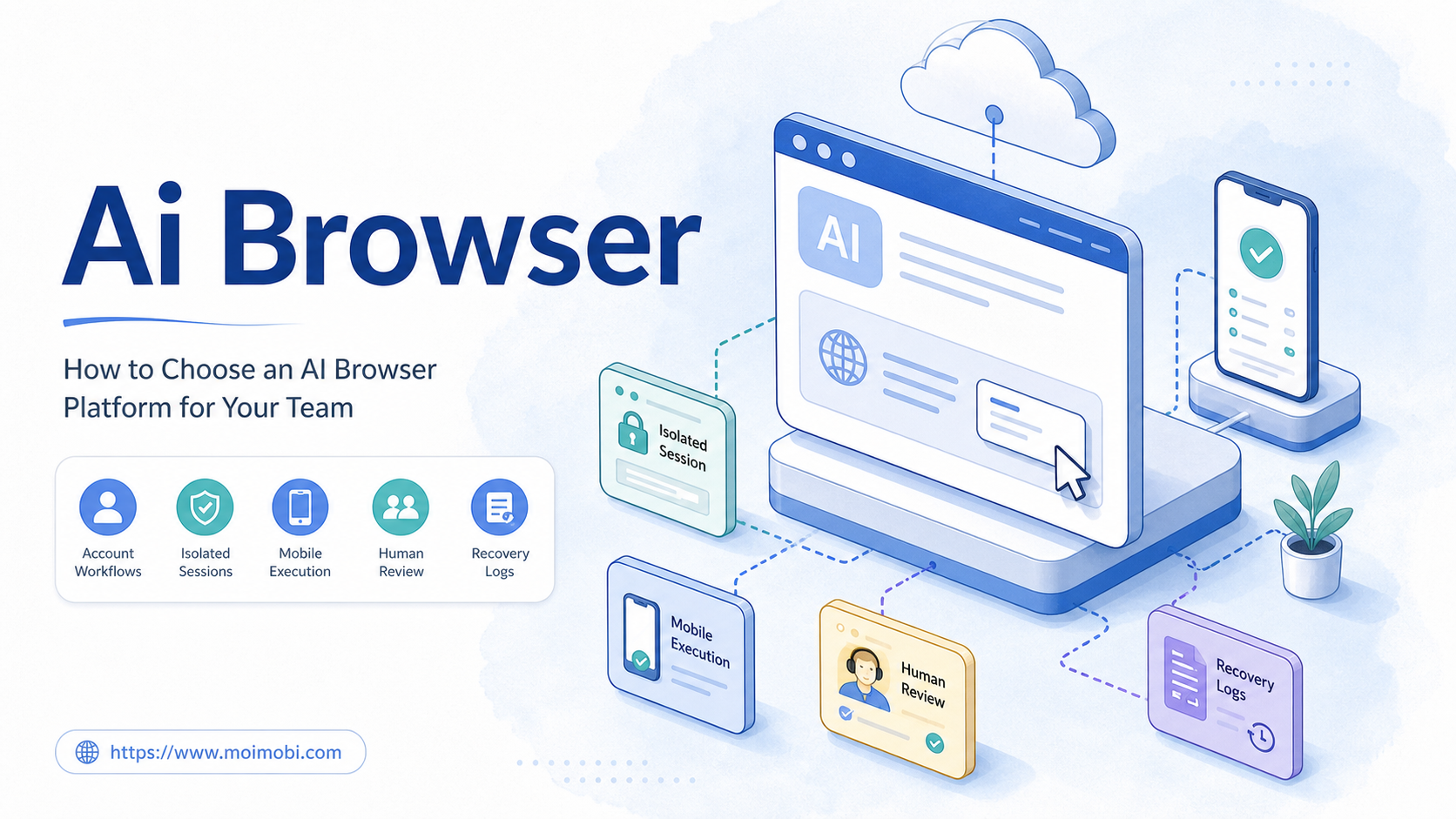
Browser-first teams can evaluate Moimobi as an AI browser execution platform when their work happens inside dashboards, CRMs, forms, and web apps. Mobile-heavy teams should also review Moimobi's mobile automation product area.
Account Environments and Operational Limits
The platform should not blur every account into one operating space. B2B teams may use different accounts for markets, brands, customer segments, sales territories, or support queues. Each lane needs a clear account boundary.
Device and mobile boundaries matter when workflows depend on app sessions. Android Enterprise documentation explains managed Android concepts for work environments, policy, and device administration. That does not mean every B2B workflow needs managed Android. It does show that mobile execution should be treated as an environment with policy and state, not as a casual screen.
Moimobi's device isolation product area fits teams that need cleaner separation across browser and mobile workspaces. The practical target is not a promise of perfect safety. It is to reduce mixed sessions, unclear ownership, and hard-to-audit account activity across repeated workflows.
Use a fit boundary:
- Fit: repeated tasks, clear inputs, known account environments, reviewable outputs.
- Not fit: unclear strategy, sensitive decisions without review, unapproved messaging, or tasks with no stop condition.
Success Metrics and Review Loop
A B2B team should judge an AI employee platform by operating evidence. More automation is not automatically better. Better execution means less manual rework and clearer handoff.
Track these metrics during the first month:
- Task completion rate: how many assigned tasks reach the defined finish state.
- Human correction load: how often a person must rewrite or redo the result.
- Exception rate: how often the worker stops because the task is unclear.
- Review time: how long the owner spends approving or rejecting outputs.
- Environment accuracy: whether the right account, workspace, or device lane was used.
- Next-action clarity: whether the log makes the next step obvious.
Run a weekly review with a small sample. Check five completed tasks, three exceptions, and one failed handoff. Then update the task protocol, account assignment, or approval rule, and note who owns the next change. This creates a practical feedback loop instead of a vague impression that AI is saving time.
Common Mistakes to Avoid
The first mistake is starting too broad. A B2B team should not ask one AI employee to manage sales, support, marketing, and operations at the same time. That creates unclear accountability and weak review.
Another mistake is treating generated text as completed work. A reply draft is useful, but the workflow may still require account context, CRM updates, customer history, and approval. Execution quality depends on the full lane, not only the written output.
Some teams also skip account boundaries. If one shared browser session handles many customers or channels, review becomes harder. Separate environments are not a substitute for policy, but they make ownership easier to inspect.
The final mistake is scaling before measuring. If the first pilot creates high correction load, expanding it will multiply the problem. Fix the role, inputs, and stop rules before assigning more accounts or workflows.
Frequently Asked Questions
What is an AI employee platform for B2B teams?
It is a platform that assigns repeatable B2B tasks to AI workers with roles, account environments, logs, and human review. It should support execution, not only text generation.
How is it different from AI employee software?
The terms overlap. A platform usually suggests a broader system for task assignment, execution environments, workflow records, and review loops. Software may describe a narrower assistant.
What should a B2B team automate first?
Begin with a low-risk task that repeats often. Lead research, CRM cleanup, inbox triage, campaign checks, and monitoring are good candidates because humans can review outputs before customer impact.
Does every B2B workflow need a cloud phone?
No. Browser workflows may be enough for CRM, dashboards, and web apps. A cloud phone becomes relevant when the workflow depends on mobile apps, Android sessions, or mobile-first account environments.
Can AI workers send customer replies automatically?
They can prepare replies, classify messages, and route exceptions. Sensitive replies, pricing, complaints, refunds, and legal topics should keep human approval.
How many AI workers should a team start with?
Use one worker and one workflow lane at first. Add more workers after the first workflow shows lower review load, clear logs, and repeatable completion.
What metrics prove the pilot is working?
Completion rate, review time, correction load, exception rate, and handoff clarity are stronger signals than task volume alone. The goal is less operational drag, not just more activity.
How does Moimobi fit B2B operations?
Moimobi connects AI-assisted workflows with browser and mobile execution environments. It is useful when B2B teams need account separation, task records, mobile execution, and reviewable multi-account operations.
Conclusion
This AI employee platform decision should be evaluated as execution infrastructure, not as a broad promise to replace operators. The strongest first use case is a narrow, repeated workflow with clear inputs, a defined environment, a review rule, and measurable output.
The next step is simple: choose one workflow that wastes time every week. Define the worker role, account environment, approval boundary, success metric, and escalation owner. If the pilot reduces review load and produces clear logs, the team has a reliable base for broader AI worker operations later.