Key Takeaways
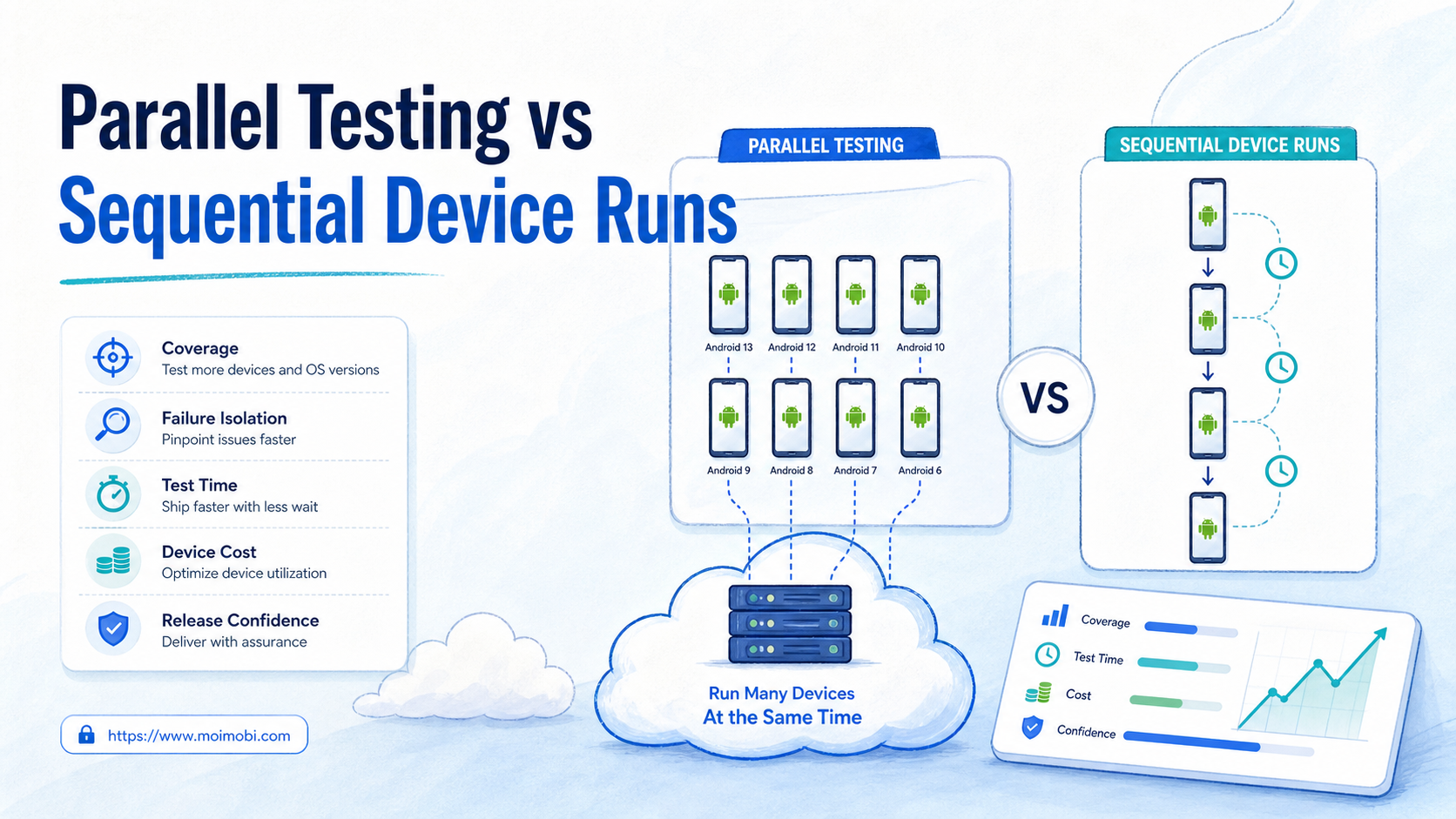
- Parallel app testing runs selected checks on more than one device at once. Sequential runs use one device path at a time.
- Parallel runs shorten feedback time when the test matrix is well chosen. Sequential runs simplify diagnosis when a workflow is new or unstable.
- The right choice depends on release risk, device coverage, test independence, budget, and the team's ability to interpret failures.
Parallel app testing is a way to run the same Android checks across several selected devices or configurations at the same time. Sequential device runs execute one configuration after another. Neither is universally better. Teams should use parallelism for validated, independent checks and use sequential runs when they need tight control over state, debugging, or a fragile flow.
The decision starts with the test question. If a team needs to learn whether a release works across Android versions, device profiles, locales, or screen sizes, a test matrix provides faster evidence than one long device queue. Firebase Test Lab describes this model as selecting devices, OS versions, locales, and orientations in a matrix, then reviewing the results after execution. Firebase Test Lab documentation provides a useful reference for this testing pattern.
Speed alone is not enough. Parallel capacity can create a large set of failures that are hard to classify. A sequential run can be slower, but it gives the team a cleaner path to reproduce a timing issue, inspect a task handoff, and capture the last confirmed state. Choose the smallest testing model that can answer the release decision with confidence.
What to Compare Before Choosing Parallel App Testing
Begin with the release risk rather than the number of available devices. A simple UI regression check may be independent across every target device. A login flow that depends on a shared staging record, a rate-limited API, or a one-time code may need controlled sequencing. Running it in parallel without isolation can produce failures that are test-data conflicts, not product defects.
| Decision area | Parallel runs | Sequential runs | What to validate |
|---|---|---|---|
| Feedback time | Several independent checks finish in the same window | Each result waits for the prior run | Whether faster feedback affects a release decision |
| Failure diagnosis | Needs clean logs and per-device evidence | One active path is easier to replay | Whether the team can separate product and environment failures |
| Device coverage | Works well for a defined test matrix | Limits coverage when the queue is long | Which models, OS versions, and locales actually matter |
| Test data | Requires separate records or safe reset rules | Can reuse controlled state more easily | Whether tests alter shared accounts or data |
| Cost and capacity | Uses more concurrent device time | Uses less concurrency but more elapsed time | Peak release windows and budget constraints |
Android's official emulator documentation explains that an Android Virtual Device can represent many device configurations without requiring a physical device for every early check. Android Emulator documentation is useful for rapid local validation. It does not remove the need to select meaningful configurations or to test on physical devices where hardware behavior, carrier conditions, or device-specific issues matter.
Start with a compact matrix. Include the Android versions, screen categories, locales, and device classes that represent current users or known risk areas. Do not increase device count simply because more capacity exists. Each row in the matrix should map to a release question, such as a camera path, payment handoff, notification permission, or layout breakpoint.
Key Differences Between Parallel Testing and Sequential Device Runs
Parallel execution changes the team's observability requirement. A single red result is not enough. Each run needs a device identifier, build version, test case, start and end time, screenshots or traces where appropriate, and an error category. Without that evidence, a team spends the time it saved in execution trying to reconstruct what happened.
Sequential execution changes the queue requirement. Teams need a clear priority order and stop rule. A critical failure should pause later release checks when it invalidates their result. For example, do not keep running downstream purchase tests after the basic authentication service is unavailable. Sequential work is valuable when one failure changes the meaning of later tests.
The testing layer should also be separate from account operations. A cloud device used for authorized mobile workflow execution is not automatically a test lab. A cloud phone may give a team an assigned Android workspace for a mobile task, while a formal test matrix answers whether a build behaves across selected device configurations. Keep test objectives, test data, and account permissions distinct.
Firebase Test Lab documents that test matrices report individual execution outcomes and that an incompatible device and API-level combination can be skipped. Firebase's result analysis guide illustrates why the release review must distinguish pass, fail, inconclusive, and incompatible results. Treating all non-passes as the same defect produces poor prioritization.
Parallel App Testing Workflow and Trade-Offs
Parallelism works best after the team has made the test cases independent. Use unique test users, resettable data, stable fixtures, and per-run output folders. Each test should be able to fail without changing the state required by another device run.
- Define the release question. State what each device dimension is intended to prove.
- Build a small matrix. Select representative devices, API levels, locales, and orientations.
- Isolate data. Give every parallel test a unique user, fixture, or cleanup path.
- Set evidence requirements. Capture build ID, device ID, test result, logs, and a reproducible failure path.
- Run the pilot batch. Start with a limited matrix and inspect whether results are actionable.
- Classify before retrying. Separate application defects, test defects, environment issues, and inconclusive runs.
Do not parallelize a workflow merely because it is slow. First identify why it is slow. The bottleneck may be test setup, network dependency, manual review, or a shared third-party service. More concurrent devices can amplify that bottleneck and make the output noisier.
Sequential runs are a strong choice for exploratory testing, newly automated flows, stateful integrations, and regression reproduction. They are also useful after a parallel batch finds an issue. Re-run the failing configuration in a controlled sequence, collect more evidence, and confirm whether the failure repeats before changing the product or test.
Pricing and Operational Considerations
The real cost is not only device minutes. It includes test maintenance, test data, storage for evidence, team review time, and the delay caused by unclear failures. A parallel matrix can lower calendar time but increase review work if every failure lacks a clear category. A sequential queue may cost less capacity but slow a release if it includes checks that could safely run together.
Use four cost questions:
- How many device configurations are required for a meaningful release decision?
- Which tests are independent enough to run concurrently?
- What evidence must be retained for a failed or inconclusive result?
- Who owns the decision to retry, stop, or escalate a test failure?
Firebase notes that test execution time depends on the selected matrix and that the results page provides execution-level status. Firebase Test Lab test matrices are a useful model for tracking the workload rather than judging a release by one overall label. For recurring mobile operations, a mobile automation workflow can add task assignment and result logging, but it should not replace proper test isolation.
Which Option Fits Different Teams
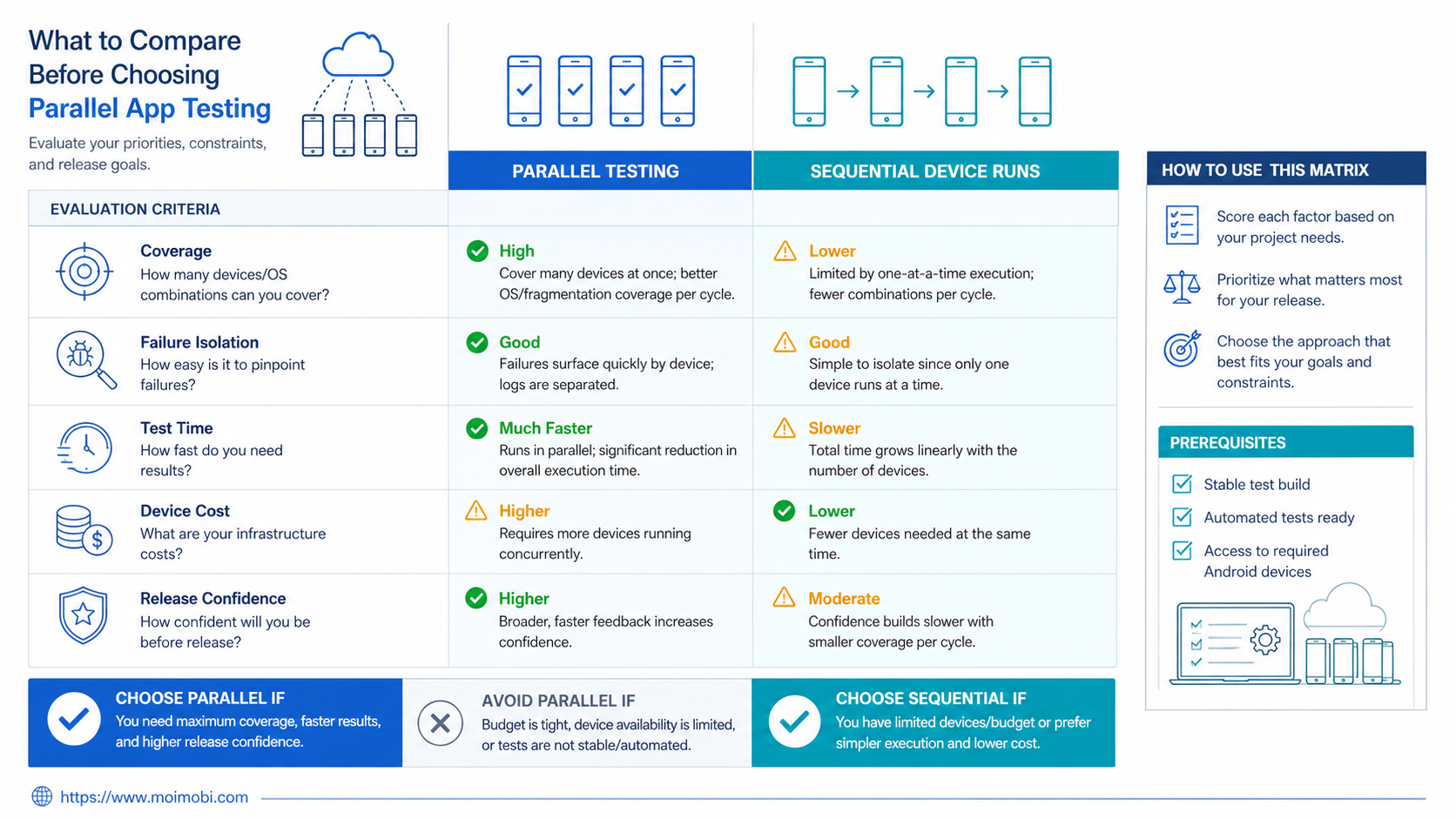
Best fit: parallel device testing
Use it for established, independent regression checks across a defined Android matrix when the team has clean fixtures and per-run evidence.
Best fit: sequential device runs
Use them for exploratory checks, shared-state flows, new automation, difficult reproduction, and tests where one failure should stop later work.
Best fit: blended release process
Run quick sequential smoke tests first, then parallelize the stable regression set. Reproduce failures sequentially before making a release call.
Not a strong fit
Do not run a wide matrix when the team lacks independent test data, result ownership, or time to inspect individual failures.
The blended model is often practical. A team can run a small sequential smoke check to catch release-blocking problems. After that passes, it can run independent layout, compatibility, and regression checks in parallel. The failure review then returns to a sequential path for diagnosis.
Pilot Rollout and Recovery Checks
Run a pilot around one release train. Pick five to ten representative configurations rather than every possible device. Define the expected runtime, the evidence fields, the owner for each result category, and the rule that blocks a release.
Measure total feedback time, percentage of failures that reproduce, time to classify an inconclusive result, test-data conflicts, and the number of release decisions made with complete evidence. These measures show whether parallelism is producing faster clarity or only faster noise.
When a device run fails, do not immediately rerun the entire matrix. Preserve the build identifier, configuration, logs, screenshots, and last confirmed step. First run the affected case sequentially. If it reproduces, classify it as an application or test issue. If it does not, check the environment and mark the original result as inconclusive until evidence supports a stronger conclusion.
Add a review deadline to every inconclusive result. A test that stays inconclusive for several releases can hide a meaningful gap in coverage. The assigned owner should either reproduce it, replace the unstable test, remove an invalid configuration, or document why the result does not affect the release decision. This keeps the matrix useful as it grows.
Review these decisions in the release retrospective. The matrix should evolve with actual failures, user impact, and real release risk, not with arbitrary device-count targets.
Frequently Asked Questions
What is parallel app testing?
It runs independent app checks on several device configurations at the same time. Teams use it to reduce feedback time for a selected test matrix.
Is parallel testing always faster?
It reduces elapsed time for independent work. It can increase total review time when tests share data, logs are incomplete, or failures cannot be classified.
When should tests run sequentially?
Use sequential runs for new automation, exploratory testing, shared-state workflows, critical smoke checks, and reproducing a difficult failure.
Do Android virtual devices replace physical-device testing?
No. Android virtual devices help cover many configurations efficiently. Physical devices remain useful for checks that depend on real hardware, vendor behavior, or network conditions.
How large should a first test matrix be?
Keep it small and representative. Every selected device or configuration should answer a known release question.
What evidence should each run keep?
Keep the build, device configuration, test case, timestamps, result category, logs, screenshots or traces, and the next owner.
What should happen after an inconclusive result?
Reproduce the affected case in a controlled sequence. Do not classify it as a product defect until the team can separate application behavior from the test environment.
Conclusion
Parallel testing and sequential device runs solve different parts of release confidence. Parallel app testing is valuable for stable, independent checks across a purposeful matrix. Sequential runs are valuable for control, investigation, and stateful workflows.
Start with a small smoke check, a defined matrix, independent data, and an evidence rule for every failure. Expand parallel capacity only after the team can classify results quickly and recover a failing run without guessing.