Key Takeaways
- Device fleet operations ROI comes from task output, uptime, repeatability, and recovery speed.
- More devices do not create profit unless the workflow can assign, track, and review work.
- A small pilot should measure utilization, failed tasks, manual rescue, and account-level output.
Device fleet operations ROI means the return a team gets from running many mobile devices, cloud phones, or Android environments as an operating system. Profit is not driven by device count alone. It comes from useful completed work per device, per account, and per operator hour.
A team buying 100 phones without workflow control may only create more overhead. A smaller cloud phone fleet with clear task assignment, device isolation, and recovery rules can be easier to measure.
What Is Device Fleet Operations ROI?
Fleet ROI is the relationship between device cost and business output. The output may be content published, customer replies handled, app checks completed, leads reviewed, or marketplace tasks finished.
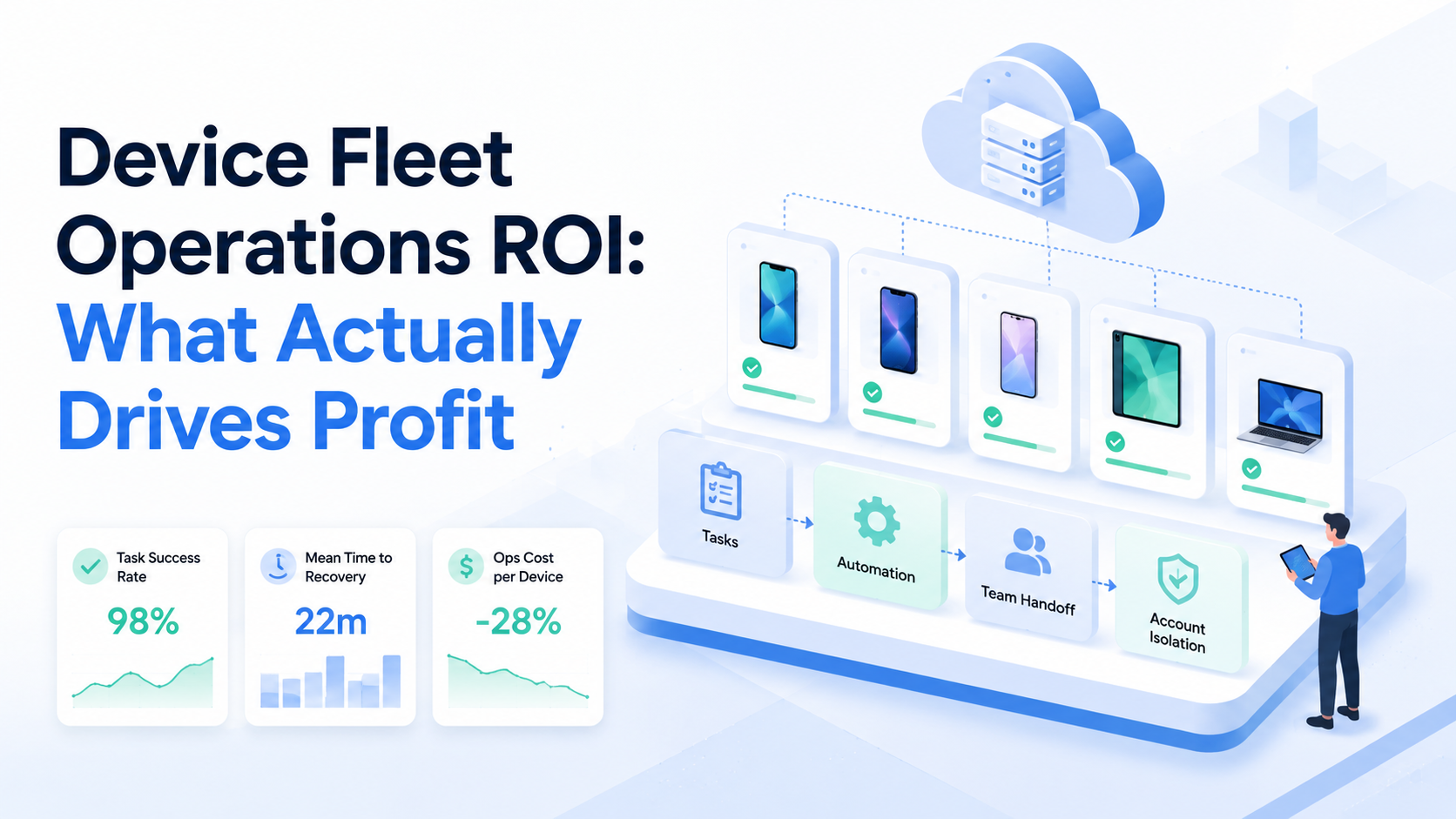
Use three numbers first: active use, task success, and recovery time. Active use shows real work. Task success shows clean output. Recovery time shows how fast the team can fix a failed device or task.
The metric becomes useful when it changes a decision. If 20 managed devices do the same useful work as 50 unmanaged devices, the smaller system can be easier to run and review.
Why Device Fleet Operations ROI Matters
Fleet ROI matters because mobile work scales differently from software seats. Each extra cloud phone adds capacity, checks, account context, logs, routing, and support work.
A phone farm business can look profitable on a spreadsheet and fail in daily operations. Idle devices, lost account context, and rescue work are the usual warning signs; managers then struggle to see which workflow created value.
The better question is not "how many devices do we own?" It is "how many reliable task slots do we operate each day?"
Device Fleet Operations ROI Metrics to Track
Profit comes from repeatable work, not device ownership. A mobile farm becomes valuable when each environment has a clear job and a measurable result.
| Driver | What to measure | Why it affects ROI |
|---|---|---|
| Active use | Task hours per device | Idle devices create cost without output |
| Workflow completion | Finished tasks per assignment | Failed tasks hide labor costs |
| Account isolation | One account per clean environment | Mixed context increases review work |
| Operator handoff | Notes, screenshots, owner changes | Better handoff lowers rescue time |
| Recovery loop | Time from failure to restart | Faster recovery protects capacity |
Use mobile automation for repeatable workflows. Use device isolation when account state matters. For risk work, the NIST AI Risk Management Framework is a useful reference because it separates mapping, measuring, managing, and governing risk.
How to Start Measuring ROI
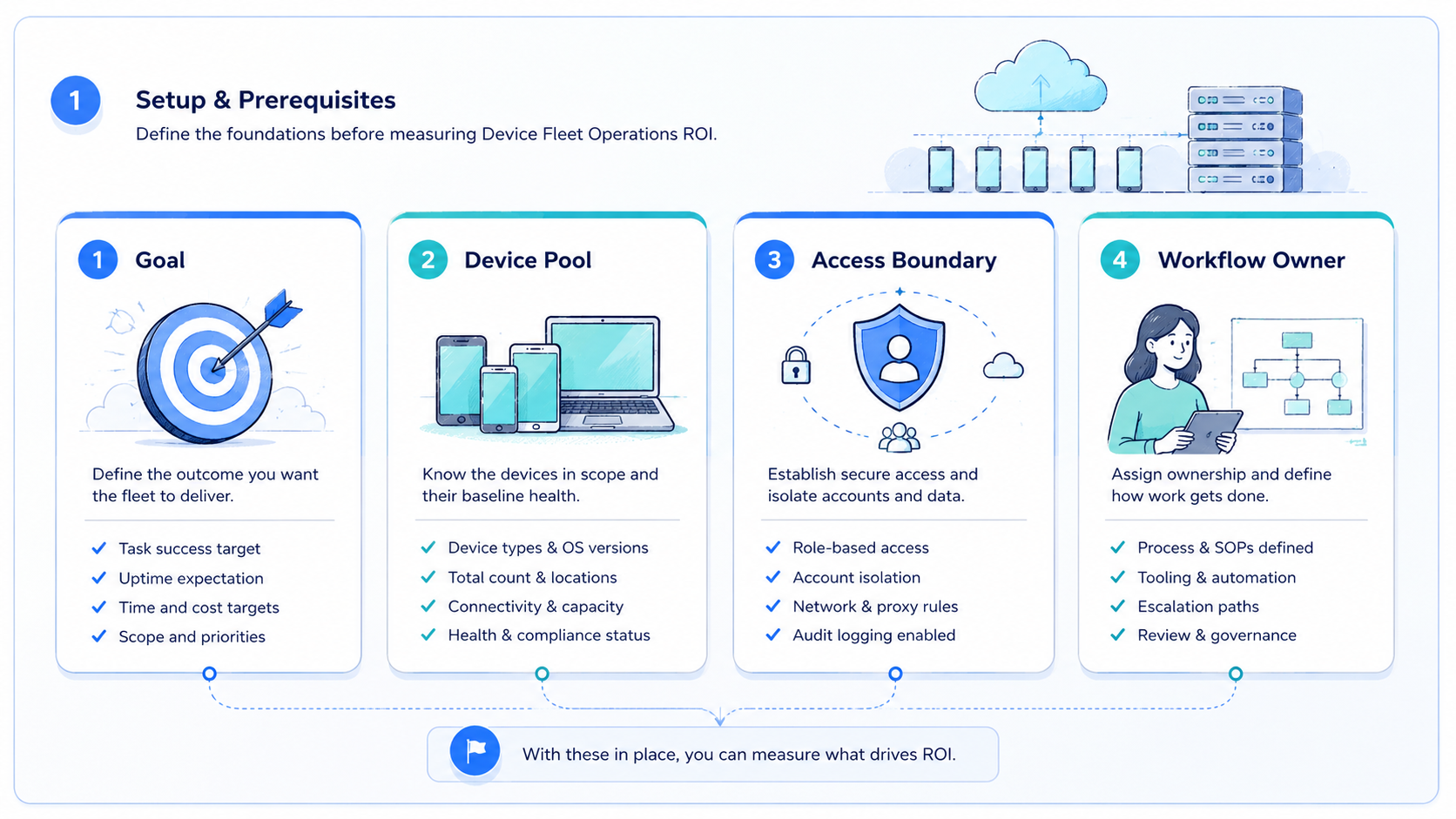
Do not begin with a full fleet model. Use one workflow and enough devices to see real behavior.
| Step | What to do | Pass signal |
|---|---|---|
| 1 | Pick one task | Everyone can name the same workflow |
| 2 | Assign 5 to 10 devices | The batch is small enough to inspect |
| 3 | Track every task | Each row has account, device, owner, result |
| 4 | Review daily | Idle time and failed work are separated |
| 5 | Decide after 7 days | Results repeat without hidden rescue |
For broader teams, multi-account management helps connect device work to account ownership. Teams that publish or message through third-party apps should also review platform rules, such as the Google Play policy center, before they automate app-heavy workflows.
Common Mistakes That Reduce Returns
Counting devices as capacity is the first mistake. A device is only capacity when it has a task, a prepared account, and a way to report results.
Recovery gets ignored until it burns time. One blocked login can consume more operator time than several good tasks, so track manual rescue like a real cost.
Mixed account environments create another hidden cost. A shared context may look efficient, but it can confuse operators and reviewers. Clean account workspaces are easier to audit.
Who This Fits
Fleet math matters most for teams running daily mobile work. Examples include cross-border sellers, social teams, app test teams, support teams, and agencies that manage client accounts.
It is a weaker fit for one-off app checks or occasional manual posting. Those teams may not need a fleet. They may need a few cloud phones, a clearer SOP, and a simple review process.
Use a phone farm model when the work is repeated, assigned, and measurable. Avoid it when the team cannot name the workflow that each device should run.
Pilot Rollout and Recovery Checks
A useful pilot should answer one question: does each device produce more value than it costs to operate? Keep the scorecard plain. Google Search Central's guidance on helpful content is written for search, but the same plain-language habit helps internal reports: show what was done, why it mattered, and what changed.
Track these fields for 7 days:
- device ID and account owner
- assigned workflow
- completed tasks
- failed tasks
- idle hours
- manual rescue minutes
- next action after failure
The recovery field is important. A fleet that fails clearly can improve. A fleet that fails silently only grows confusion.
Frequently Asked Questions
What is device fleet operations ROI?
It is the return from running managed mobile devices, cloud phones, or Android environments for repeatable work after staff time, device cost, and rescue work are counted.
What drives ROI most in daily fleet work?
Useful output per account.
Is a cloud phone farm cheaper than physical phones after staff time?
It depends on the workflow, device plan, staff time, and review process. Compare total operating cost before choosing, including failed tasks and review time.
How many devices should a pilot use before expanding?
Use 5 to 10 devices.
What should teams measure first?
Completed tasks come first. Then track idle time, failed tasks, rescue minutes, output per account, and whether a reviewer needed to reopen the work.
Can automation improve ROI if the workflow is still unclear?
Not reliably.
When should a team stop scaling the fleet?
Pause when failed tasks, unclear ownership, or manual rescue time grows faster than useful output, especially if the same account or device keeps failing.
Conclusion
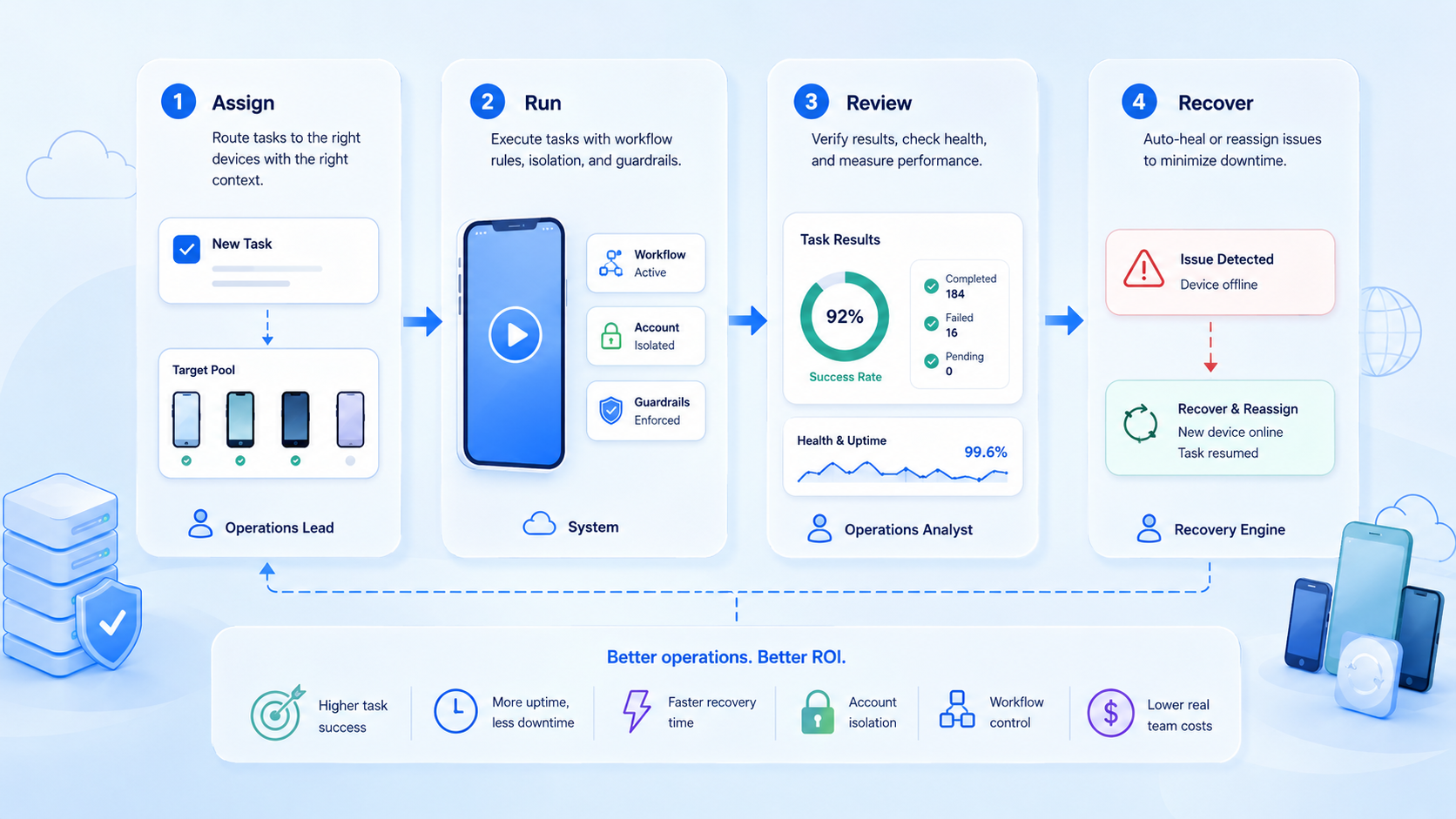
Device fleet operations ROI is not about owning the largest fleet. It is about turning devices into reliable task slots that a team can assign, inspect, and improve.
Run one workflow through a 7-day scorecard across 5 to 10 devices. Expand only when active use, task success, and recovery time are visible. Unclear numbers are a stop sign, not a reason to buy more devices.