Key Takeaways
- A cloud phone for Instagram gives teams a remote mobile environment for app-based account work.
- Secure operations depend on device lanes, account ownership, approval rules, and recovery logs.
- The strongest use cases are repeated mobile workflows across accounts, clients, or team members.
- Start with one pilot lane before adding more accounts or automation.
A cloud phone for Instagram is a remote Android phone environment used to run Instagram app workflows without relying on one local physical device.
For operations teams, remote app access is only the first layer. The harder question is whether the team can assign accounts, separate workspaces, review output, and recover when a mobile workflow reaches an unclear state.
Moimobi treats cloud phone capacity as execution infrastructure. Teams can connect cloud phones with mobile automation, account workspaces, browser planning, and review workflows. That makes it useful for Instagram teams handling inbox triage, comment checks, content workflow, creator operations, and client account management.
What Is Cloud Phone for Instagram?
Cloud phone for Instagram operations means using remote Android environments to run Instagram app-based workflows. Each account or account group can have its own mobile lane, owner, notes, and task history.
Start small.
This is different from simply opening Instagram on an available device. A team needs to know which account belongs to which phone, what task was run, who reviewed the result, and what happened when the workflow paused.
For example, a social media agency may assign 3 Instagram accounts from one client to a dedicated cloud phone lane. The morning teammate checks comments and DMs while the lead reviews sensitive replies and checks weekly task outcomes.
The phone provides the mobile environment, while the workflow keeps ownership clear.
That is enough.
Instagram's official Community Guidelines are a useful reminder for teams. Tools can support workflow control, but account behavior and content still need policy-aware human judgment.
Why Cloud Phone for Instagram Work Needs More Than Devices
More devices do not automatically create better operations. More devices can add capacity, but they also create confusion when teams do not map accounts, tasks, owners, and review paths.
That map is the control point.
Secure Instagram operations depend on traceability. A team should be able to answer five questions after any task: which account, which device lane, which operator, which action, and which review result.
Use this operating model:
| Control Area | What to Define |
|---|---|
| Account lane | Which Instagram account or client group belongs to each phone |
| Operator role | Who can research, draft, reply, review, or publish |
| Task boundary | Which actions are allowed without approval |
| Review path | Which actions pause for a human decision |
| Recovery record | What happens when prompts, errors, or unclear messages appear |
This model keeps mobile work from becoming private manual work. It also helps leads see whether the workflow is adding capacity.
Cloud Phone for Instagram Benefits and Use Cases
The strongest use cases are repeated app workflows. Instagram work includes app-only views, inbox states, story interactions, comments, and account-specific context that may not appear cleanly in browser tools.
Common use cases include these 7 repeatable workflows:
- Reviewing Instagram comments before replies go out
- Checking DMs and routing customer chats
- Preparing post work for review
- Watching peer profiles, post formats, and reply patterns
- Separating agency client accounts into clear phone lanes
- Giving AI workers or team members a controlled mobile workspace
- Recording mobile task results for weekly review
Moimobi is useful when these tasks connect to a larger team process. A creator team may prepare content in one tool, inspect account context on a cloud phone, then review output inside a task workflow.
An agency may combine Instagram work with social media marketing operations across other platforms.
The value is not blind automation. The value is cleaner execution capacity, visible handoff, and easier review.
How to Get Started with a Cloud Phone for Instagram
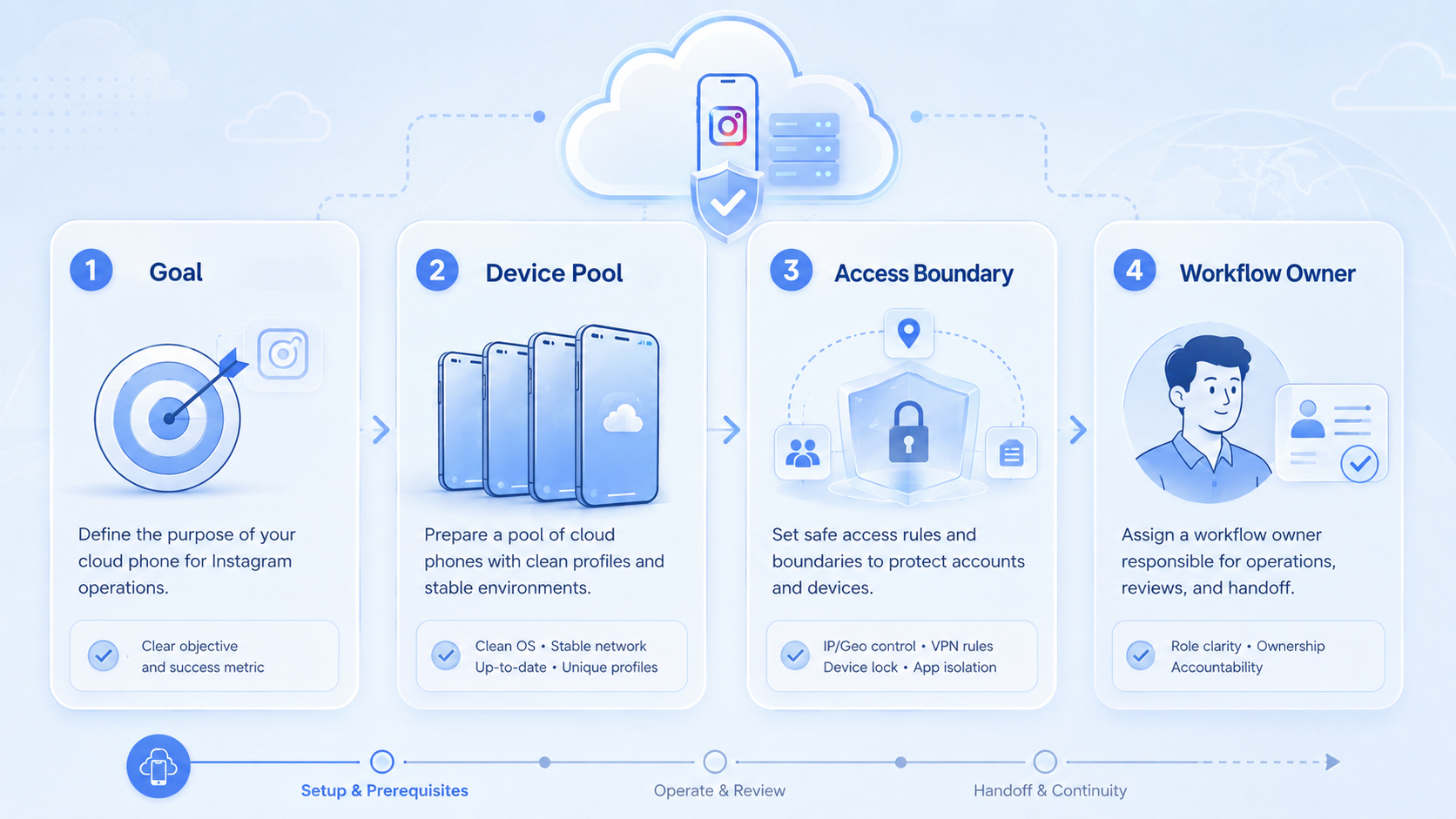
Begin with one workflow, not the whole Instagram operation. A narrow pilot helps the team find weak spots before more accounts enter the system.
Use these setup checkpoints:
| Checkpoint | Pass Condition |
|---|---|
| Account mapping | Each Instagram account has one clear phone lane |
| Role assignment | Operator, reviewer, and manager responsibilities are named |
| Task scope | The pilot covers one workflow, such as comment review or DM triage |
| Approval rule | Public or customer-facing actions pause for review |
| Exception log | Prompts, errors, unclear messages, and manual edits are recorded |
| Weekly review | The team reviews completion rate, edit rate, exceptions, and recovery time |
Do not start by adding extra devices. Device count helps only after the workflow is clear. Pause first. One well-run lane teaches more than a large setup with unclear ownership.
Google's SEO Starter Guide is about organizing content for people and search systems. The same principle applies to operations: clear structure helps teams understand what they are managing.
Cloud Phone for Instagram Daily Workflow Design
Daily workflow design should separate preparation from public action. This keeps routine checks, draft work, and customer-facing steps from blending together.
A practical Instagram lane may include 4 task types:
| Task Type | Typical Owner | Review Need |
|---|---|---|
| Account check | Operator or AI worker | Low, unless an alert appears |
| DM triage | Operator or support teammate | Medium, because customer context matters |
| Comment review | Operator, reviewer, or brand manager | Medium to high, depending on topic sensitivity |
| Publishing or reply action | Approved operator | High, because the action is public |
This split works well for social teams and agencies. One teammate can prepare the work. Keep roles clear. Another can review what will be posted or answered.
The cloud phone lane keeps the mobile context consistent, while the task log keeps handoff visible.
Good daily design also limits random lane switching. A device used for DM triage should not become a competitor research lane without a note. Later review depends on knowing what the device was used for.
Example Instagram Work Lane
An agency lane should be concrete enough that a new operator can read it and understand the next action. A vague note like "check Instagram" is not enough.
Use a lane record like this:
| Field | Example Value |
|---|---|
| Lane name | Client A - Instagram DM review |
| Account owner | 1 social teammate, morning shift |
| Device purpose | DM triage and comment review only |
| Allowed actions | Read messages, label conversations, prepare up to 5 reply drafts |
| Approval required | Replies, story reactions, public comments, profile edits |
| Stop condition | Login prompt, policy-sensitive message, angry customer, payment question |
| Review output | Draft reply list plus issue notes |
This kind of record makes the cloud phone lane easier to audit. It also prevents the common problem where one operator uses the same device for research, replies, publishing, and competitor checks without leaving a trail.
A practical morning workflow might look like this: open the assigned Instagram lane, check 10 unread DMs, label urgent customer questions, prepare 5 reply drafts, flag sensitive messages, then hand the task to a reviewer. The reviewer approves or edits replies before anything goes public.
The same pattern can support AI assistance. An AI worker may classify messages or summarize comment themes, but approval remains with a human reviewer for public-facing action.
Common Mistakes to Avoid
The first mistake is treating cloud phones as a shortcut around platform judgment. Instagram operations still need content quality, appropriate behavior, and account-level review. Teams should keep platform policy in the workflow.
The second mistake is mixing account context. When several accounts share unclear devices or notes, the team loses track of what happened. Review becomes slower, and recovery becomes harder.
Use a stop rule: if the operator cannot name the account owner, lane purpose, and next reviewer in less than a minute, pause the workflow and fix the record.
The third mistake is automating public actions too early. Drafting, classifying, and preparing work are easier to manage than posting or replying. Customer-facing steps need clearer approval rules.
The fourth mistake is ignoring recovery. Apps change and prompts appear. Login state can require attention, so the team should decide who handles each exception before the pilot starts.
Fit Boundaries for Instagram Teams
A cloud phone for Instagram is a strong fit for teams that operate more than one account or need mobile execution as part of a daily workflow. It is less useful for casual posting or one-off viewing.
- Agency account operations
- Instagram content review
- DM and comment triage
- Mobile-first research tasks
- Multi-account team handoff
- One personal account
- No defined SOP
- No review owner
- Pure caption ideation
- Untracked public automation
Moimobi is strongest when Instagram work is part of a wider operating system. That may include device isolation, account workspaces, cloud phones, and browser-based planning. The tool should make account work easier to inspect, not harder to audit.
Cloud Phone for Instagram Pilot Rollout for Teams
A pilot should prove that the workflow is manageable. It should not try to cover every possible Instagram use case at once.
Keep the first pilot narrow.
The aim is to learn where the handoff fails before the team adds more accounts, more people, or more device lanes.
Begin with one lane. Assign one account group, one task type, and one reviewer. Run the pilot for 7 days, then inspect the evidence.
Use sample limits during the first week:
| Pilot Field | Example Limit |
|---|---|
| Account group | 3 Instagram accounts |
| Daily DM review | 10 conversations |
| Daily comment review | 20 comments |
| Draft replies | 5 replies before reviewer approval |
| Recovery owner | 1 named teammate |
| Review meeting | 30 minutes at the end of the pilot |
Keep the first week plain. Check the same lane each day, use the same note format, and ask the same reviewer to approve the same kind of work. Ten DMs is enough for day one because it gives the team real work without hiding weak notes.
Stop early if the log is unclear, the owner is missing, or the next step is vague. A small lane is easier to fix than a large roll out with poor notes.
Track these fields:
- Account lane
- Team member name or role
- Task type
- Done or paused state
- Human edits
- Pause reason
- Recovery time
- Reviewer decision
- Next action owner
- Reason for manual review
The recovery check matters most. When a task pauses, the operator should know why it paused and what to do next. Unexplained exceptions are a stop signal.
Review the pilot with 3 questions: did the lane reduce manual switching, did reviewers understand the prepared work without asking for extra context, and did paused tasks have clear owners?
If the answer is no, fix the lane design before adding more accounts.
For AI-assisted workflows, NIST's AI Risk Management Framework is a useful reference for teams building oversight practices. It encourages measurement, monitoring, and risk controls instead of invisible automation.
Cloud Phone for Instagram Security and Handoff Rules
Security in this context means clean operational boundaries. No tool removes every platform or account risk.
Make the rules visible.
Define these 5 handoff rules before the team scales:
- Each Instagram account has a named lane and owner
- Each lane has a current task purpose
- Each public action has a reviewer or review rule
- Each exception has a recovery owner
- Each weekly review checks what changed in the account lane
These rules prevent common team failures. Team members know where to work, reviewers know what to inspect, and leads can see whether the workflow is adding capacity or creating hidden cleanup work.
For AI support, the same boundaries matter even more. AI can prepare drafts, classify messages, or summarize inbox patterns, but the team should decide which steps require human approval before the workflow runs.
Cloud Phone vs Emulator for Instagram Team Work
A cloud emulator can be enough for simple testing, but team operations need more than an Android runtime. They need account lanes, access control, notes, task logs, and repeatable review.
Use this practical distinction:
| Option | Better Fit |
|---|---|
| Local physical phone | Solo work, direct manual control, occasional tasks |
| Basic emulator | App testing or lightweight technical checks |
| Cloud phone platform | Remote team workflows, account lanes, handoff, review, and recovery |
The decision is not about naming alone. Evaluate the workflow. If the team needs repeated Instagram tasks with ownership and review, a cloud phone platform is easier to manage than scattered personal devices.
Frequently Asked Questions
What is a cloud phone for Instagram?
It is a remote Android phone environment for Instagram app workflows, account reviews, comment checks, inbox triage, and team handoff.
Is a cloud phone the same as an emulator?
No. A cloud phone platform adds remote access and team controls. A basic emulator is closer to a local runtime for testing.
Can teams use it for Instagram automation?
Teams can use it for structured workflows such as monitoring, draft preparation, inbox triage, and review queues. Public actions should include review and policy checks.
What should an Instagram team automate first?
Begin with monitoring, DM triage, comment review, draft preparation, and workflow review before testing any public action.
Does this remove the need for platform compliance?
No. Teams still need Instagram rules, internal content standards, and customer communication rules before work reaches public channels.
How should agencies organize accounts?
Map each client or account group to clear device lanes, owners, notes, review rules, and weekly recovery reports.
Where does Moimobi fit?
Moimobi fits teams that need Instagram cloud phones connected to mobile automation, account isolation, and operations review.
Conclusion
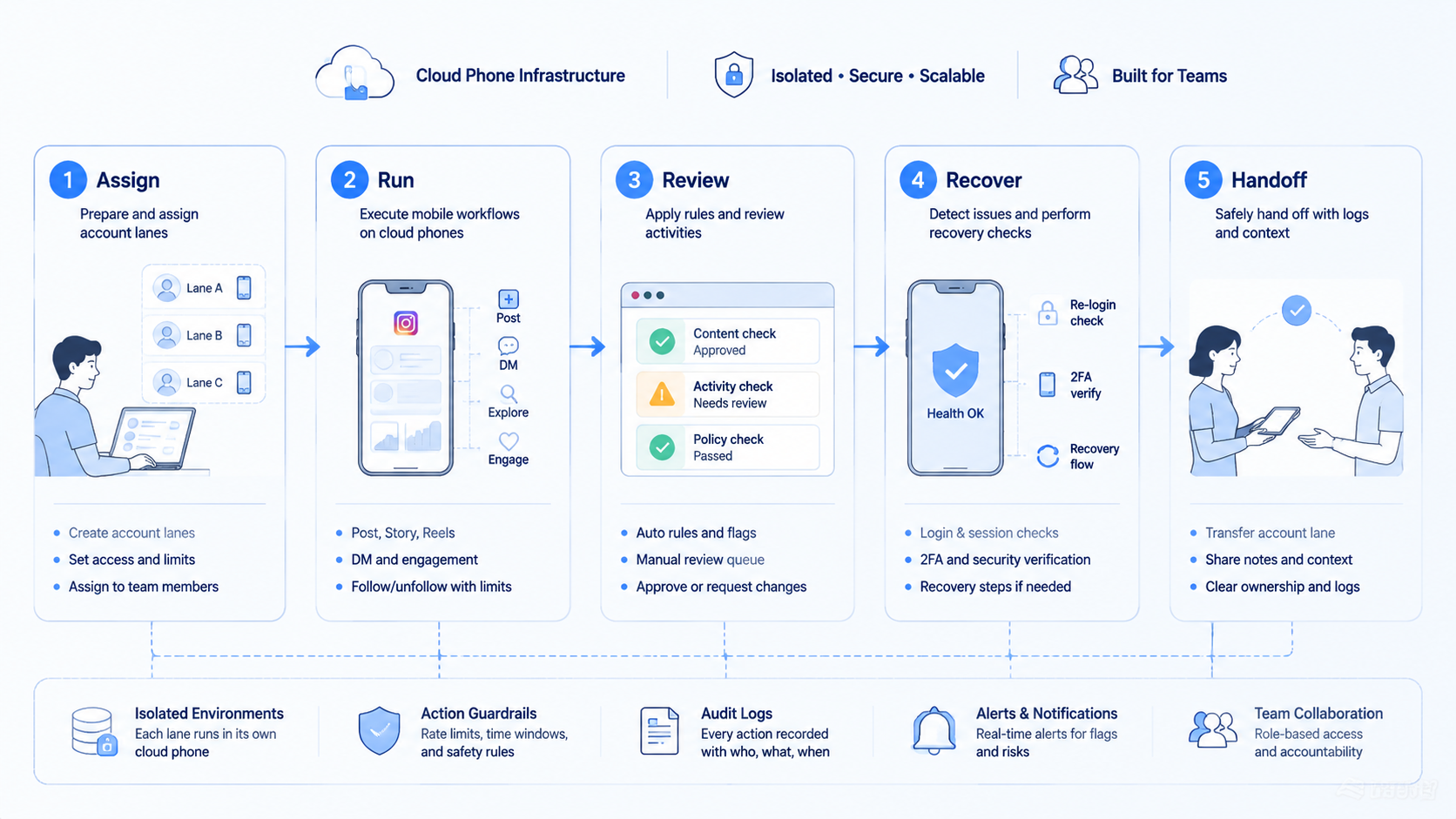
A cloud phone for Instagram is most useful when teams need controlled mobile execution, not just remote app access. The decision should focus on account lanes, review rules, recovery checks, and team handoff.
Start with one account group and one workflow. If the team can run the task, review the result, explain exceptions, and keep ownership clear, the setup is ready for a broader Instagram operations pilot.