Key Takeaways
- An AI employee platform gives cross-border teams controlled execution, not just content generation.
- The platform is most useful when workflows cross accounts, dashboards, and mobile surfaces.
- Isolation and routing matter because account mistakes can create costly manual cleanup.
- The first rollout should prove review discipline and recovery speed before higher volume.
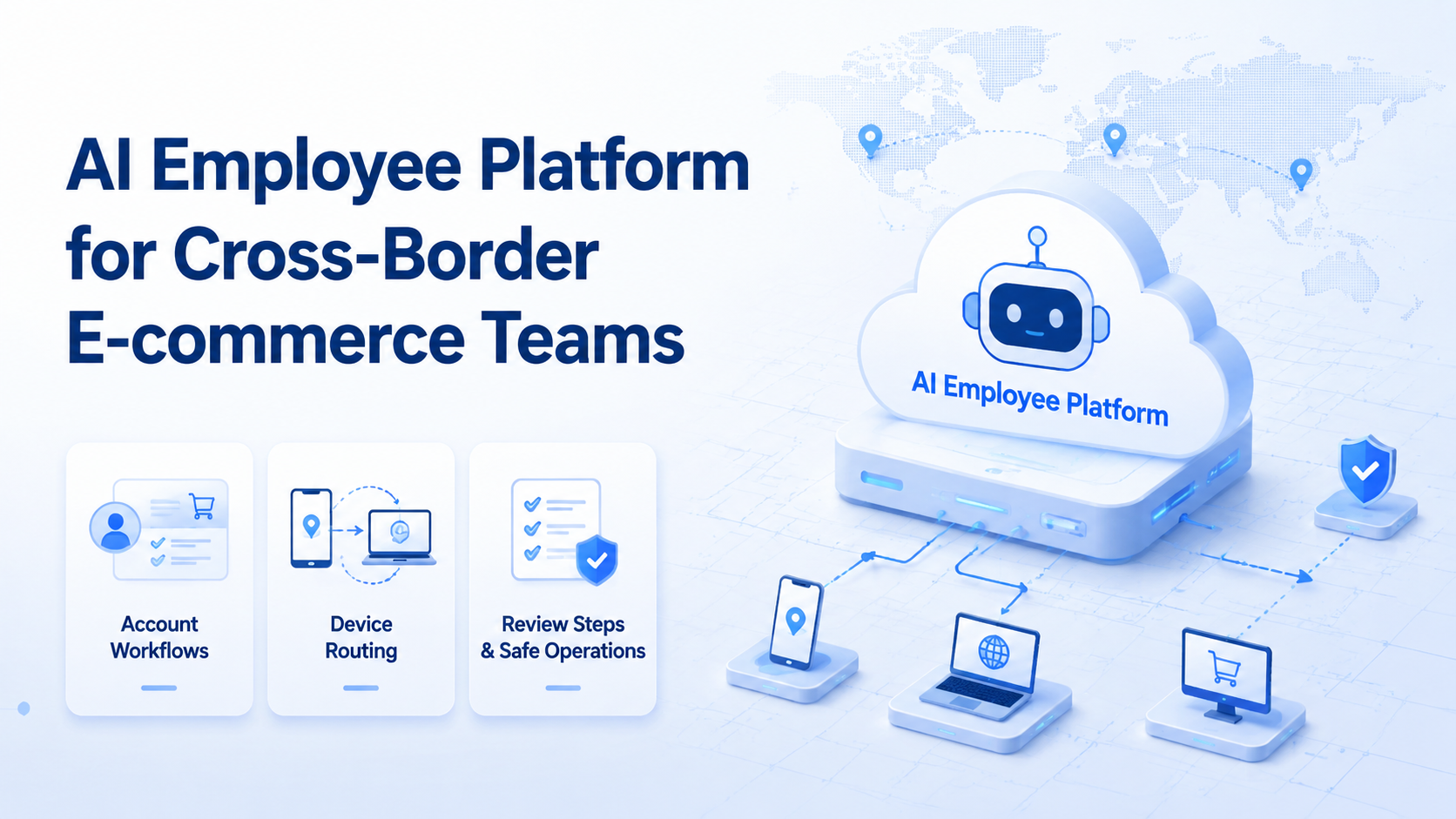
AI Employee Platform for Cross-Border E-commerce Teams is a system that helps teams run repeated e-commerce work through assigned environments, role-based workflows, and clear review rules. The platform is not only a writing assistant or chatbot layer. It is an execution model for listings, account checks, customer follow-up, and operational coordination.
Cross-border teams usually feel the need when the work spreads across several systems. Product updates may happen in web dashboards. Customer engagement may happen in browser inboxes or mobile apps. Account review, escalation, and retry paths add another layer of complexity.
Primary documentation supports the need for clear execution environments. W3C WebDriver defines browser automation through explicit sessions.1 Playwright uses isolated contexts to separate browser state.2 Android Enterprise describes managed workspaces for device control.3 Those sources support the same operating idea: repeated work becomes easier to govern when environments are separated.
What Is AI Employee Platform for Cross-Border E-commerce Teams?
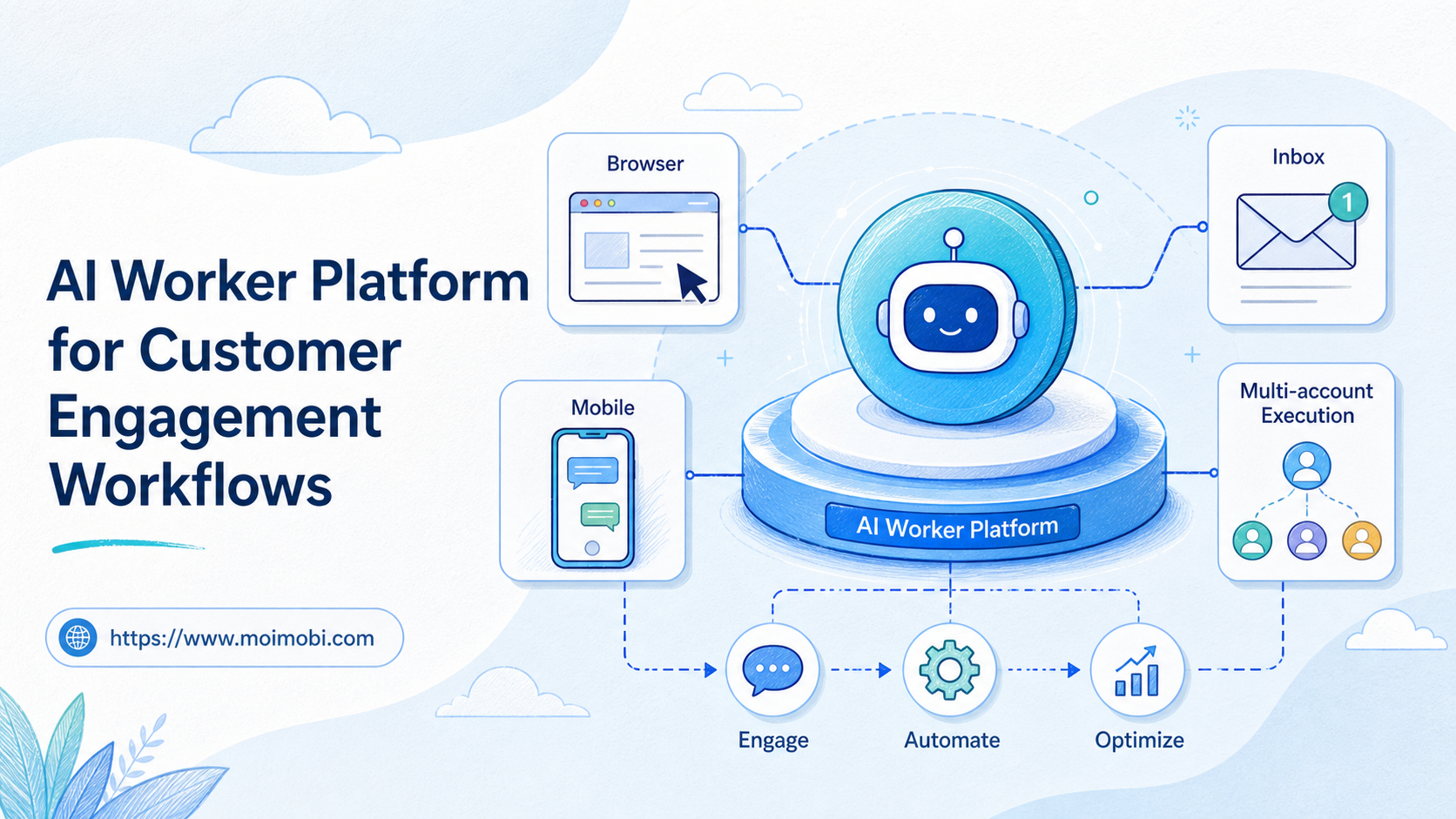
The label sounds broad, so it helps to be precise. In this context, an AI employee platform is an operating layer that assigns workflows, environments, and review checkpoints to repeatable tasks.
That may include product listing updates, catalog checks, dashboard monitoring, customer reply queues, or order follow-up. One worker may own browser-based catalog tasks. Another may support app-based or mobile-first steps. A reviewer may approve exceptions before the system continues.
The platform becomes useful when those pieces stay traceable. Without that structure, teams fall back to shared logins, ad hoc spreadsheets, and cleanup after failures.
Why AI Employee Platform for Cross-Border E-commerce Teams Matters
Cross-border teams usually operate with more operational variance than domestic single-channel teams. Different marketplaces, messaging channels, account rules, and runtime needs create more handoff points.
An AI employee platform matters because it reduces ambiguity in three places:
- who owns a task
- where the task runs
- how the task resumes after failure
That framework matters more than AI copy alone. If a team can generate content quickly but cannot route the work into the right account environment, the execution layer stays weak.
Key Benefits and Use Cases
The main value is not automation volume by itself. The main value is repeatable control.
Typical use cases include:
- listing updates across several accounts
- dashboard checks and status collection
- inbox and customer follow-up support
- catalog monitoring and exception review
| Use case | Why the platform helps | What to verify |
|---|---|---|
| Listing updates | Keeps account routing and ownership clear | Approval path |
| Dashboard checks | Reopens the same browser state for repeat runs | Resume quality |
| Customer follow-up | Separates queue handling from other account work | Escalation speed |
| Catalog monitoring | Logs exceptions instead of relying on memory | Correction cost |
Teams that already depend on device isolation, mobile automation, or proxy network usually see the fit sooner. They already know environment control matters.
Cross-border e-commerce teams also feel this need when one store workflow spills into another. Listing changes, account checks, and customer follow-up may all be valid tasks, but they should not share one vague lane. The platform helps by making role boundaries visible before the workload expands.
How to Get Started with AI Employee Platform for Cross-Border E-commerce Teams
Avoid a broad rollout at the start. Cross-border workflows have too many moving parts for that.
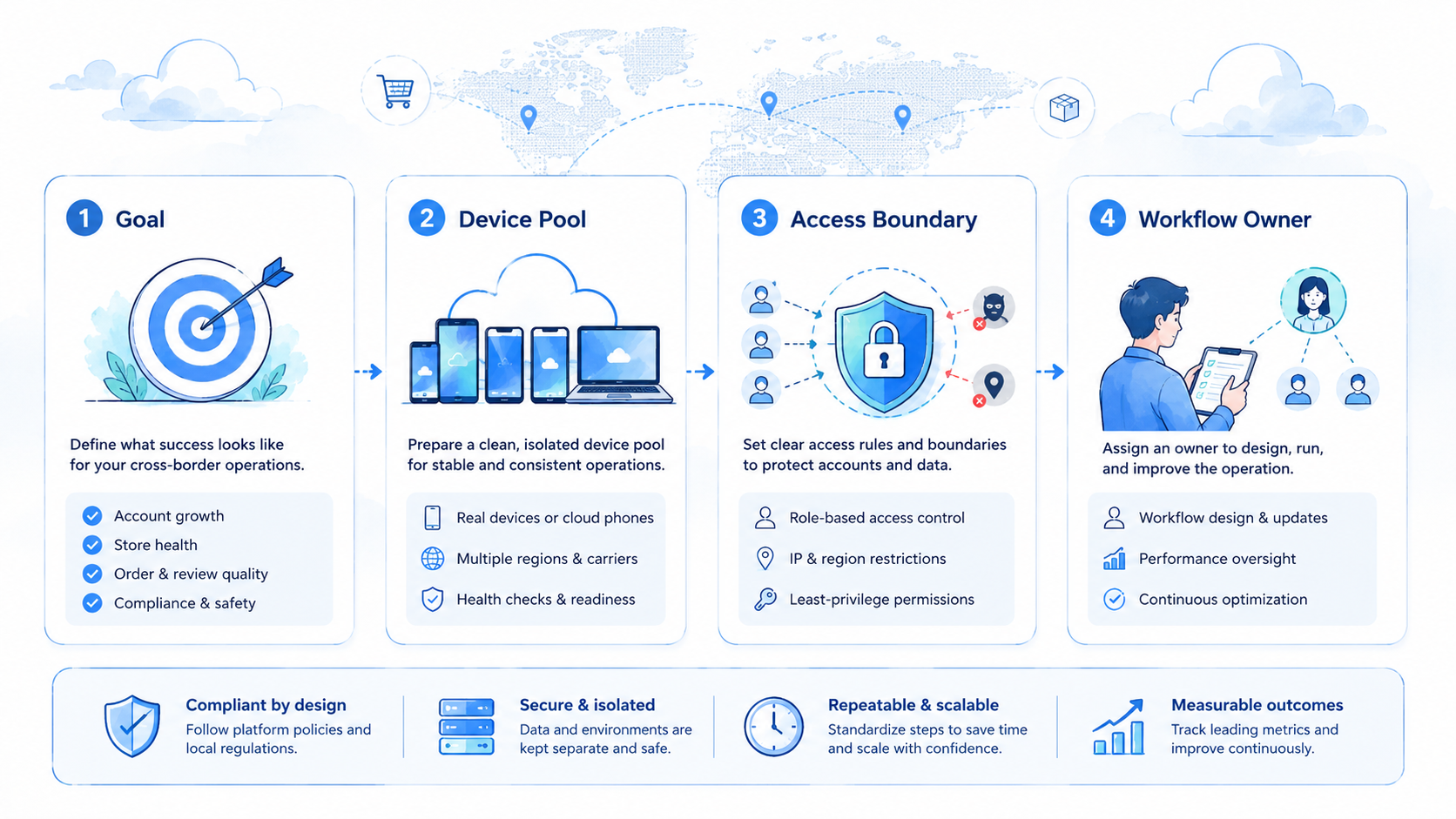
- Choose one repeated workflow. A small listing-update or customer-follow-up lane is enough.
- Define the account boundary. Keep each worker tied to one account set or one queue class.
- Choose the runtime. Use browser execution for dashboard work and mobile execution for app-native steps.
- Create a stop rule. Document where human approval interrupts the workflow.
- Create a recovery path. Decide how the team resumes after login expiry, app failure, or missing data.
If the workflow leans on mobile-first account work, compare your design against cloud phone and phone farm options before scaling. Runtime choice affects correction cost later.
Common Mistakes to Avoid
The first mistake is assigning one worker to too many unrelated jobs. That sounds efficient at first, but it weakens routing and review.
Another mistake is assuming the browser lane can cover every workflow. Some cross-border teams need browser dashboards and mobile app actions in the same operating model. If the runtime choice is vague, the team creates manual rescue work.
A third mistake is measuring success only by completed actions. A faster workflow can still be a poor design if every failure requires long cleanup.
Common warning signs are:
- several account types sharing one loose environment
- retries handled differently by different operators
- review rules living in chat instead of in the workflow
- no clear audit trail after exceptions
Who It Fits and When It Is a Strong Match
This model fits cross-border teams that repeat account work across several channels and need more control than a shared spreadsheet can offer. It is less useful for teams with low repetition and very little account separation.
Teams running repeated listing, monitoring, and customer workflows across several stores or regions.
Teams formalizing account routing, review steps, and device choice as volume grows.
Teams with low-volume manual work and almost no workflow reuse.
Pilot Rollout, Measurement, and Recovery Checks
The first pilot should prove that the platform lowers cleanup cost for one real workflow. A listing-update lane or customer-follow-up lane is usually enough.
Track four review points:
| Review area | What to inspect | Good sign |
|---|---|---|
| Routing | Did the task stay with the right account group? | Few manual corrections |
| Review | Did approvals happen at the planned step? | Predictable handoff |
| Recovery | Could the team reopen the same state after interruption? | Short resume time |
| Cleanup | How much rework followed each run? | Low correction cost |
Lean teams usually benefit most when they validate recovery before adding more workflows. A system that looks efficient on a clean run may still create hidden work after routine exceptions.
Frequently Asked Questions
Is this only for very large e-commerce teams?
No. Small cross-border teams can benefit when the workflow already repeats.
Does every workflow need mobile execution?
No. Mobile execution matters only when app-native steps are real and frequent.
What should a first rollout cover?
Start with one workflow that has clear pass, retry, and review outcomes.
Why is isolation important for e-commerce teams?
Because shared environments make diagnosis slower and ownership less clear.
Can one platform support listings and customer operations?
Yes, but only when the workflows stay separated by role and runtime.
What should a manager measure first?
Correction cost and recovery time are better starting metrics than volume.
When should the team expand the rollout?
Expand after the pilot proves stable routing and low cleanup overhead.
Conclusion
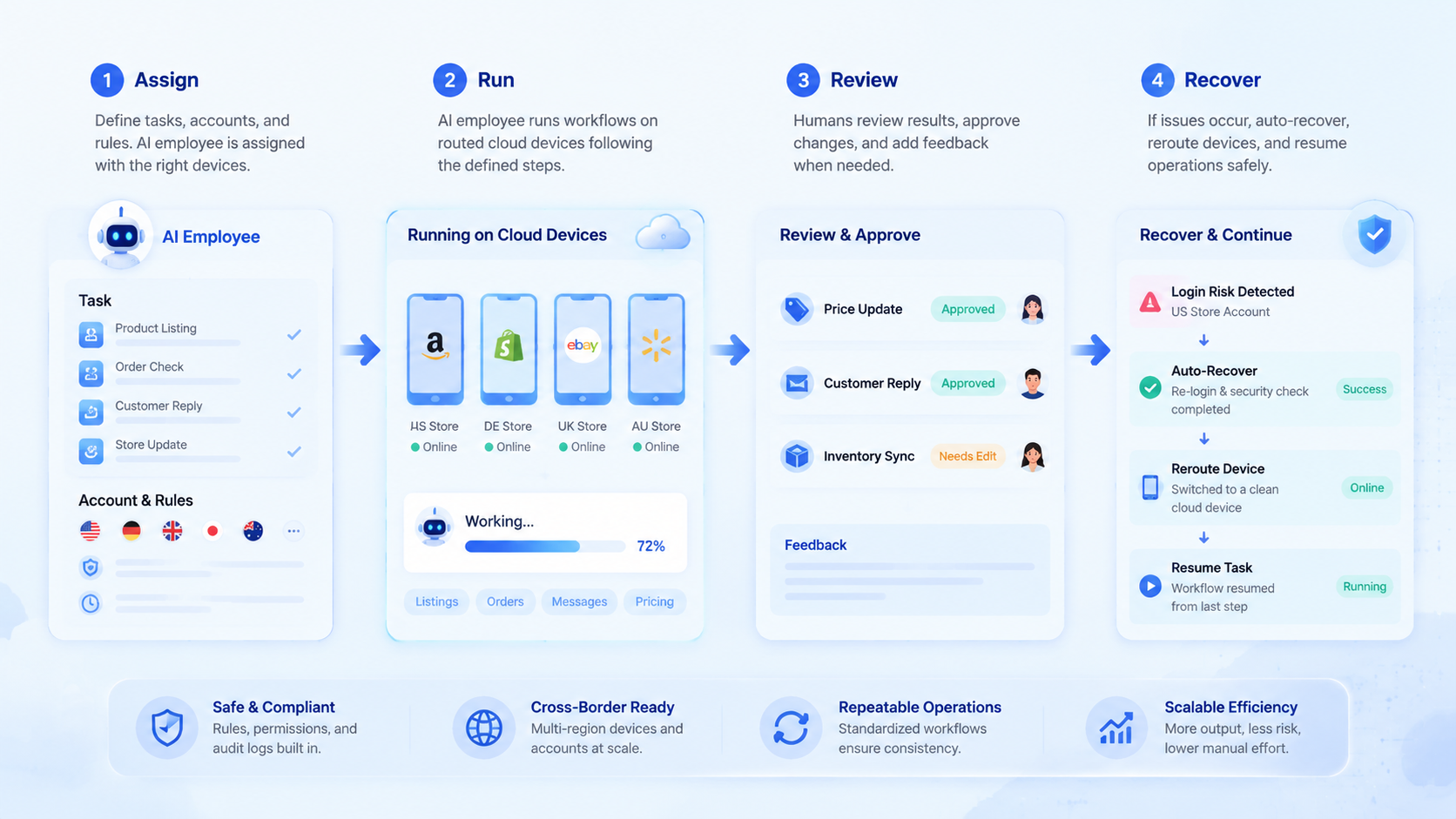
An AI employee platform helps cross-border e-commerce teams turn scattered account work into a repeatable operating model. The real gain comes from clearer ownership, cleaner environments, and faster recovery after failure.
Before scaling, check these priorities in order: account boundary, runtime choice, and review path. If one of those stays weak, expansion will create more noise than leverage.