Key Takeaways
- Video publishing automation is a workflow for staging, review, routing, and delivery, not only scheduled posting.
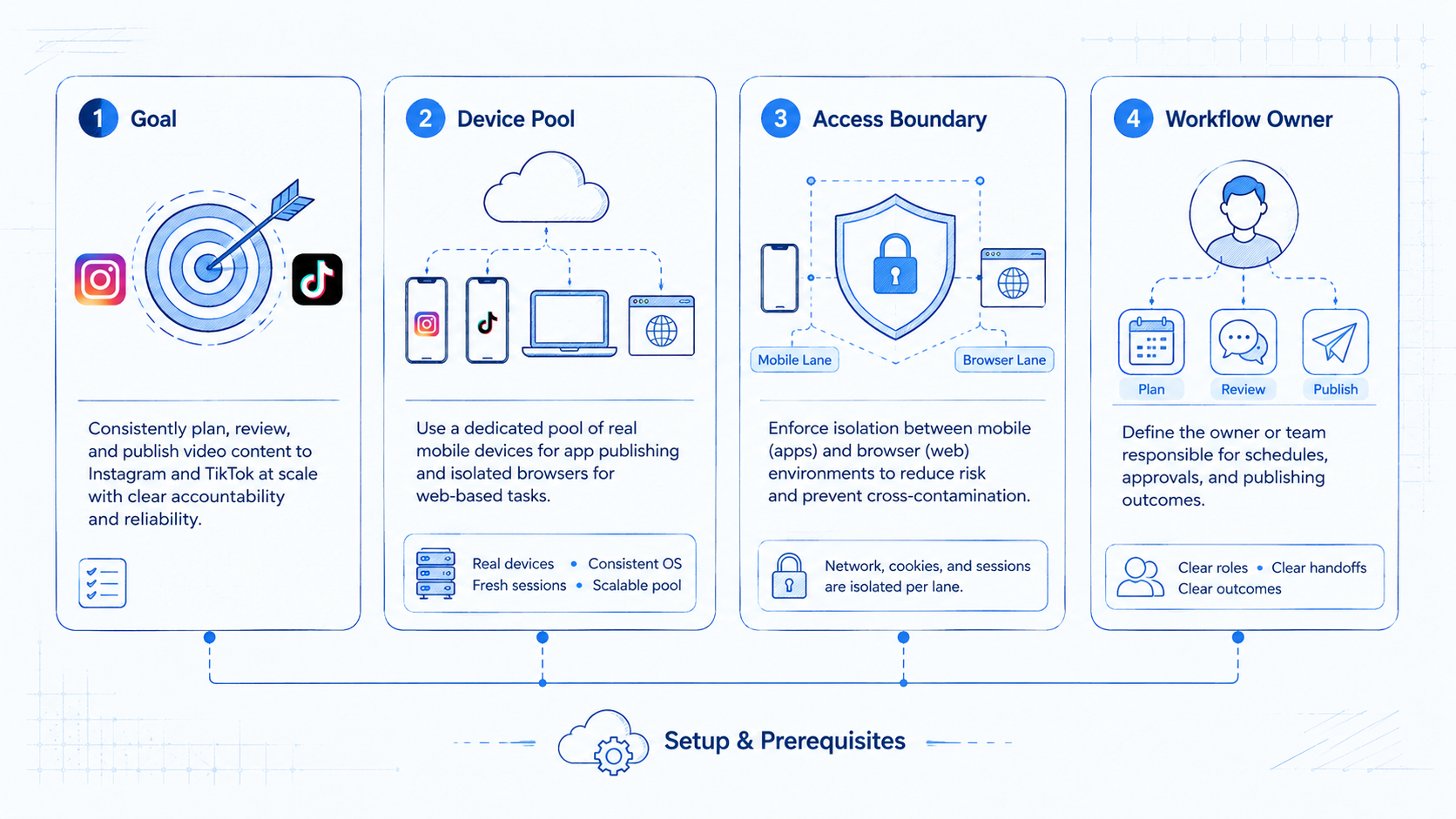
- Instagram and TikTok publishing teams need clean account lanes and visible approval steps.
- Browser and mobile execution usually support different parts of the same publishing run.
- A pilot should prove review quality and recovery speed before scale.
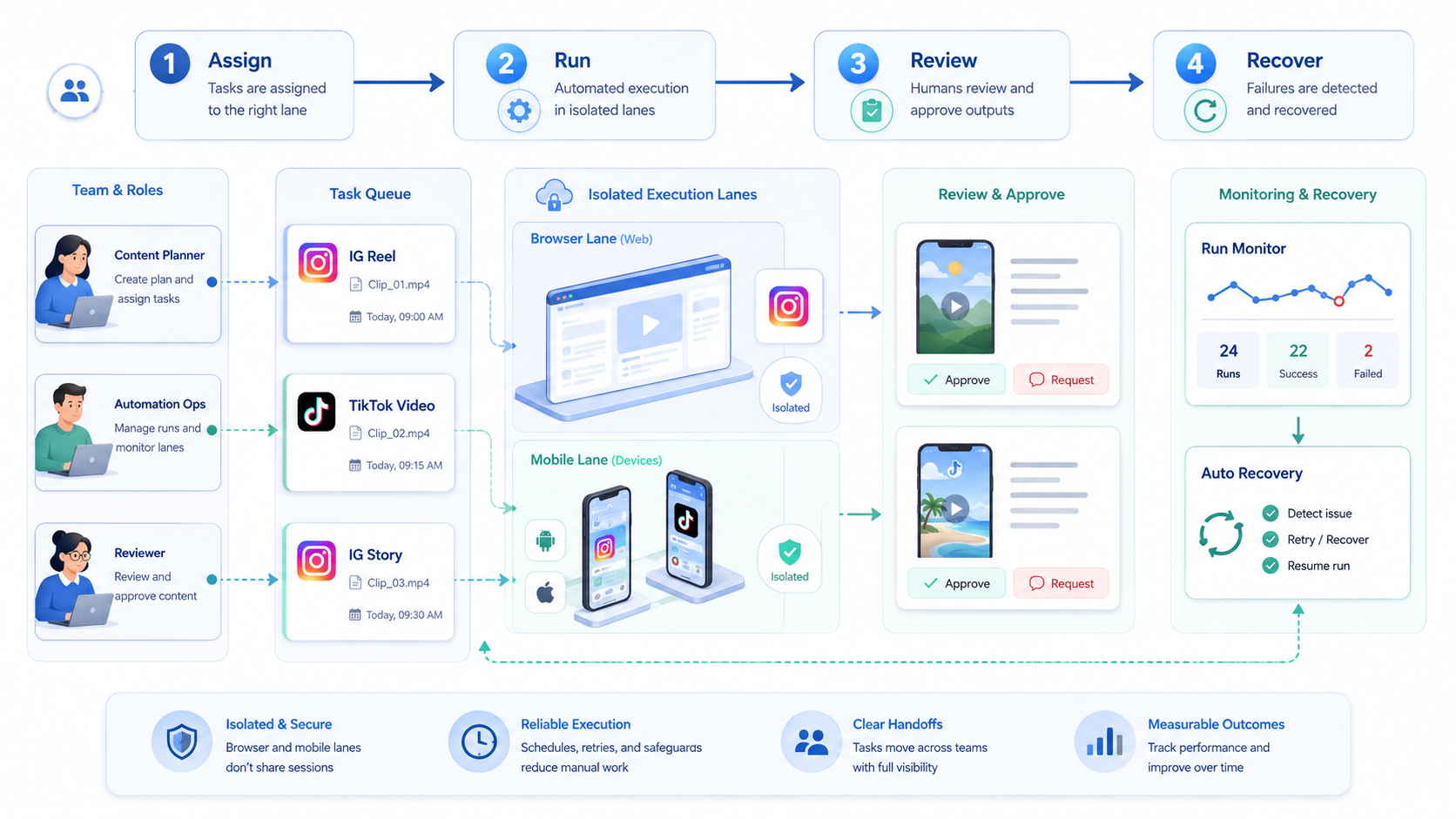
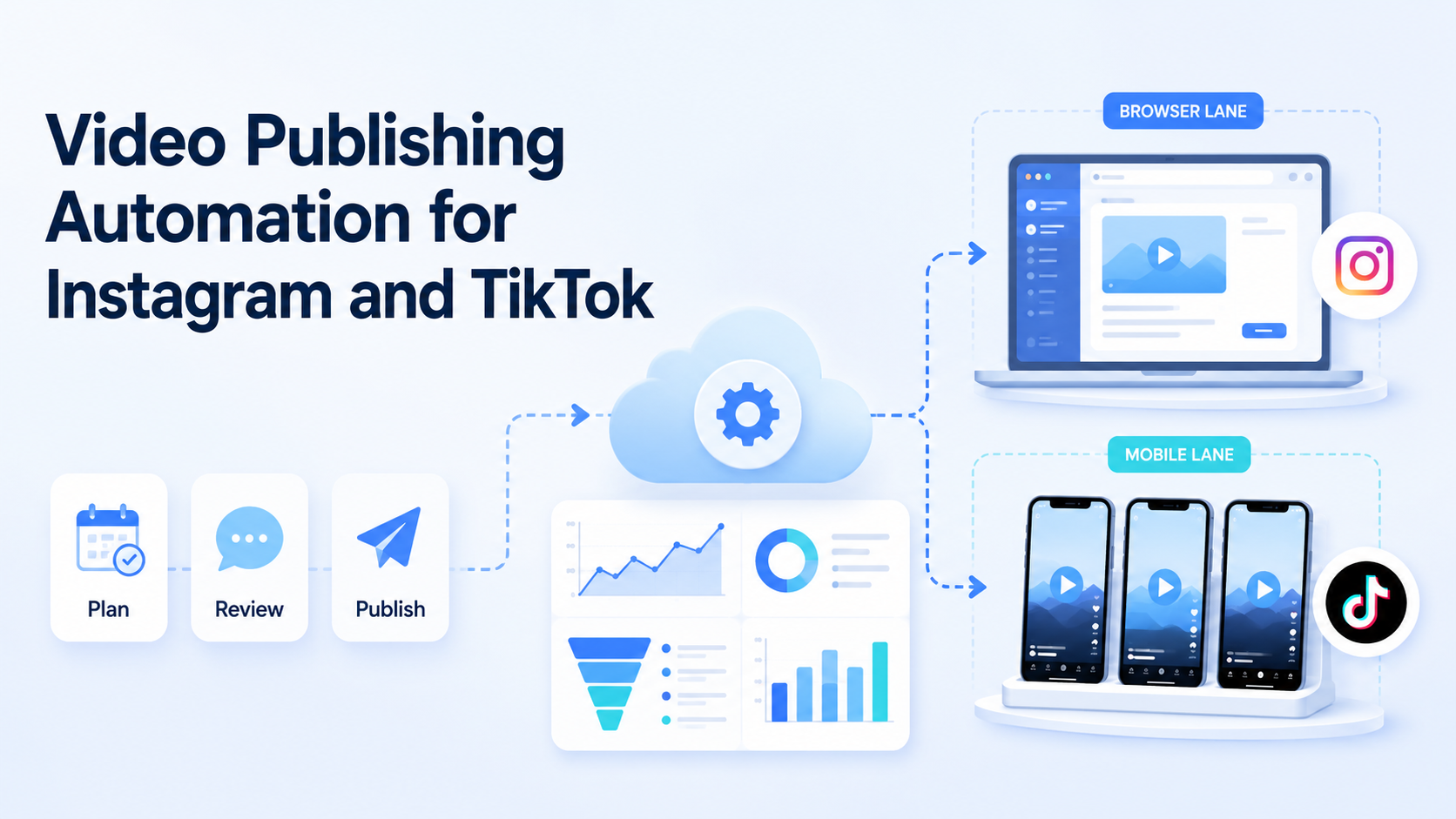
Video publishing automation is a system that helps teams prepare, review, schedule, and deliver video posts across Instagram and TikTok with repeatable rules. It is not only a posting bot. A reliable setup also needs account separation, review gates, and a recovery path when a run pauses or fails.
The topic matters because short-form publishing is rarely one click in a real team. A queue may include captions, hashtags, asset checks, approval notes, account-specific timing, and a final execution step in a browser or mobile surface. Once several accounts or several markets share the same queue, the work stops being simple content scheduling.
Many teams therefore evaluate MoiMobi as an execution platform, not only as another scheduler. The better question is not "can this tool post a video?" The better question is "can the team run video publishing automation repeatedly across account lanes without losing state, ownership, or review control?"
Official platform and tooling documentation supports that operating model. Meta Business Help and Instagram for Business both document role-based management and publishing surfaces.1 2 TikTok Business Help and TikTok Support do the same for business and account-side workflows.3 4 Playwright and W3C WebDriver also define browser work around explicit sessions and commands, which matches how operators think about account-specific execution.5 6
What Is Video Publishing Automation for Instagram and TikTok?
The common myth is that video publishing automation means fully automatic posting with no human judgment. The workable version is narrower and more useful.
A workable program usually combines four jobs:
| Job | What it covers | Why it matters |
|---|---|---|
| Preparation | Assets, captions, tags, publish windows | Keeps every run consistent |
| Review | Approvals, brand checks, account checks | Protects public-facing quality |
| Execution | Browser or mobile actions in the right lane | Keeps account state separate |
| Recovery | Retries, pauses, and blocked runs | Prevents queue confusion |
The publishing system is useful when those four jobs are connected. A tool that only schedules content may still leave the team with manual handoff, unclear approval ownership, or account-state problems. That is why multi-account management is part of the same conversation.
Why Video Publishing Automation for Instagram and TikTok Matters
The pressure usually starts with volume, not with technology. One brand account can be handled with a spreadsheet and a careful operator. Ten accounts across creators, regions, or product lines create a queue problem very quickly.
This matters because social publishing has more moving parts than the final "post" action. Teams need the right asset version, the right caption, the right timing, and the right account context. When those checks are scattered across chat, spreadsheets, and personal tabs, scale becomes expensive.
A second reason is that Instagram and TikTok often involve different surfaces for the same publishing run. Review may happen in a browser. The final publishing action may depend on a mobile lane, app workflow, or account-specific environment. For that reason, cloud phone and mobile automation can matter as much as content planning itself.
Key Benefits and Use Cases
The main benefit is not more output by itself. The main benefit is a cleaner publishing system.
Typical use cases include:
- Multi-brand queues: route videos into the right account lane with the right publish checklist.
- Agency publishing: keep client approvals separate from final execution steps.
- Cross-border teams: match region-specific captions, timing windows, and account owners.
- Creator operations: prepare repeatable upload workflows across several active accounts.
One practical advantage is that the publishing system becomes easier to audit. A reviewer can see which caption version was approved, which account lane is active, and which step is still waiting. That is harder to track in an informal workflow built from shared chat and manual copy-paste.
Teams that publish heavily to TikTok should also look at TikTok operations because platform-specific workflow details often affect the final execution design.
How to Get Started with Video Publishing Automation for Instagram and TikTok
Start with one publish queue, one account group, and one approval rule.
- Choose one repeatable publishing workflow, such as daily product videos or weekly creator clips.
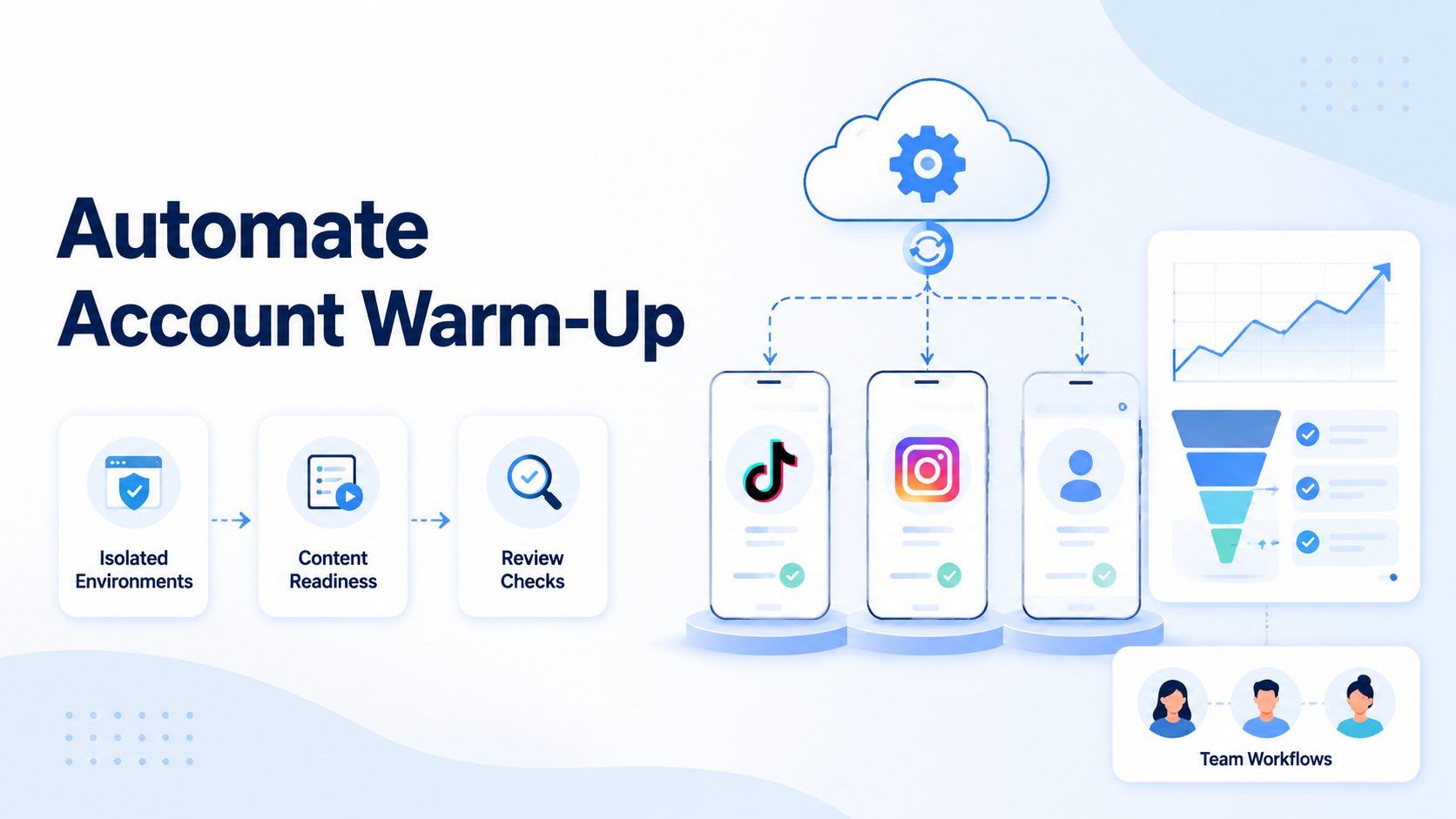
- Map one account group to one execution lane. Do not share the lane with unrelated brands or regions.
- Define the publish checklist: asset ready, caption ready, reviewer assigned, publish window confirmed.
- Separate browser-side review from mobile-side execution if the workflow needs both surfaces.
- Record every blocked or retried run before adding more accounts.
Use a short pass or fail check:
- Pass: every run shows one account lane, one reviewer, and one next step.
- Pass: the team can reopen a paused run without asking what happened.
- Fail: operators still rely on private notes to finish the post.
- Fail: a blocked upload forces the team to restart the workflow from scratch.
If the workflow relies on several mobile devices or repeated app-side actions, phone farm becomes a natural next evaluation page.
Teams also should decide which publish failures can retry automatically and which ones must pause. A missing asset, a timing conflict, and a wrong account lane should not all follow the same recovery rule. That distinction keeps the queue easier to explain.
Common Mistakes to Avoid
The first mistake is treating all video publishing as a single queue. That looks efficient at first, but it usually hides differences in approvals, timing, and account ownership.
The second mistake is automating the final post before the review path is clear. Automation is most useful when the routine parts are structured first. Teams should know who approves, who retries, and who owns blocked cases before expanding the workflow.
The third mistake is ignoring account-state control. Playwright browser contexts and W3C WebDriver both make session boundaries explicit.5 6 The same discipline matters for publishing runs. One account lane should not quietly inherit state from another lane.
What not to do
- Do not pool unrelated accounts into one execution lane.
- Do not count scheduled posts as success if retries are still manual and unclear.
- Do not mix approval logic with final execution logic in one undocumented step.
- Do not expand to more accounts before blocked runs are traceable.
Who It Fits and When It Is a Strong Match
This model is a strong fit when teams already publish videos repeatedly and need cleaner operations around those runs. It is weaker when publishing is rare or highly custom every time.
Strong match
- Agencies with repeatable client publishing queues.
- Brand teams managing several Instagram and TikTok accounts.
- Cross-border operators running region-based content calendars.
- Teams that already use structured approval and asset review.
Weak match
- One-off posting with no repeated queue.
- Small teams with no account separation problem.
- Workflows where every post requires a fresh custom process.
- Teams with no reviewer or no documented publish checklist.
One example makes the fit clearer. A team managing weekly product launches across several markets can prepare assets centrally, route each video to the correct account lane, pause for review, and then complete the final publish step in the proper environment. That is a good automation candidate because the work repeats, but still needs control.
Pilot Rollout, Measurement, and Recovery Checks
The pilot should prove that the queue becomes more reliable, not only faster.
Track these checks over one or two publishing cycles:
| Check | Healthy sign | Failure sign |
|---|---|---|
| Queue clarity | Every video has a clear owner and stage | Operators ask where the run stopped |
| Approval visibility | Review decisions are easy to inspect | Approval still happens informally in chat |
| Lane integrity | Each account keeps its own execution context | Account state or credentials drift |
| Recovery speed | Blocked runs move to a named retry owner | Retries are improvised each time |
| Scale readiness | The pattern works for the next account cluster | Manual rescue grows with every lane |
AWS Device Farm, BrowserStack, and Android Enterprise all reinforce the value of repeatable environments and observable runs in device-based workflows.7 8 9 That same discipline keeps publishing automation from becoming a fragile chain of hidden steps.
Another check helps before a wider rollout. A second operator should be able to reopen a paused run and identify the next action without reading private chat history. If that handoff fails, the workflow is still too dependent on memory.
Frequently Asked Questions
Is video publishing automation the same as scheduled posting?
No. Scheduled posting is one part of the workflow. Automation also covers preparation, approval, execution, and recovery.
Does every post need human review?
Not always. Many teams review only edge cases, new campaigns, or high-visibility accounts.
Why do teams separate browser and mobile steps?
Because review often happens in one surface and final execution happens in another.
What should a team automate first?
Start with one repeatable queue that already has a stable publish checklist.
Does this fit agencies?
Yes, especially when several client accounts share the same publishing process.
What is the first warning sign?
Blocked uploads that no one owns are a stronger warning sign than slow speed.
What should a pilot measure?
Queue clarity, review visibility, recovery speed, and lane integrity.
Does this work for both brands and agencies?
Yes. The same structure works for both when account lanes, review ownership, and retry rules are documented clearly.
Conclusion
For Instagram and TikTok teams, the model works when publishing is treated as an execution workflow, not only as a scheduling feature. The strongest setups keep approvals visible, account lanes separate, and retries easy to trace.
Before scaling, check four things:
- the publish checklist is stable
- the reviewer and retry owner are both visible
- each account runs in its own lane
- the team can reopen a paused run without guessing
If those checks hold, the workflow is ready for a wider rollout.
Sources