Key Takeaways
- Instagram warm-up automation is a staged account workflow, not a shortcut for risky growth tactics.
- The real value is environment control, task limits, and review checkpoints.
- Teams should separate early-growth lanes from normal publishing lanes.
- A small pilot should test lane clarity and recovery before expansion.
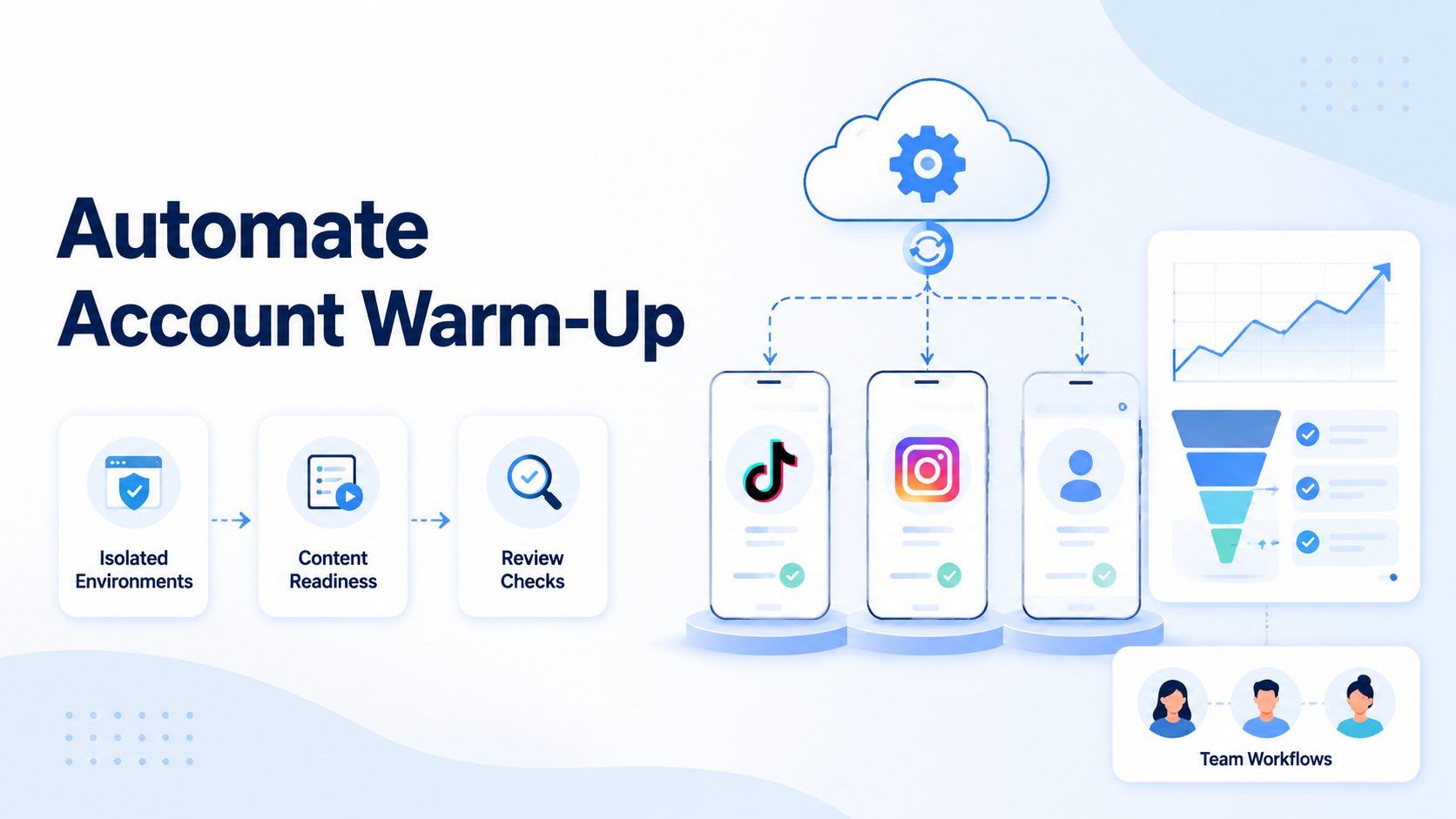
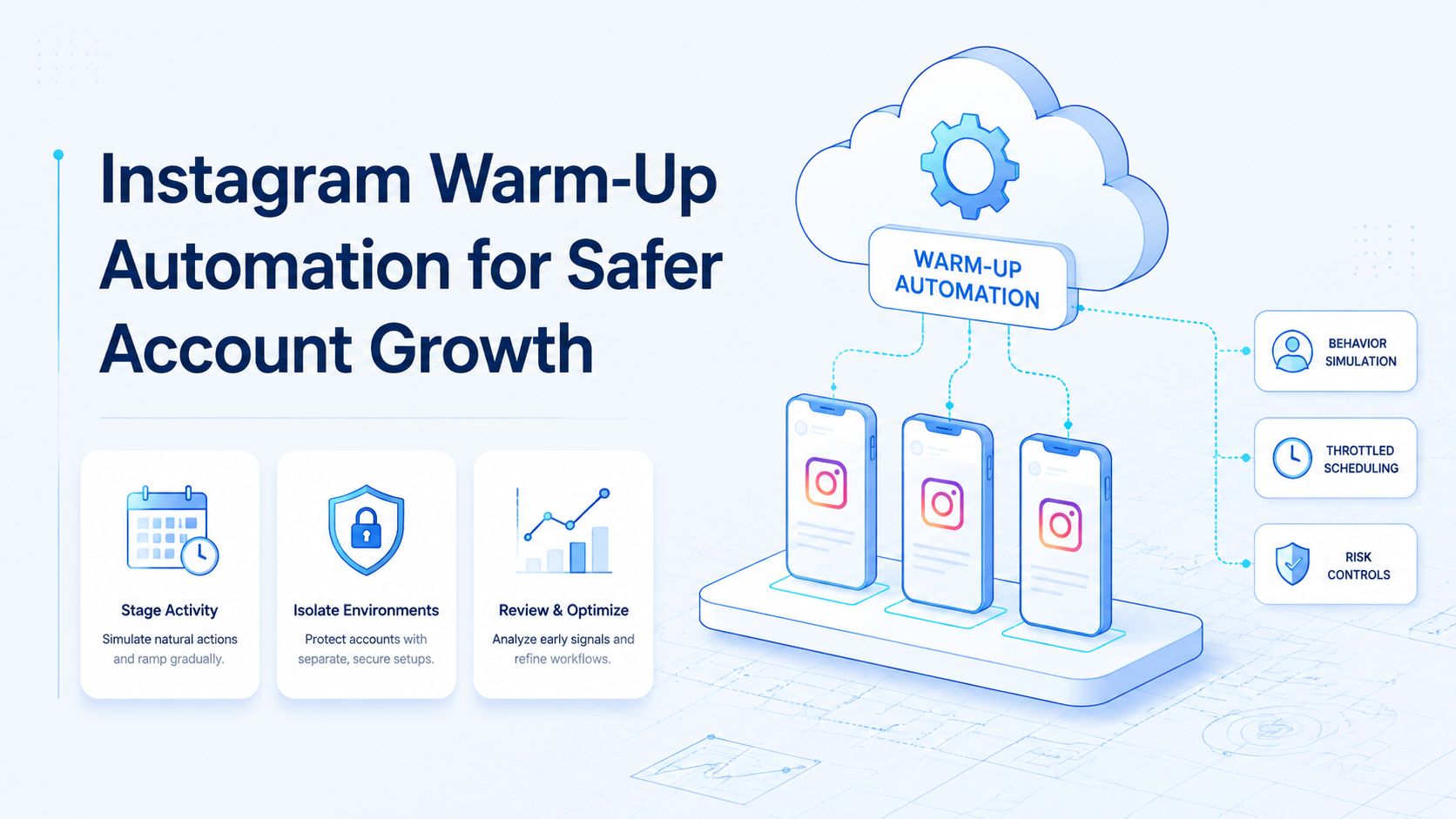
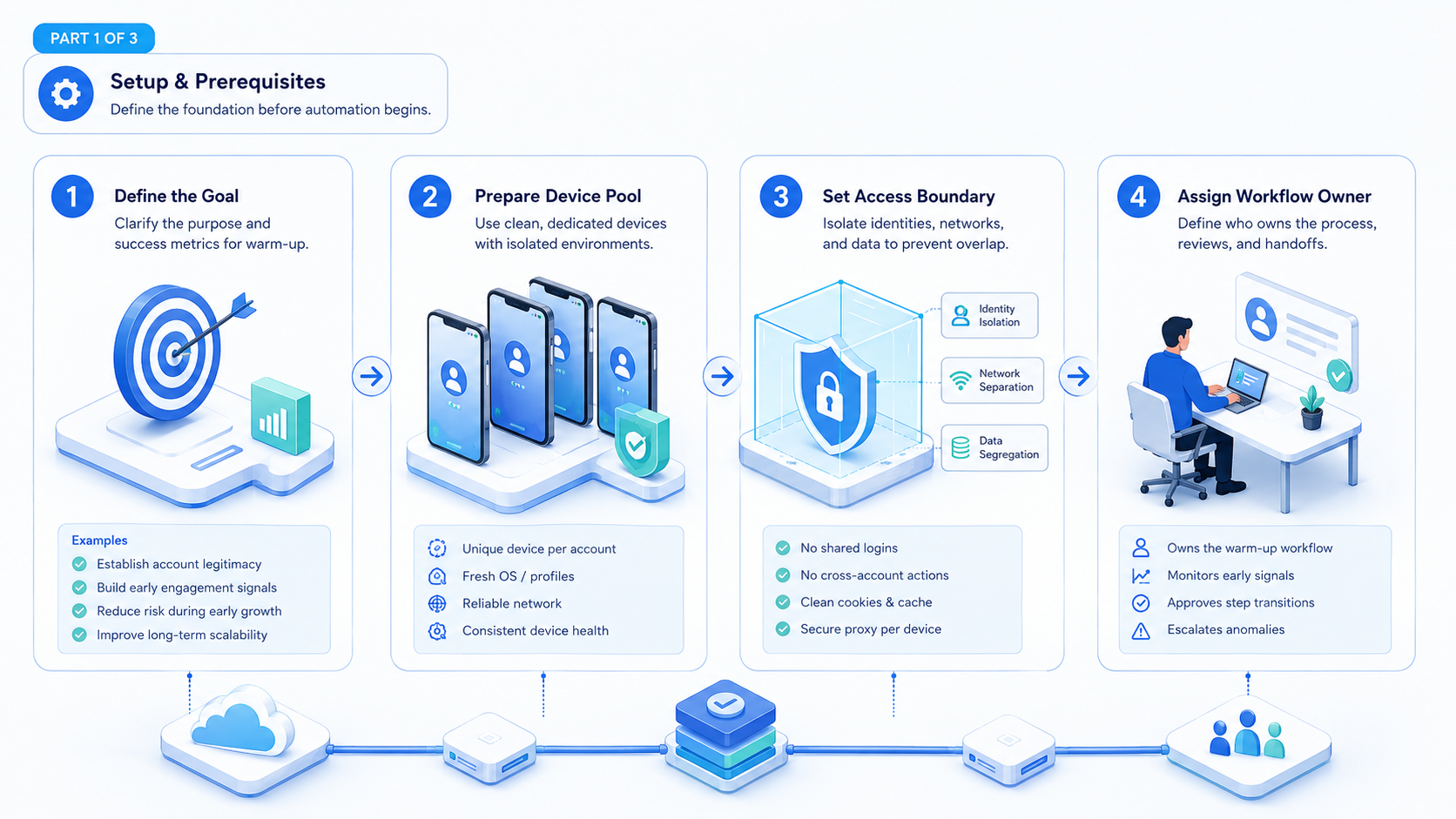
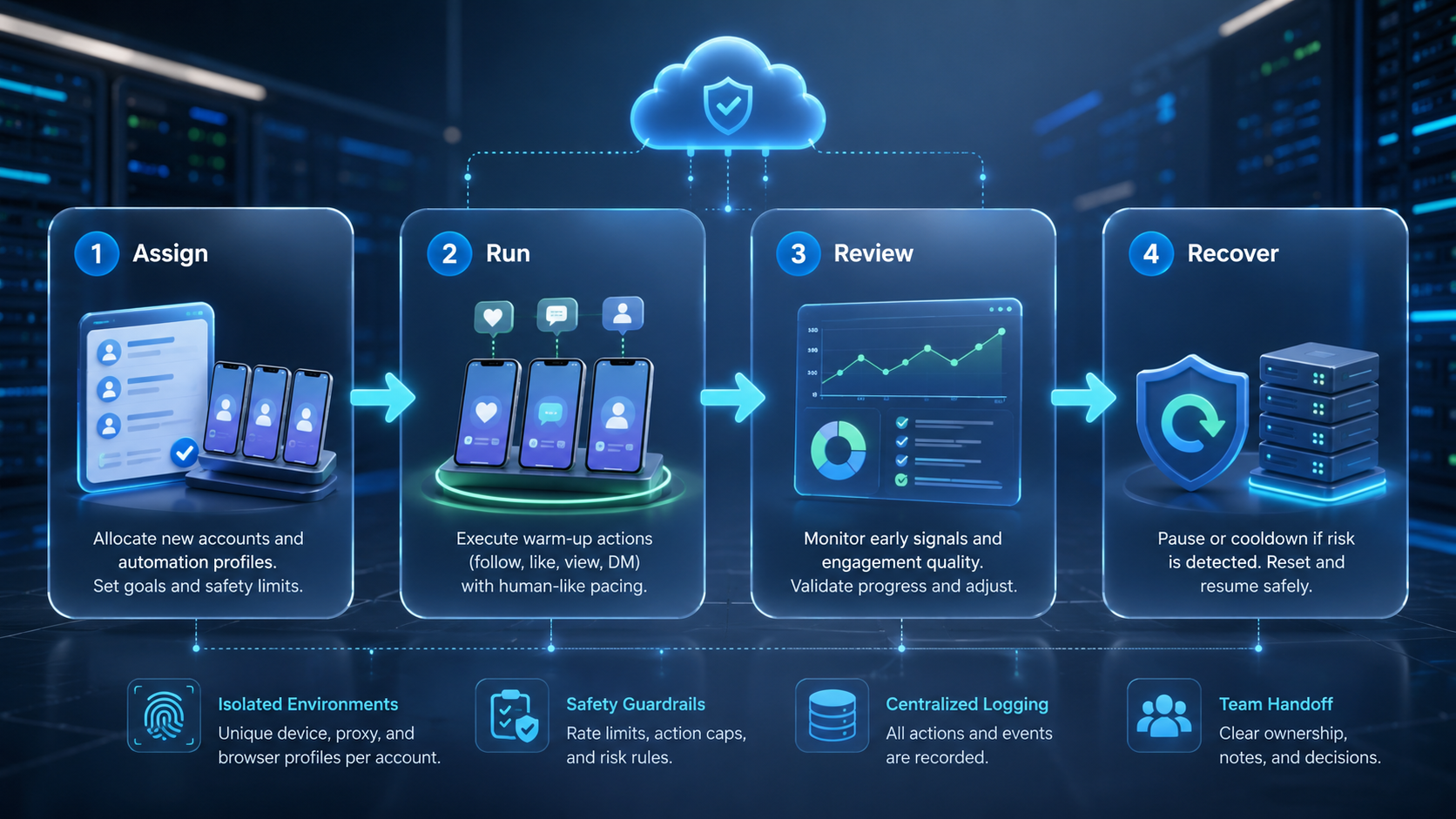
Instagram warm-up automation is a controlled workflow for staging early Instagram account activity through isolated environments, defined task limits, and review checkpoints. The practical goal is not to imitate random behavior. It is to help teams run early account operations in a way that is easier to assign, inspect, and recover when something pauses or changes.
That matters because Instagram account growth work often starts before the team has stable routines. Operators may switch accounts, test content paths, review inbox activity, or stage early publishing. Without a clear workflow, the team can lose track of who did what and which lane owns the next action.
Instagram for Business, Instagram Help, Playwright browser contexts, W3C WebDriver, and Android Enterprise all point toward the same operating principle: controlled sessions and managed environments are easier to scale than shared state or improvised handoff.1 2 3 4 5
What Is Instagram Warm-Up Automation for Safer Account Growth?
The common myth is that warm-up means "make a new account look active." The better model is a staged workflow for early account operations.
That workflow usually controls:
| Layer | What it controls | Why it matters |
|---|---|---|
| Account lane | One account or account group per environment | Stops mixed state |
| Activity scope | Which early actions are allowed | Keeps the stage narrow |
| Review checkpoint | When a human checks the next move | Reduces blind expansion |
| Execution layer | Browser or mobile environment | Makes the lane inspectable |
| Recovery rule | What happens after a pause or exception | Prevents ad hoc rescue |
In that sense, Instagram warm-up automation is closer to onboarding and early account operations than to broad marketing automation. That is why social media marketing and multi-account management are useful next pages.
Why Instagram Warm-Up Automation for Safer Account Growth Matters
Early account growth is fragile when several operators touch the same account with no lane model. One person may review content. Another may handle inbox or profile checks. A third may run the next publishing step. Without a controlled workflow, activity history becomes hard to interpret.
The cost is not just confusion. It also affects decision quality. Teams need to know when an account should continue on the same path, when it should pause for review, and when the environment itself may need attention.
That is why Instagram warm-up automation matters. It converts vague advice into concrete operating rules: which actions belong in the stage, which environment owns them, and how the team reviews the next step.
Key Benefits and Use Cases
The benefit is not raw volume. It is clearer early-account control.
- New-account onboarding: separate new lanes from steady-state account work.
- Team handoff: move account setup between operators without losing context.
- Cross-market operations: stage early account growth by market or brand lane.
- Client onboarding: agencies can review first-stage workflows before normal delivery.
The fit gets stronger when the team already uses isolated environments and visible review. Some groups begin with browser-side review and later connect cloud phone or mobile automation for app-facing actions.
That split matters because Instagram operations rarely stay in one surface forever. Teams may inspect account state in the browser, then shift later actions into a mobile lane. Warm-up automation helps because the early lane already has a known owner and a known next step before that handoff happens.
How to Get Started with Instagram Warm-Up Automation for Safer Account Growth
Start with one lane and one limited activity set.
- Choose one account cluster and assign one isolated environment lane.
- Write the list of allowed actions for the early stage.
- Set one review checkpoint before the account moves to a broader content lane.
- Document every pause, block, or manual override in the same run record.
- Only expand after the first lane remains easy to explain.
Instagram documentation is useful here because it keeps the workflow grounded in actual platform surfaces and business tools.1 2 For teams that need app-facing follow-up later, device isolation and Android antidetect are the next practical checks.
Common Mistakes to Avoid
The first mistake is calling any early account action "warm-up" with no real structure behind it.
The second mistake is letting one shared lane serve several unrelated account groups. That makes debugging and review much harder.
The third mistake is scaling content or follow-up activity before the team has proven the recovery path.
What not to do
- Do not reuse one environment lane for unrelated Instagram account groups.
- Do not let different operators expand activity with no shared review checkpoint.
- Do not treat blocked runs as noise that can be ignored.
- Do not judge progress only by activity count if the lane history is unclear.
Who It Fits and When It Is a Strong Match
Instagram warm-up automation fits teams that need structure around early account growth and account onboarding.
Strong match
- Teams onboarding several Instagram accounts over time.
- Agencies moving client accounts from setup to normal operations.
- Cross-border teams using market-specific account lanes.
- Operators already using logs, approvals, and recovery owners.
Weak match
- Single-account users with no shared workflow.
- Teams using one shared device or browser state for all setup work.
- Projects with no clear owner for blocked lanes.
- Cases that only need full production publishing.
The fit test is direct: does the team need early-growth work to become more explainable and easier to review? If yes, the workflow is worth testing.
Pilot Rollout, Measurement, and Recovery Checks
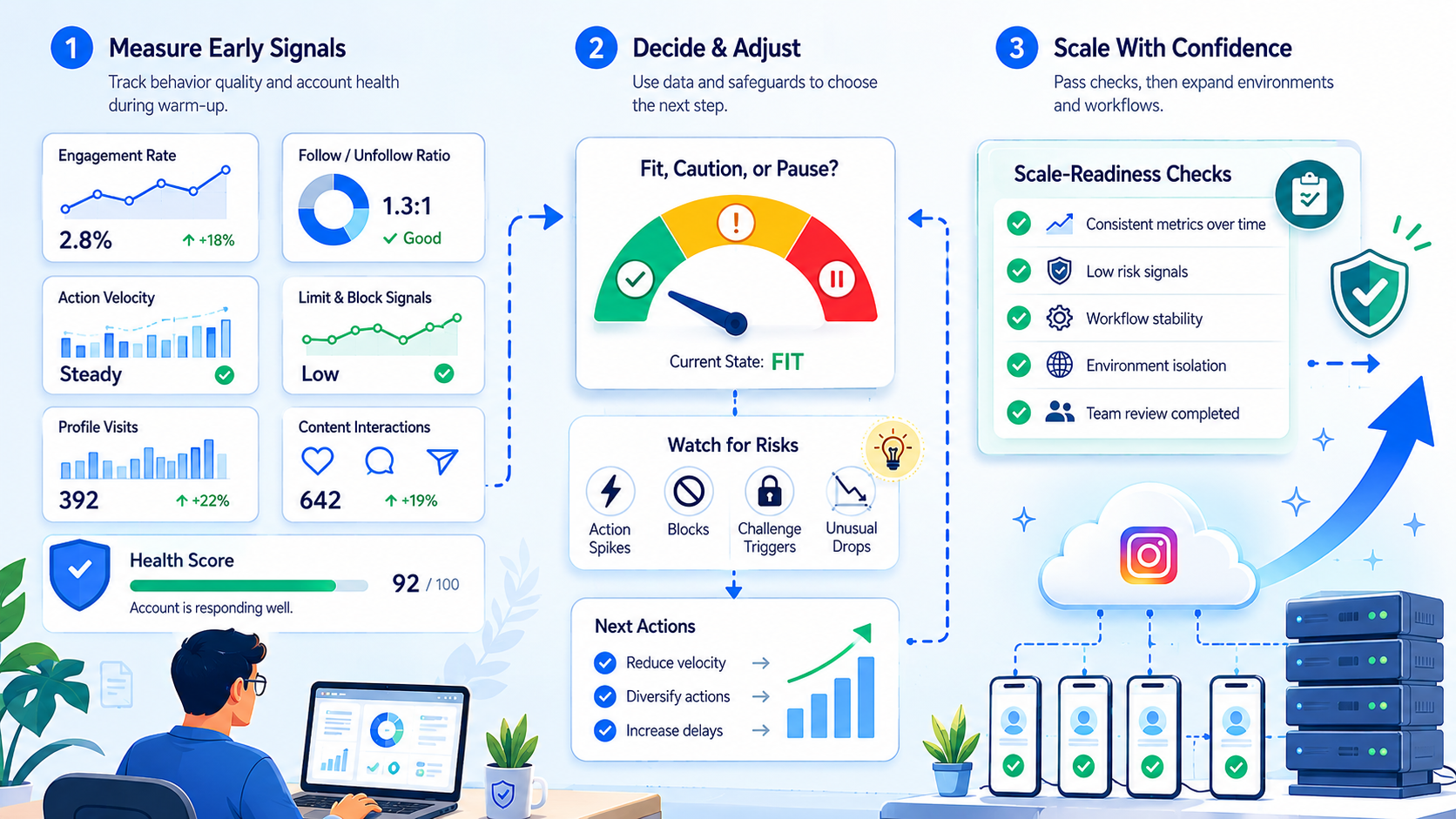
The pilot should prove that the early Instagram lane becomes more predictable.
| Check | Pass condition | Failure sign |
|---|---|---|
| Lane clarity | One environment lane maps to one account cluster | Operators guess which lane is active |
| Stage scope | Allowed actions stay limited and visible | Unplanned activity appears in the stage |
| Review quality | A human can explain the next step | The lane only shows done or failed |
| Recovery speed | Blocked runs reach a named owner | Issues drift in chat or notes |
| Scale readiness | The same model works for the next lane | Each new lane becomes a special case |
Android Enterprise and managed environment thinking are useful because they push teams toward ownership and repeatability rather than improvisation.5 If the pilot fails, reduce scope before adding more activity.
Another practical check is shift handoff. If the next operator can reopen the lane, read the log, and explain why the account is still in the current stage, the workflow is close to production quality. If that handoff still depends on chat, the lane is not ready to scale.
Instagram Warm-Up Automation Pass or Fail Rules
- Pass: one lane, one owner, and one visible activity scope.
- Pass: the team can explain why the latest action happened.
- Fail: several operators change the stage without one review rule.
- Fail: the next step depends on memory instead of the run record.
Fields worth tracking
| Field | Why it matters |
|---|---|
| Account lane | Shows which environment handled the work |
| Allowed action set | Keeps the stage narrow |
| Review owner | Shows who approves the next action |
| Pause reason | Makes recovery easier |
| Next action | Prevents operator guesswork |
A useful extra field is stage exit reason. When the team records why an account leaves the early stage, later reviewers can tell whether the move came from stable progress, a workflow change, or an exception that still needs follow-up.
That record also helps when the same account returns to a review lane later.
It gives the team a cleaner history for later decisions.
That history becomes valuable when ownership changes later.
It also improves later team handoff quality.
Another useful practice is to add a short weekly summary for each account lane. That summary can note what stage the account reached, which actions were allowed, which pauses happened, and what should change next week. Teams that write that summary spend less time re-reading old logs before making the next decision. It also helps managers compare ten lanes quickly without opening every detailed run record.
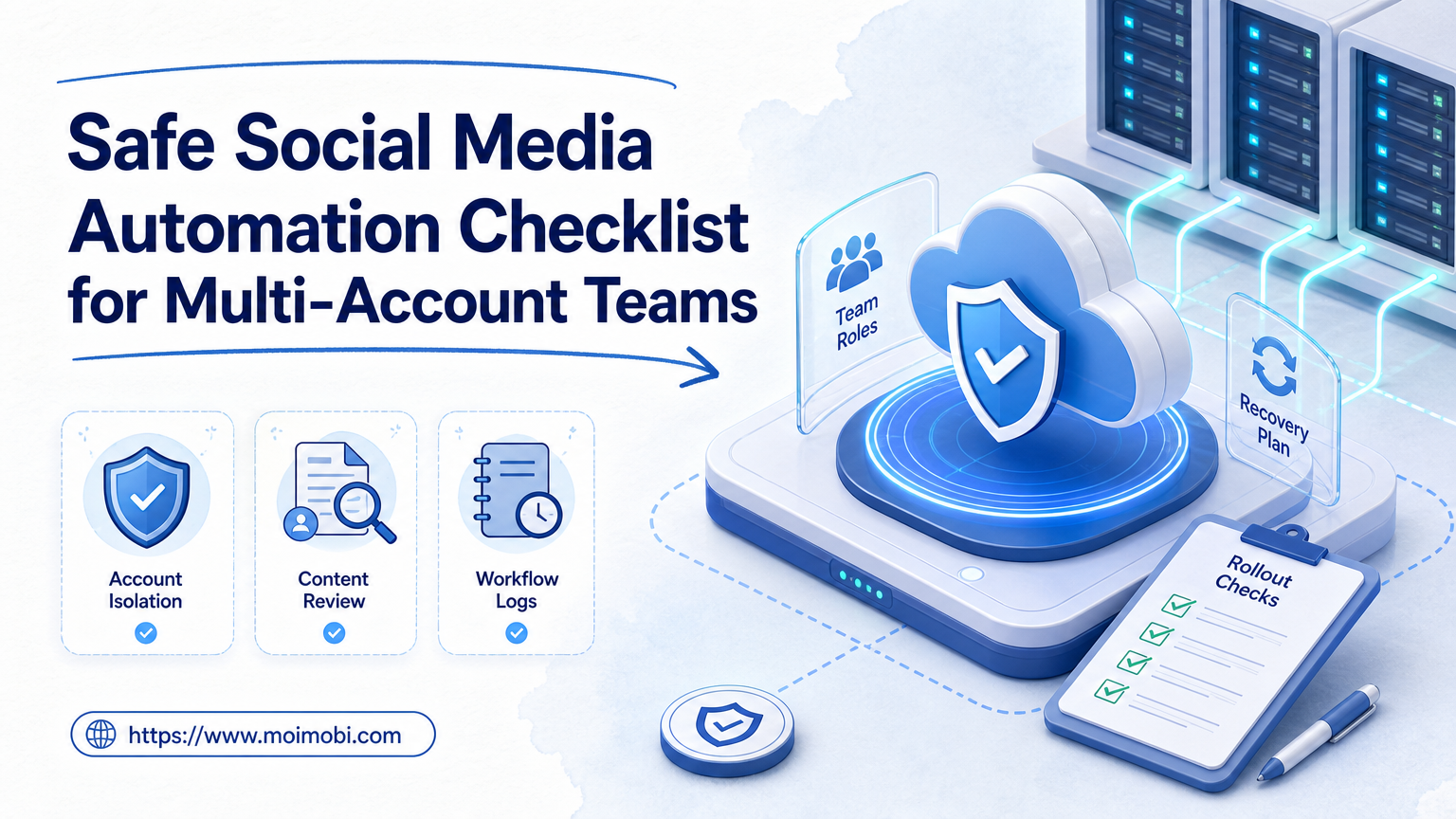
One more control point is a lane-change checklist. Before an account moves from early review to normal growth work, the operator can confirm that the last review passed, the approved action scope was respected, the next owner is named, and any open exception is documented. That checklist prevents accounts from moving forward just because the calendar says they should. It keeps progression tied to observed stability instead of habit.
Frequently Asked Questions
Is Instagram warm-up automation the same as a bot?
No. A safer workflow is about staged operations and review, not blind activity.
What should a team automate first?
Automate lane assignment, activity scope, and review checkpoints first.
Does this replace later publishing workflows?
No. It supports early-stage account growth before broader publishing lanes take over.
When should the team stop scaling?
Pause when lane history becomes hard to explain or blocked runs lose ownership.
Is this only for new accounts?
No. It also helps when accounts change teams, markets, or ownership models.
What is the first warning sign?
The first warning sign is a shared lane with unclear scope.
What should the team review next?
Review whether environment ownership, review checkpoints, and recovery notes still stay visible.
Conclusion
Instagram warm-up automation for safer account growth works when early account activity is treated as a staged workflow with isolation, limits, and review checkpoints. The point is not to push more actions faster. The point is to make early growth operations clearer and easier to hand off.
Before adding more volume, check three things: one lane maps to one account cluster, the next action is documented, and blocked runs still reach a named owner. If those checks hold, the workflow is doing its job.
Sources
- Instagram for Business
- Instagram Help Center
- Playwright browser contexts
- W3C WebDriver
- Android Enterprise overview
-
Instagram for Business documents business-facing publishing and account workflows. ↩↩
-
Instagram Help Center documents real platform surfaces and account-management flows. ↩↩
-
Playwright documents isolated browser contexts as separate sessions. ↩
-
W3C WebDriver defines browser automation through explicit session control. ↩
-
Android Enterprise documents managed Android control models relevant to team-owned mobile lanes. ↩↩