
Key Takeaways
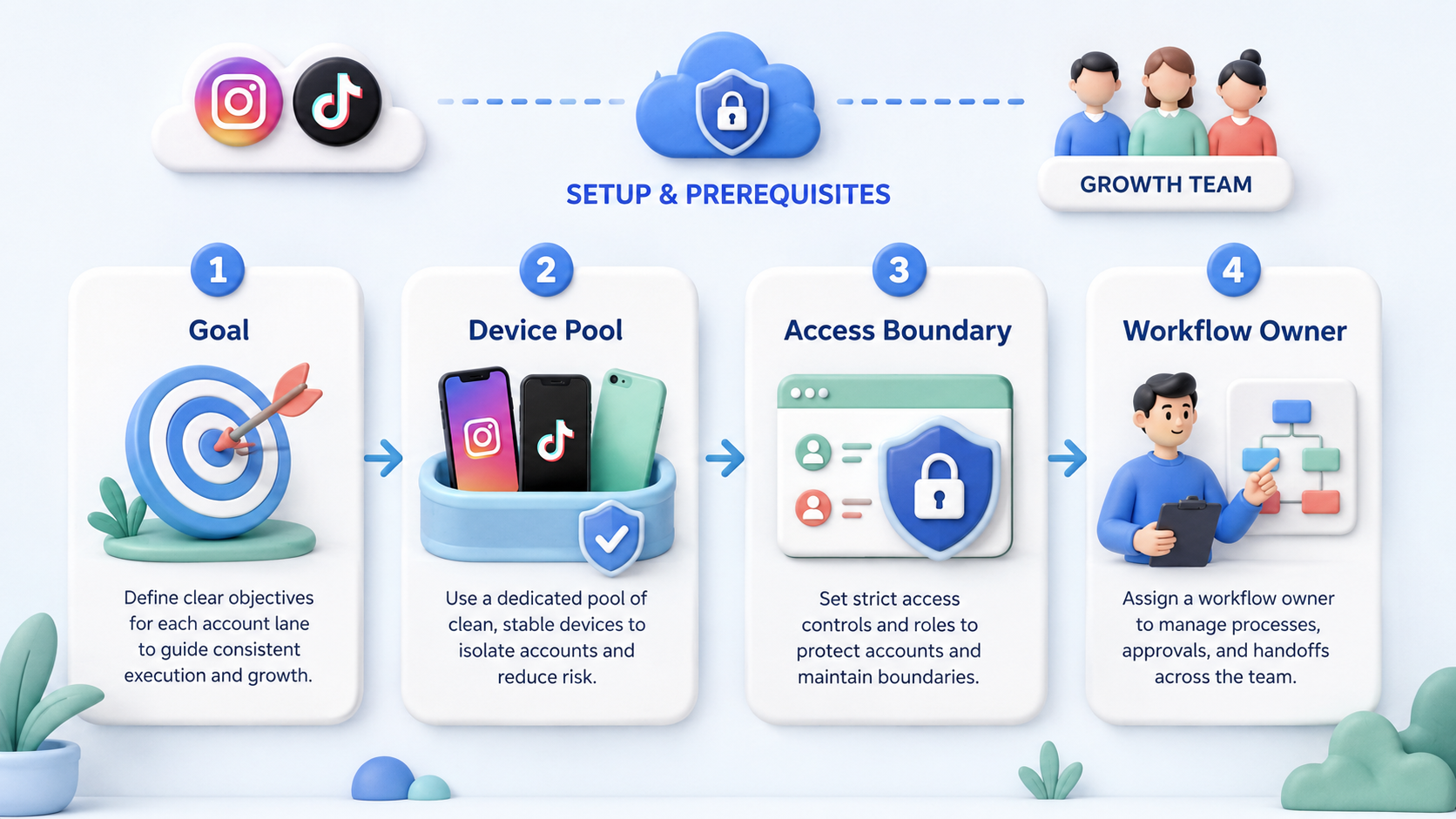
- Instagram TikTok multi-account management is an operating system for routing accounts, tasks, and reviews across separate execution lanes.
- The main value is control, not just scale. Teams need isolated sessions, clear ownership, and visible recovery rules.
- Growth teams usually struggle when they mix onboarding, publishing, replies, and monitoring inside one shared lane.
- A small pilot should track lane clarity, exceptions, and recovery speed before it tracks volume.
Instagram TikTok multi-account management is a team workflow for running many accounts through separate environments, named owners, and repeatable review rules. The real job is not only to keep accounts available. It is to help a team know which lane owns each action, what changed, and what must happen next.
That matters because growth teams rarely manage one account at a time. They may run creator outreach, content publishing, inbox follow-up, and competitor monitoring in parallel. When those actions share the same session or the same undocumented routine, account history becomes hard to explain and even harder to recover.
Official platform and infrastructure sources all point in the same direction. Managed account work depends on controlled sessions, reviewable environments, and clear execution boundaries.1 2 3 4 5
The Core Idea Behind Instagram TikTok Multi-Account Management for Growth Teams
The common misunderstanding is that multi-account management means "one dashboard for many logins." That is only part of the system. The working model is broader. It covers session separation, task routing, ownership, and review.
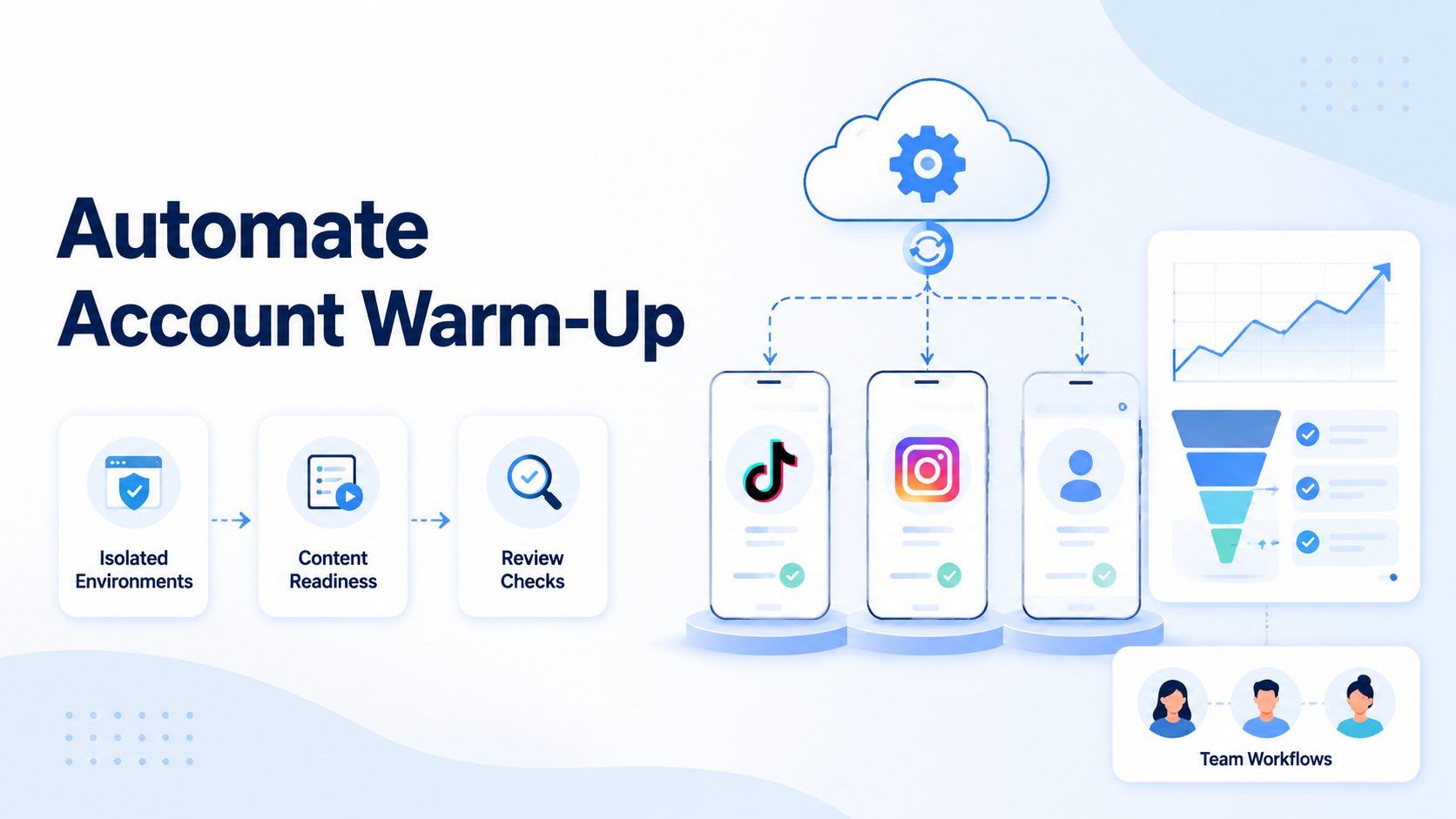
In practice, Instagram TikTok multi-account management works best when each account or account group has a defined lane. That lane can live in a browser profile, a mobile lane, or a cloud phone. The point is not the interface alone. The point is that the team can explain which environment handled which task.
The model usually includes five layers:
| Layer | What it controls | Why it matters |
|---|---|---|
| Account lane | Which account lives in which environment | Stops mixed sessions |
| Task scope | What the lane is allowed to do | Prevents random workflow expansion |
| Owner | Who approves and who executes | Removes handoff confusion |
| Recovery rule | What happens after an exception | Makes retry work visible |
| Tracking record | What the team logs after each run | Supports later review |
That is why multi-account management is a better next step than thinking only about device rental or a posting tool.
Why Teams Search for Instagram TikTok Multi-Account Management
Most teams search for this topic after the simple setup stops working. A small group may begin with a few accounts and shared operator habits. Then publishing, replies, and account checks increase. At that point, the same shortcuts that felt fast start producing avoidable confusion.
The first trigger is usually unclear ownership. One operator may draft content. Another may handle replies. A third may inspect account status. When the team cannot see which lane touched which action, every exception becomes slower to review.
The second trigger is workload growth across both web and app surfaces. Teams may need browser-side review for dashboards and mobile-side execution for account actions. That split pushes them toward mobile automation and device isolation, because one shared environment rarely stays readable for long.
The third trigger is recovery pressure. Growth teams do not only need to publish more. They need to pause a lane, reassign a lane, and compare lane quality across markets or clients. Multi-account management becomes valuable when it shortens those decisions.
- Signal 1: more than one operator touches the same account every week.
- Signal 2: Instagram and TikTok tasks no longer share the same execution layer cleanly.
- Signal 3: the team spends more time explaining exceptions than fixing them.
Who Benefits Most and In What Situations
This model fits teams with repeated account workflows, not only teams with a high account count. A ten-account team with weak routing can have more friction than a fifty-account team with clean lanes.
The best fit usually looks like this:
- Growth teams running content, replies, and monitoring together
- Agencies handling several client account groups
- Cross-border teams with market-specific account lanes
- Operators who need browser review plus mobile execution
- Single-account creators with no shared workflow
- Teams that do not document ownership changes
- Programs that expect one shared session to cover every task
- Groups that measure output only and ignore recovery
One useful test is role overlap. If the same team handles onboarding, publishing, reply work, and reporting, lane structure matters early. Without it, one person often becomes the memory layer for the whole program. That does not scale.
Another useful test is platform mix. When the team works across both Instagram and TikTok, task rhythm changes. Video publishing, inbox review, content checks, and exception handling do not always happen in the same place. Multi-account management helps because each lane can carry its own rule set instead of forcing one workflow onto every account.
How to Evaluate or Start Using Instagram TikTok Multi-Account Management for Growth Teams
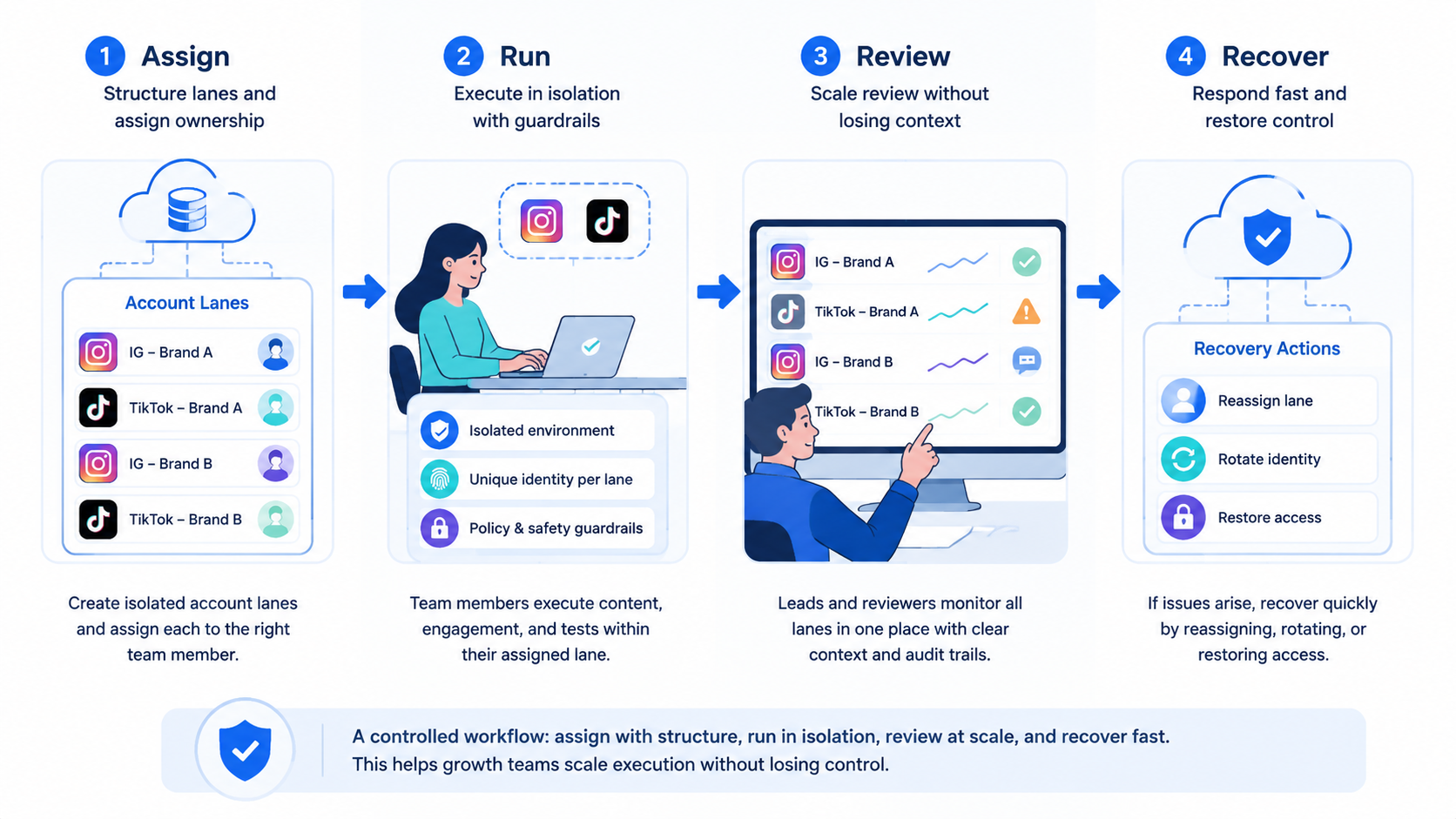
The most common failure is starting with volume instead of structure. Teams add accounts first and governance later. That usually creates hidden debt.
Use a simple rollout path instead:
- Define lane types. Decide which lanes are for onboarding, publishing, replies, monitoring, or recovery.
- Assign one owner per lane. Separate approval from execution when the team is large enough.
- Choose the environment. Browser profiles may fit review work. App-facing tasks may need [phone farm](https://www.moimobi.com/en/products/phone-farm) or cloud-device lanes.
- Write task scope. Each lane needs a short list of allowed actions and stop rules.
- Log exceptions in one record. Do not let retries disappear into chat messages.
- Expand only after one lane stays readable. If a reviewer cannot explain the last five actions quickly, the lane is not ready to scale.
Playwright browser contexts and the W3C WebDriver model support this kind of controlled session design on the browser side.3 4 Android Enterprise and cloud-device testing platforms reinforce the same idea for device-backed execution: managed environments are easier to route and audit than improvised ones.5 6
Mistakes That Reduce Results
The first mistake is treating every account as the same operational unit. Some lanes are for content preparation. Others are for replies, checks, or staged onboarding. When teams ignore those differences, task scope drifts.
The second mistake is routing unrelated accounts through one environment because it feels efficient. Shared state may look convenient for a day. Later it makes review slower because the team has to reconstruct what happened from fragments.
The third mistake is tracking output without tracking exceptions. A growth team may know how many posts shipped but still fail to explain which lane produced the cleanest delivery or which lane keeps absorbing rescue work.
What not to do
- Do not let one operator carry account context only in memory.
- Do not mix client accounts or market lanes just to reduce setup time.
- Do not move an account into broader publishing before the recovery path is clear.
- Do not measure posts or replies if the team cannot also measure retries, pauses, and reassignment.
These mistakes are common because they do not break the workflow on day one. They break it later, when the queue gets longer and the team rotates owners faster.
Pilot Rollout, Measurement, and Recovery Checks
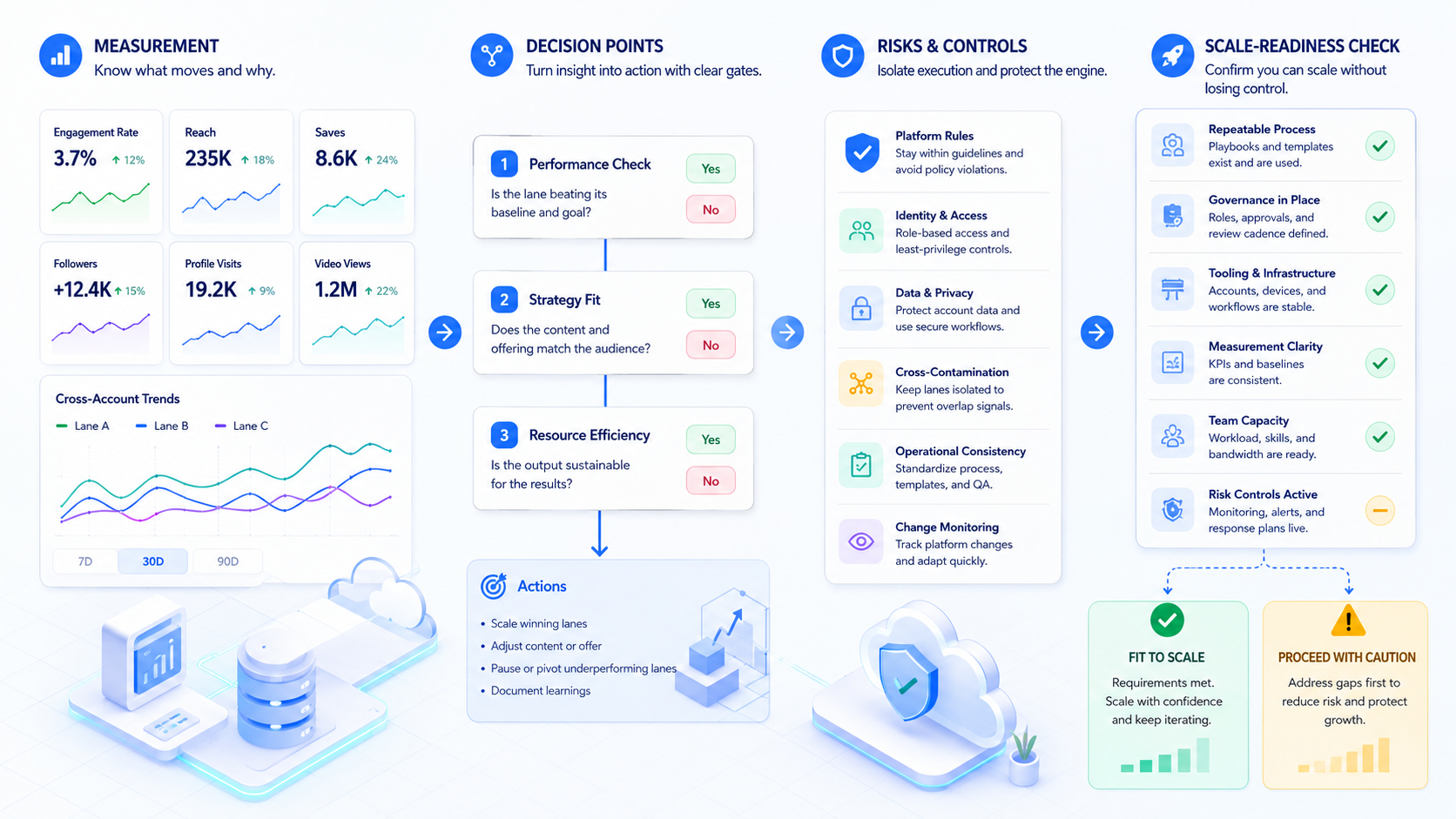
A pilot should prove control before it proves speed. Start with one small account cluster, one lane design, and one review cadence.
Three measurements matter first:
- Lane clarity: can a reviewer explain the latest actions without asking the operator?
- Recovery speed: when a lane pauses, how long does it take to assign the next action?
- Owner stability: can the team hand the lane to another operator without rebuilding history?
After that, add simple tracking fields:
| Field | Why it matters |
|---|---|
| Lane type | Shows which workflow the account belongs to |
| Current owner | Makes handoff visible |
| Last successful review | Confirms review cadence |
| Exception reason | Distinguishes lane issues from content issues |
| Next action | Prevents idle ambiguity |
Recovery checks should happen on a schedule, not only when something fails. A weekly review can compare which lanes needed manual rescue, which lanes changed ownership, and which lanes stayed stable across both platforms. That helps a growth team improve the right layer. Sometimes the problem is content planning. Other times the problem is lane design.
When the pilot works, the next step is not "add every account." The next step is to copy the lane model into one more cluster and confirm that the same rules still hold. That is how social media marketing programs grow without losing operational readability.
Another useful check is lane age versus lane complexity. A lane that is new but already running publishing, reply work, and monitoring at the same time is harder to review than a lane that adds those jobs in sequence. Teams that track that progression make cleaner expansion decisions. They can see whether the next account group is ready for more work or whether the current lane still needs a simpler task scope first.
| Review question | Healthy signal |
|---|---|
| Can a reviewer explain the last five actions? | Yes, from the lane record alone |
| Can another operator take over? | Yes, without rebuilding context |
| Are exceptions tagged by cause? | Yes, by lane, content, or owner issue |
| Is the next expansion decision obvious? | Yes, because the lane history is readable |
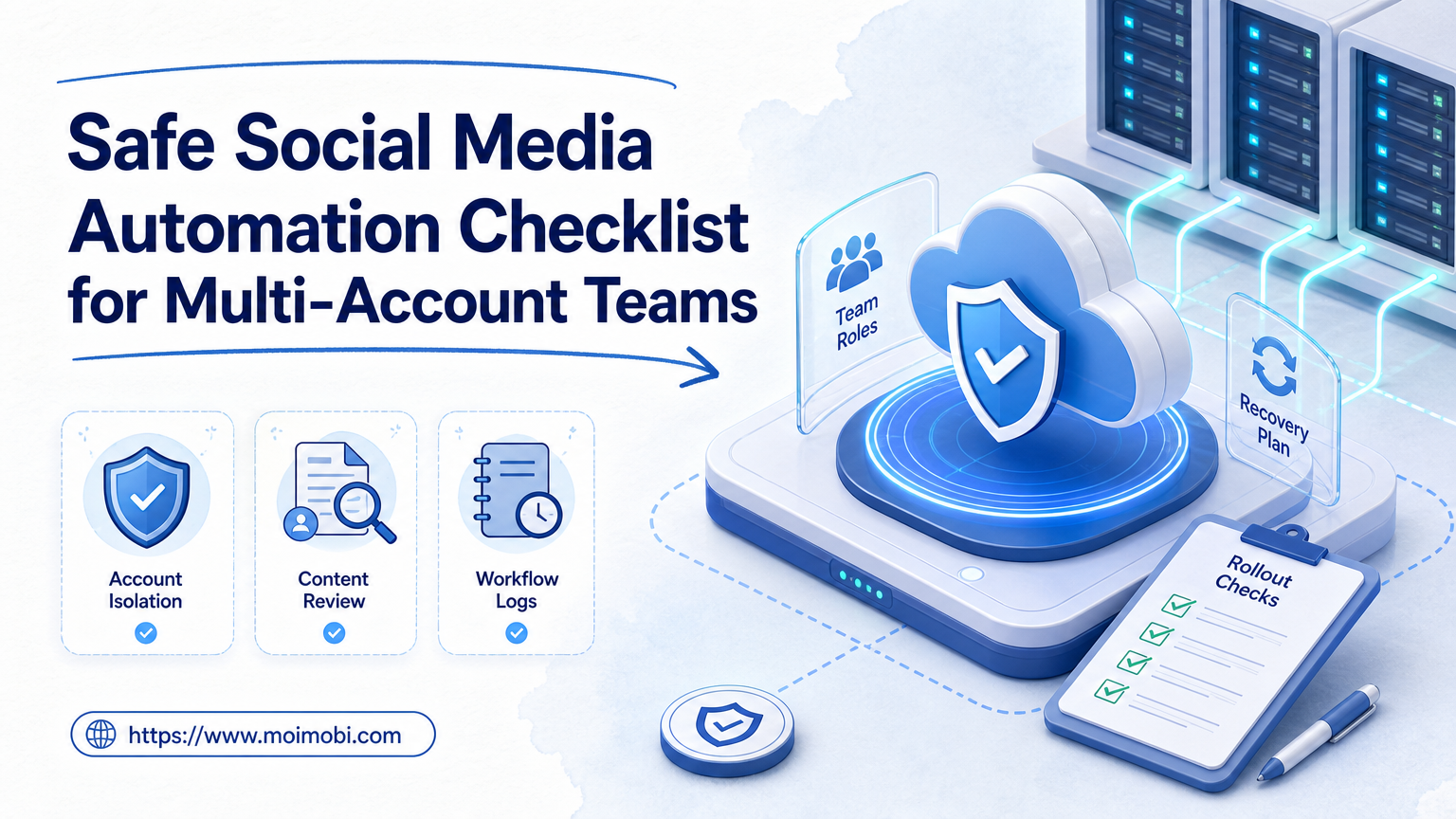
- Pass: one reviewer can inspect lane history without private chat context.
- Pass: each account group has a named owner and a visible next action.
- Pass: the team can separate content failures from lane failures quickly.
- Fail: operators still rely on memory to explain account state.
- Fail: one shared lane still covers unrelated account groups.
Frequently Asked Questions
Is Instagram TikTok multi-account management just a posting tool?
No. A posting tool can be one layer. Multi-account management also covers ownership, session control, reviews, and recovery.
Do all lanes need cloud phones?
No. Some teams begin with browser review lanes and move app-facing tasks into cloud-device lanes later.
What should a small growth team automate first?
Start with lane assignment, task scope, and exception logging before broader automation.
Is this only for agencies?
No. In-house growth teams also need clean routing when they manage several brands or markets.
What is the biggest warning sign?
The biggest warning sign is when nobody can explain the last account action without asking the same operator.
Should Instagram and TikTok share the same lane?
They can share a management model, but execution lanes often need platform-specific rules.
What should a pilot prove first?
It should prove that the team can review, reassign, and recover the lane cleanly.
Conclusion
Instagram TikTok multi-account management is a control framework for growth teams, not a shortcut for account volume. The useful version gives each lane a clear environment, owner, task scope, and recovery rule.
Start with one cluster, one lane map, and one review loop. If the team can explain the workflow without relying on memory, the model is ready to expand.