
Choose a cloud-based Android emulator for app testing when you need repeatable virtual configurations and controlled resets. Evaluate a cloud phone when the job needs a persistent remote Android workspace and ongoing operator access. Neither label proves hardware fidelity, app compatibility or session persistence. Ask the provider what actually runs underneath.
The deciding question is whether you are validating a software build or maintaining an operational environment. A release test should produce evidence about a named build. An ongoing workspace should preserve the state your authorized workflow needs. If your requirement depends on physical hardware, evaluate real devices separately rather than assuming either cloud label means physical.
Key Takeaways
- Cloud describes hosting; emulator describes an execution model.
- App testing and ongoing account work need different lifecycle rules.
- Check Android version, app dependencies and reset behavior before price.
- Require useful failure evidence, not just a screen that opens.
- Hardware-dependent release checks may need a separate physical-device test.
Define a cloud-based Android emulator for app testing
For this comparison, the term means a remotely hosted virtual Android environment used to evaluate an app. The hosting service may expose a screen, a test runner or both. Confirm that definition with each vendor because product names do not establish architecture.
Android's virtual-device documentation describes an AVD as a configuration for a simulated device. It includes a hardware profile, system image and storage area. That explains the Android emulator concept. It does not establish how a particular cloud service provisions its machines or preserves their state.
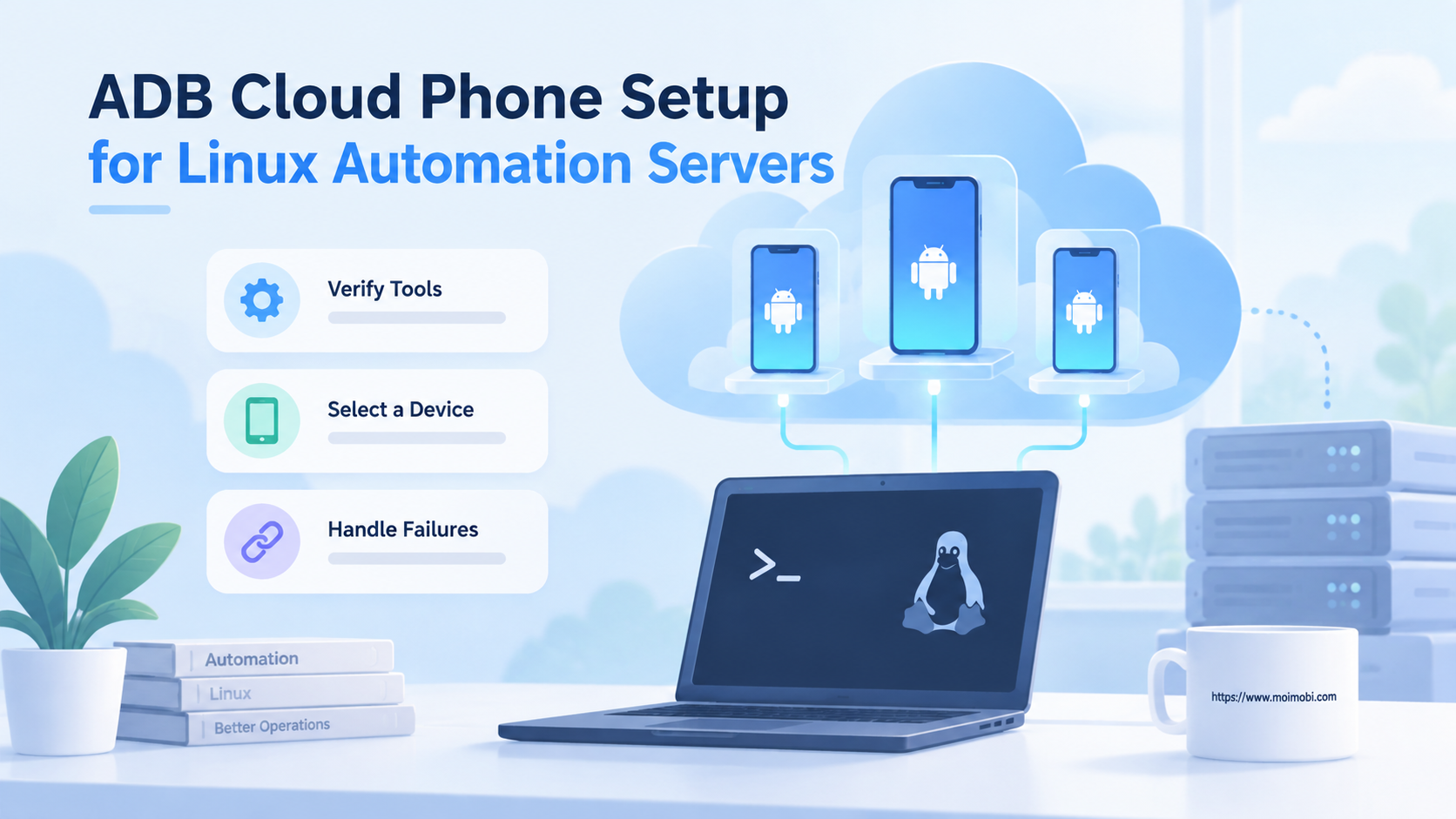
Define cloud phone separately as a remote Android workspace offered for continuing use. The underlying implementation varies by provider. Treat persistence, hardware access and automation support as questions to verify, not properties that follow from the name.
A third category is a hosted physical-device testing service. AWS describes Device Farm as testing and interacting with apps on real phones and tablets. This is a useful counterexample to the idea that all remote Android screens are emulators. It is not evidence that a cloud-phone vendor uses physical devices.
When comparing quotations, ask vendors to identify the execution model in writing. Keep unknown answers marked unknown. A polished device frame or familiar Android home screen cannot settle that question.
Compare the lifecycle, not just the device label
The most important distinction is what happens before and after a run. Testing often needs a known starting state. Continuing operations may need the opposite: approved app data and session state that survive the operator's next visit.
| Decision | App-testing requirement | Continuing-workspace requirement |
|---|---|---|
| Starting state | Named build and defined setup | Known account and retained work context |
| Reset | Reproduce a clean or prepared baseline | Avoid unintended loss of useful state |
| Configuration | Record image, version and dependencies | Keep required app behavior usable |
| Output | Result tied to a test case and build | Completed task with an accountable owner |
| Access | Runner and tester access | Operator access and handoff rules |
| Failure | Diagnose and reproduce the defect | Stop safely and recover the task |
These are evaluation criteria, not a claim that every emulator or phone service meets them. A vendor could provide both temporary test environments and persistent workspaces. Compare the actual service mode you are buying.
For example, a hypothetical checkout team might reset its test user before each release run. A support team might need yesterday's approved app configuration tomorrow. Reusing the same environment policy for both could make tests inconsistent or erase operational state.
Write the required reset behavior explicitly. “Restart” is ambiguous: it may close a viewer, reboot Android or recreate an environment. Ask for a demonstration showing which app data remains. Include the result in your acceptance record.
Choose a cloud-based Android emulator for app testing by coverage
List the app behaviors that matter before selecting devices. Include installation, sign-in, a key user journey, permissions, network interruption and recovery. Add hardware-dependent behavior where relevant. The provider's device count is not your coverage plan.
Record the app build, Android version and required dependencies for each case. A configuration that launches the app may still be unsuitable for the feature you need to validate. Do not describe a successful opening screen as a passed checkout, upload or notification test.
Use a consistent test case across candidate services. Change only the environment you are evaluating. If the app build, test account and network conditions all change together, you cannot explain why results differ.
Remote access also introduces a viewing path. Separate a slow streamed display from a slow app response during investigation. Collect whatever device-side timing or logs the provider actually exposes. If none are available, record that limitation rather than guessing the cause.
An emulator result should be described at its real scope. It can support conclusions about the tested configuration and actions. It does not automatically establish behavior on every physical handset, peripheral or operating-system version.
For a broader explanation of the categories, see the existing emulator and remote-phone comparison. This article adds a narrower decision: selecting an environment around release evidence and lifecycle requirements.
Which option fits continuing Android work?

Operational work has a different unit of completion. The task might involve reviewing an approved app screen or maintaining an authorized account context. Its result belongs to an owner and a workflow, not just a software build number.
Evaluate a persistent service only if continuity is necessary. Check what survives disconnecting, rebooting and changing operators. Verify these separately. A session that survives closing a browser tab may still disappear when the environment is recreated.
Access matters as much as persistence. The next operator should know the assigned account, permitted actions and last completed step. Avoid sharing more credentials or state than the role requires. Confirm whether the service offers the access controls you need today.
If the task can be completed entirely through a web application, a browser workspace may be more appropriate. Do not choose Android merely because the business operates social accounts. Start from the actual interface and action.
Moimobi is positioned around browser and mobile execution environments. Evaluate its cloud phone environment for ongoing work against your requirements, but verify the current feature and supported action through a demonstration. Product positioning and development plans do not prove that every mobile automation path is available.
A dedicated testing system may still be needed alongside an operational platform. Keeping customer operations running is not the same contract as reproducing failures across a release matrix. Combining them should not erase those different responsibilities.
Compare evidence, cost and recovery before buying
Testing infrastructure should help explain failures. AWS's report documentation lists pass/fail information, crash reports, logs and screenshots. Those are named AWS capabilities. Use them as a reference for questions, not as a feature list attributed to other services.
Ask whether a result identifies the app build, device configuration and failed step. Determine which artifacts are available and who can retrieve them. A generic “failed” badge is less useful than a traceable case, but artifact volume alone does not ensure useful diagnosis.
Cost comparisons need the same workload. Specify environment count, concurrent work, expected active time, storage needs and the required support mode. Get current written quotations rather than copying old public prices into a budget.
Include time spent preparing devices, waiting for capacity, reproducing problems and recovering interrupted tasks. A low unit price may not fit a workflow with frequent manual setup. Conversely, do not pay for persistent capacity if temporary test runs satisfy the task.
Compare recovery behavior during a small evaluation. Interrupt a harmless test session and check whether the provider preserves useful evidence. For an operational workspace, confirm the next authorized action after reconnecting. Do not repeat a customer-facing action merely because its status is unclear.
If account responsibilities span browser and mobile environments, keep them in an environment ownership and task register. Ownership should remain clear even when different infrastructure providers perform different parts of the work.
Run a bounded comparison before moving production work
- Write the requirement. Name the app, build or business task, required state and expected evidence. Separate mandatory requirements from conveniences.
- Confirm the environment. Get the execution model, Android configuration and supported access mode. Leave unverified answers unresolved.
- Use authorized test data. Choose a disposable test account and harmless workflow. Do not begin with customer credentials or live transactions.
- Run the same case. Capture the outcome, configuration and relevant artifacts from each candidate. Record unsupported steps as gaps, not passes.
- Test reset or persistence. Pick the behavior your use case needs. Check before and after state instead of trusting the button label.
- Make the decision by missing requirements. Reject a candidate that cannot meet a mandatory condition. Use cost and convenience only among suitable options.
You can split the decision. Virtual testing might cover repeatable software checks, physical devices might cover selected hardware behavior, and another workspace might support daily operations. The split should have a stated purpose, not become an excuse to operate several overlapping systems without ownership.
Do not invent a universal performance threshold for this evaluation. Set acceptance criteria from the task: the action must complete, the result must be observable, and failures must leave enough information to decide the next step. Record what was actually tested.
Frequently asked questions
Is a cloud phone always a real device?
No conclusion follows from that label. Ask the provider whether its environment uses virtual Android, physical hardware or another documented model.
Can a hosted emulator replace every physical-device test?
Do not assume that. Decide which features depend on physical behavior and validate those separately. State each test's actual scope.
Which option is better for regression testing?
Prefer the service that supports your controlled baseline, repeatable cases and useful failure evidence. Persistent workspaces alone do not establish those capabilities.
Which option is better for daily account work?
Evaluate continuity, authorized access and recovery. If the work is web-only, also consider a browser workspace rather than either Android option.
Should I compare monthly prices directly?
Only after aligning the workload and included services. Capacity, active usage, storage and support may have different charging models.
What if the app works locally but not remotely?
Record the build and environment differences first. Inspect the failed action and available logs. Avoid assuming the provider, account or app is at fault without evidence.
Can Moimobi replace an app-testing lab?
Do not infer that from its execution-platform positioning. Verify the specific testing, reporting and lifecycle capabilities you require before making that decision.
Verdict
A cloud-based Android emulator for app testing fits a controlled validation task when its configuration and outputs meet your requirements. A continuing remote workspace fits an operational task when persistence, access and recovery are verified. Add physical-device validation where the app's behavior requires it.
Start with one representative case and a written acceptance record. Select the service that closes your mandatory gaps, not the one with the most convincing device picture.