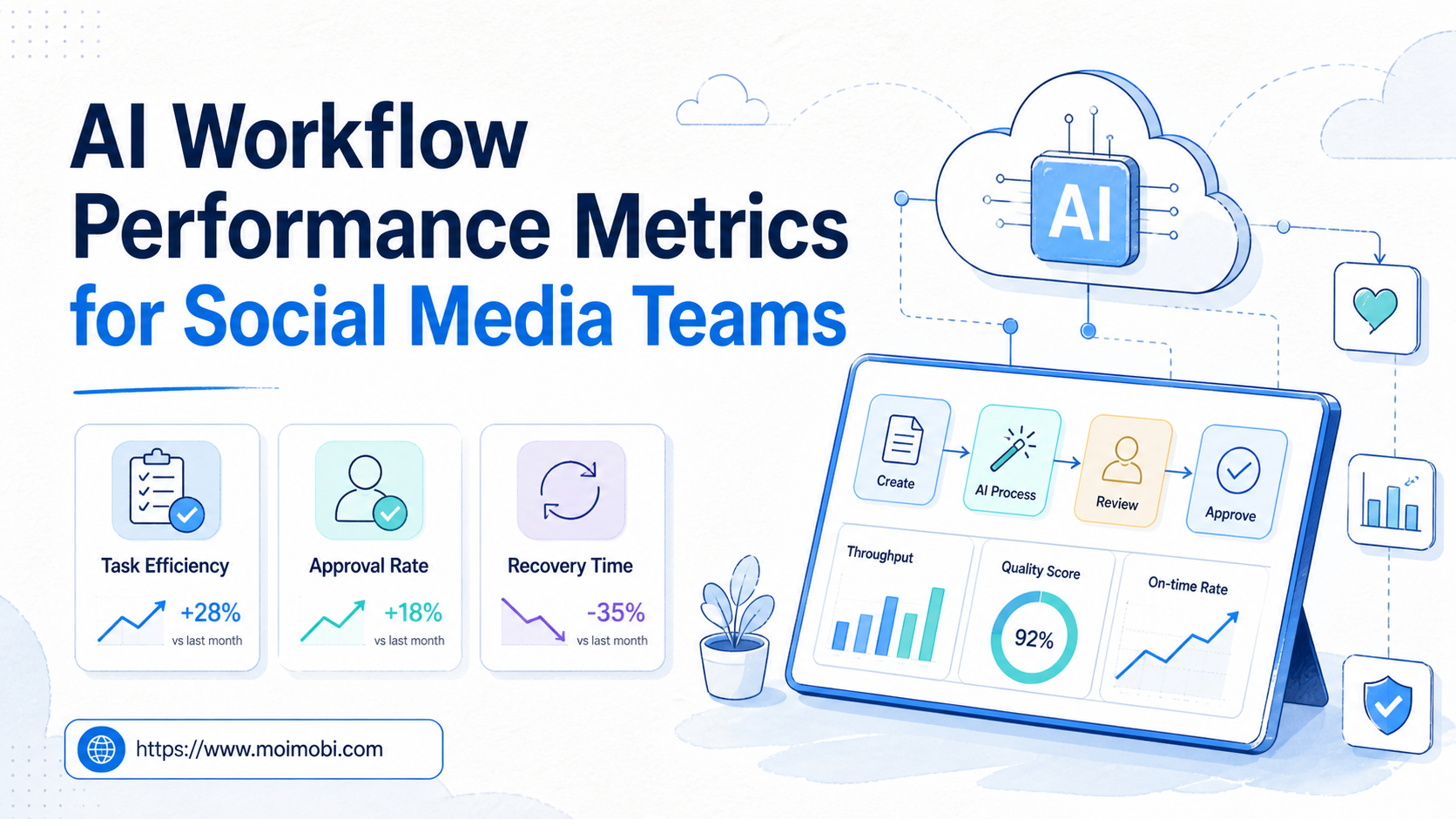
AI workflow performance metrics are measures that show whether a social media workflow is completed accurately, reviewed on time, recoverable after exceptions, and useful to the team. They are not a single engagement score. A team needs both output measures, such as tasks completed, and control measures, such as approval time and recovery quality.
This distinction matters when AI helps prepare captions, route messages, collect research, or coordinate recurring account work. A workflow can create more activity while becoming less reliable. The metrics below help teams spot that difference before they scale a fragile process.
Key takeaways
- Start with metrics tied to a specific task and owner.
- Measure quality, handoff, and recovery alongside volume.
- Use a small baseline before setting a target.
- Review exceptions by reason, not only by total count.
The Core Idea Behind AI Workflow Performance Metrics
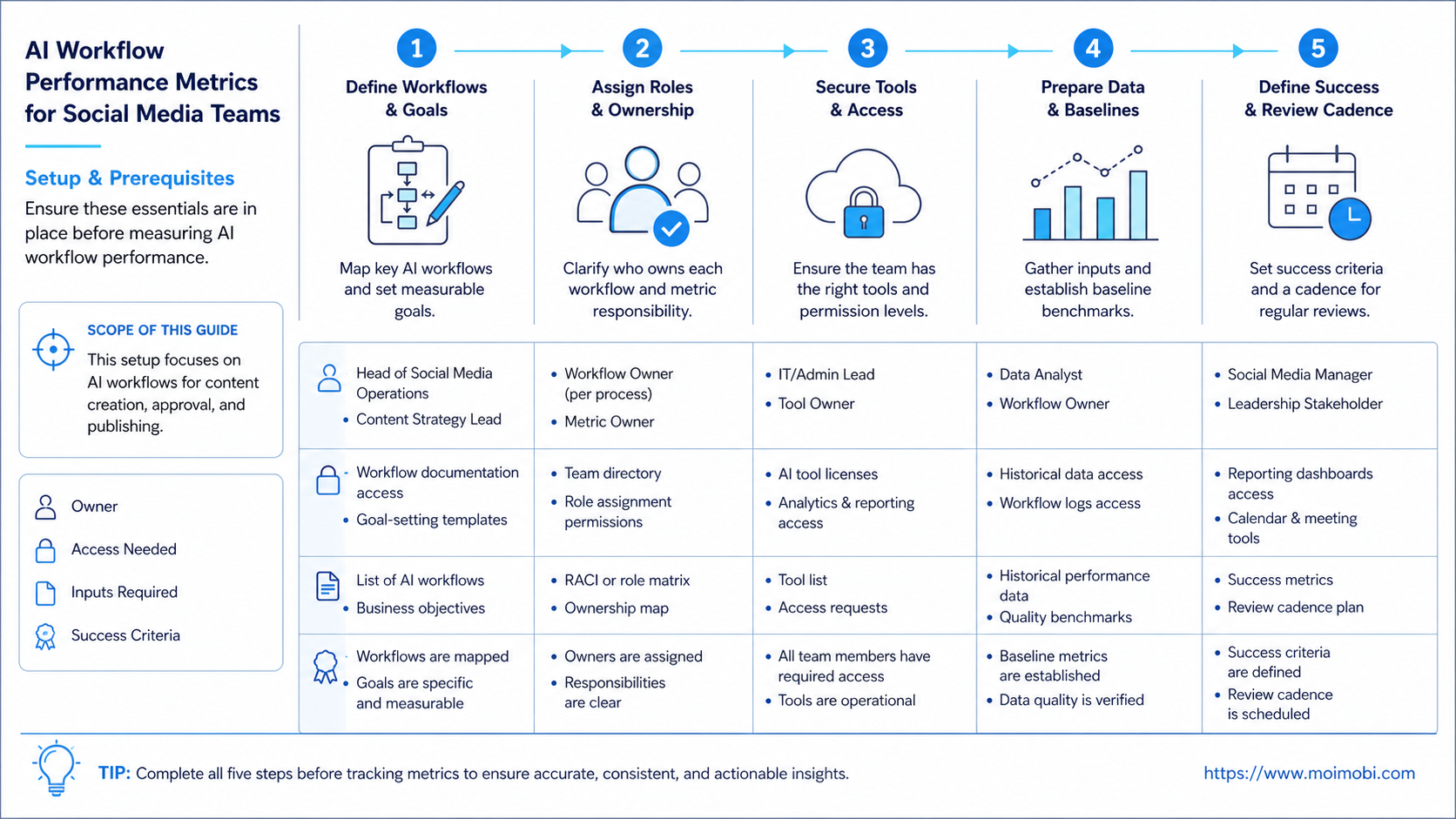
The wrong question is, “How much did the AI do?” The better question is, “Did the team complete the intended work with the right approval, account context, and evidence?” AI workflow performance metrics make that answer visible.
For a publishing workflow, the unit might be one approved post. For inbound engagement, it may be one message triaged to the correct owner. For research, it can be one brief with traceable sources. Each unit needs a start state, an owner, a completion rule, and a record of exceptions.
| Metric | What it answers | Useful first calculation |
|---|---|---|
| Completion rate | Did ready tasks finish? | Completed tasks divided by tasks marked ready |
| Approval turnaround | Did decisions arrive in time? | Median time from review request to decision |
| Rework rate | How often was work reopened? | Reopened tasks divided by completed tasks |
| Pause reason mix | Why did work stop? | Paused tasks grouped by reason code |
| Handoff success | Can a backup continue the task? | Tasks resumed without private-context chasing |
Numbers only help when their definitions stay stable. Do not change what “completed” means halfway through a reporting period. A completed task should meet a visible outcome rule, not merely show that an automated step ran.
Why Social Media Teams Need Workflow Measures
Social work often mixes content, account access, customer interaction, and review. A single dashboard total can hide the point where the workflow fails. For example, a high post count says little about whether content was approved, published to the intended account, or easy for another person to verify later.
A controlled social media marketing guide starts by separating preparation, approval, execution, and follow-up. Metrics should mirror those stages. That lets an operator see whether the bottleneck sits in content readiness, approver response, environment access, or the final handoff.
Use measures to improve the system, not to create a contest between people. An operator with a high pause count may be the person reporting incomplete inputs correctly. A low pause count may mean exceptions are being ignored. The reason code and the task record provide the context that a score alone cannot.
AI Workflow Performance Metrics for Daily Operations
Start with five daily measures. First, count tasks that entered the queue with all required inputs. Second, count tasks that completed without rework. Third, record how long external actions waited for approval. Fourth, label every pause with one primary reason. Fifth, test whether a backup can continue one selected task from the shared record.
Those five measures create a practical feedback loop. A low ready-to-complete rate usually points to weak briefs, missing approvals, or unclear account ownership. Slow approvals point to a decision-path problem. Rework points to unclear completion criteria. Repeated device or access pauses may indicate that the environment needs a clearer assignment model.
- Name one workflow. Choose publication approval, message triage, research collection, or a similar recurring unit.
- Define ready and complete. Write the required input, approval state, owner, and proof of completion.
- Add reason codes. Use a small list: missing input, approval pending, access issue, environment unavailable, or quality correction.
- Collect one baseline week. Do not set a target before observing normal work.
- Review one exception pattern. Change one process condition, then measure the next week.
Avoid measuring every possible event. A ten-field report that nobody reviews is weaker than five measures connected to a weekly decision. The first reporting page should let a team answer: what finished, what stalled, why it stalled, and who owns the next action.
Fit Boundaries: Who Benefits Most
These metrics fit teams with recurring work, more than one owner, or a workflow that needs review before an external action. Agencies, distributed teams, and multi-account operations often benefit because handoff ambiguity is expensive even when individual tasks appear small.
They are less useful for a one-off creative experiment with no repeatable process. In that case, write the human workflow first. Measurement becomes useful once the team can identify a repeatable unit and a definition of done.
The same boundary applies to AI. AI is helpful when it supports a defined task such as drafting, sorting, extracting, or preparing a decision. It is not a substitute for the owner who decides whether an external action is appropriate. Keep approval and exception ownership visible, especially where multiple accounts or clients are involved.
Common Measurement Mistakes
Do not use volume as the only measure. More messages, posts, or research items can conceal more rework. Also avoid averaging every client lane into one number. A healthy average can hide a single workflow that consumes most of the review time.
Another mistake is to treat a task as complete when an automated action starts. Completion should mean the expected outcome was recorded and any required review occurred. If an action needs a separate mobile environment, assign the task to a specific cloud phone context before it begins. That makes task evidence easier to interpret when an exception appears.
Finally, do not change several controls at once. If the team changes the approval rule, task template, and device assignment together, the next report cannot show which change improved the process. Test one adjustment, keep the rest stable, and write down the decision.
Pilot Rollout, Measurement, and Recovery Checks
Run a pilot on one account group and one task type for seven days. Keep the sample small enough that the owner can inspect every exception. The purpose is to verify definitions, not to prove a large performance claim.
At the end of each day, review completed tasks, paused tasks, and any rework. Ask three questions: Was the task ready before it entered the queue? Did the right person approve the external action? Could another operator understand the outcome from the record? Those questions create a recovery check that is more useful than a generic success percentage.
NIST's log management guide describes logging as support for monitoring and analysis. A social team does not need a formal compliance program to apply the principle. Keep enough task evidence to reconstruct the action, account context, time, owner, and result. When an exception repeats, update the workflow template rather than asking people to remember a workaround.
AI Workflow Performance Metrics Data Rules
Metrics become misleading when the underlying task records are inconsistent. Define the event that starts a task, the event that completes it, and the person responsible for correcting an incomplete record. A task created from an approved content brief should not be compared directly with an exploratory research task unless the team has chosen a shared definition of completion.
Use a short data dictionary. It can live in the team SOP and should define each metric, calculation window, owner, excluded states, and decision it supports. For example, exclude a task that was cancelled before work began from completion-rate reporting, but include a task that was paused because an approval never arrived. That distinction prevents a report from making workflow friction disappear through labeling.
NIST's AI Risk Management Framework emphasizes governing and measuring AI-related risk in context. Applied here, that means pairing a volume metric with a quality or control metric. If a caption-drafting workflow produces more drafts but increases the number returned for correction, the team has a signal to inspect the prompt, source material, or review rule rather than celebrating the draft count.
Keep raw account credentials, private message content, and unrelated client data out of a performance report. The report should contain only the task evidence necessary for the review. When work requires separate account contexts, use account-isolated mobile environments to make the task assignment clearer, then retain the resulting task record in the appropriate lane.
A Weekly Review That Leads to a Decision
Set aside a short recurring review with the workflow owner, one operator, and the person who can change the process. Begin with a small scorecard: ready-to-complete rate, approval turnaround, rework rate, and top pause reason. Next, inspect one completed task and one paused task. The goal is to check whether the metric reflects the evidence, not to debate a dashboard color.
End the review by writing one action in the workflow record. It might be a clearer content brief, a new approval deadline, a revised reason code, or a better environment assignment. Give that action an owner and test it during the next reporting window. Without a concrete change, recurring measurement becomes reporting theater.
Attribution, Quality, and Outcome Metrics
Workflow health and campaign outcomes should be reported separately, then read together. A workflow can be healthy while a creative concept performs poorly. It can also deliver a strong campaign result through an unhealthy process that depends on one person working overtime or correcting hidden errors. Separating the two helps a team decide whether to improve the operating system or the content decision.
Use three layers. Execution metrics show whether the workflow moved: ready tasks, completed tasks, approval time, and pause reasons. Quality metrics show whether the output was usable: correction rate, source completeness, review acceptance, and duplicate-action incidents. Outcome metrics show the business result chosen for that campaign, such as qualified replies, completed handoffs, or another agreed signal. Do not infer an outcome metric from execution activity alone.
For message-handling work, a useful quality metric is whether a message reached the assigned owner with enough source context to continue. For a publishing workflow, it may be whether the final post matched the approved brief and account. For research, it may be whether a reviewer can trace the source and decision. These measures make AI support auditable without pretending the system can decide every judgement call.
OWASP's logging vocabulary describes the importance of consistent event language. Teams can use the same principle by keeping reason codes stable across weeks. Rename a code only when its meaning changes; otherwise a trend line will combine unrelated events and become difficult to interpret.
How to Verify a Social Media Workflow Improved
Do not call a workflow improved after one busy day. Compare a pilot week with the next stable week using the same task definition. Look for a meaningful operational change: fewer tasks returned for missing inputs, shorter approval waits without more rework, fewer unassigned exceptions, or a higher rate of successful handoffs.
Use a verification checklist:
- Can the workflow owner explain how each metric is calculated?
- Can an operator find the correct account, environment, and next action from the task record?
- Can a backup resume a paused task without private-message context?
- Are reasons for pauses specific enough to lead to a process change?
- Did the team improve one measure without damaging correction rate or approval quality?
If the answer is no, narrow the workflow before adding more automation. A mobile automation operating flow is useful only when the team can observe the action, handle an exception, and recover cleanly. Expand from one reliable task type rather than starting with every social channel.
Frequently Asked Questions
What is the first metric to track?
Start with ready-to-complete rate. It reveals whether tasks arrive with enough inputs and ownership to be executed.
Should teams track likes and comments here?
Track outcome metrics separately. Workflow metrics explain whether the operating process was reliable enough to interpret those outcomes.
How often should the team review metrics?
A short weekly review works for many recurring workflows. Review urgent exceptions on the day they occur.
Can AI approve social posts automatically?
Teams should keep approval rules tied to the risk of the action. AI can prepare information, but named owners should control sensitive decisions.
What does a high rework rate mean?
It can indicate unclear briefs, weak approval criteria, missing context, or an incomplete definition of done. Review examples before changing targets.
How many reason codes are enough?
Begin with four to six. Add a new code only when a repeated exception needs a different corrective action.
What proves that a pilot worked?
The team can show that tasks were completed, paused, handed off, and recovered through a shared record without relying on private messages.
Conclusion
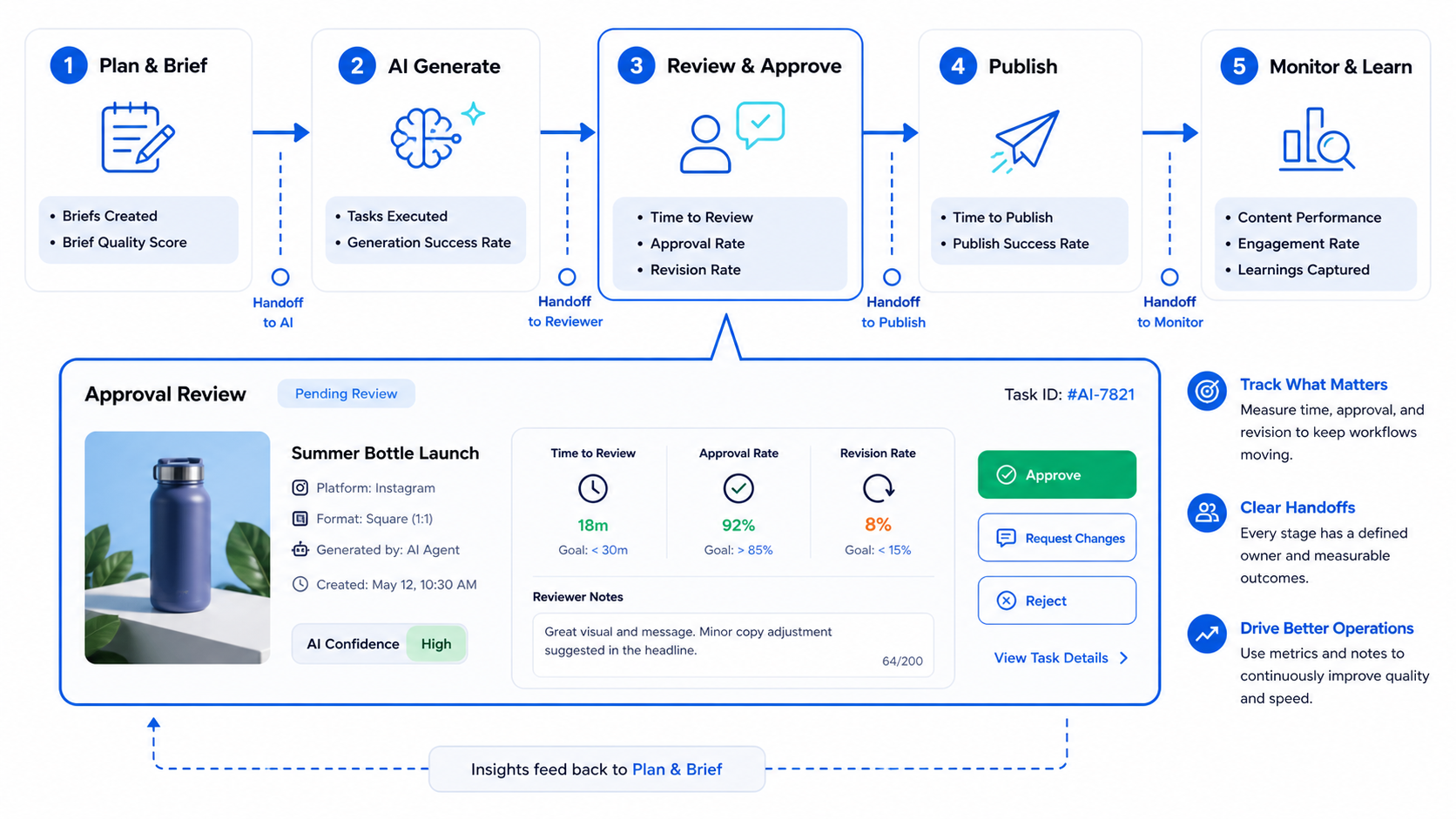
AI workflow performance metrics should make operations clearer, not noisier. Prioritize one defined task, a stable completion rule, a short list of exception reasons, and a weekly decision based on evidence. Once those basics work, add scope carefully rather than expanding activity first.