Content Type: guide
Page Role: longtail
Intent Type: informational
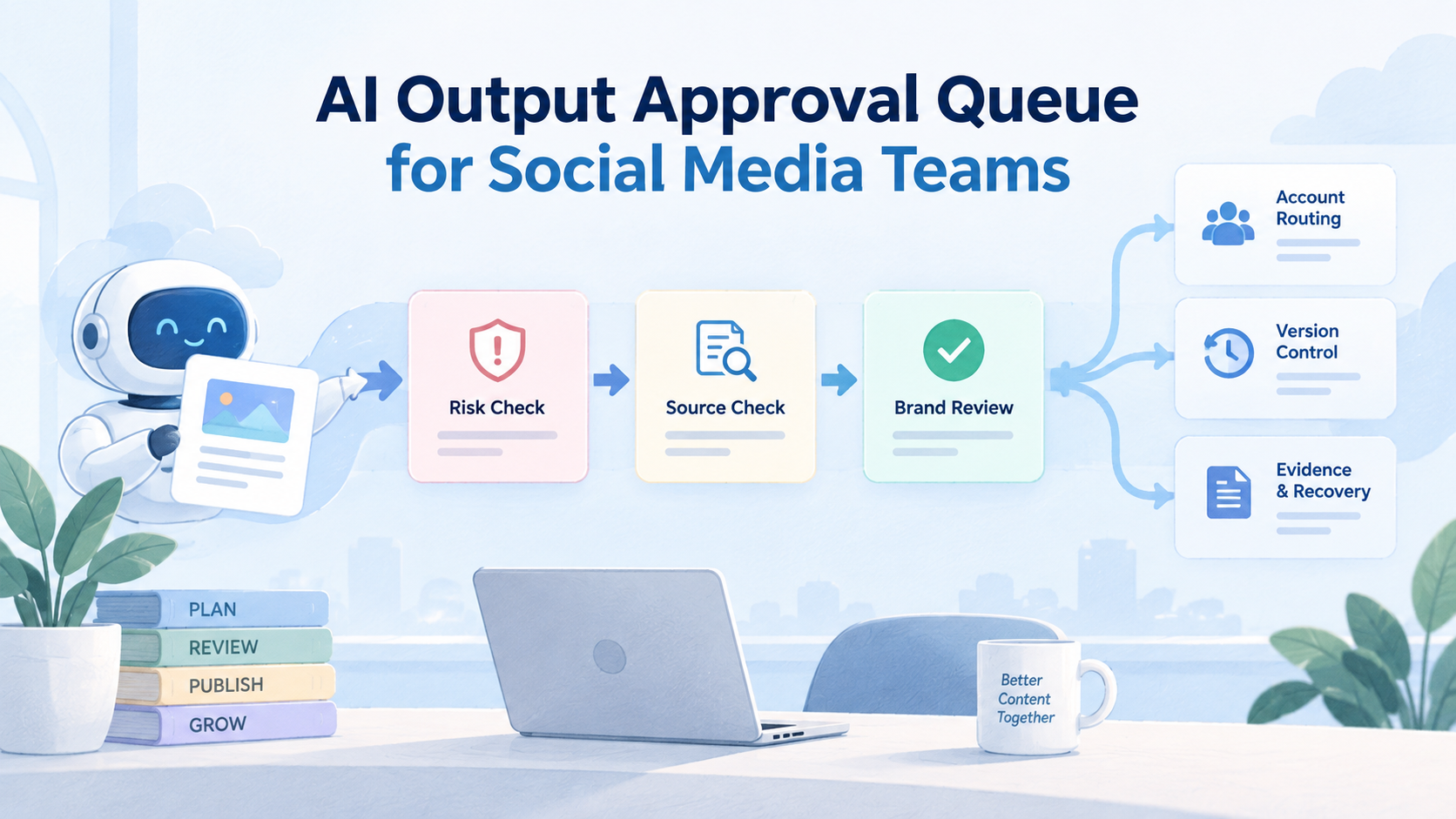
An AI output approval queue is a controlled worklist that holds generated social content until the required facts, brand rules, disclosures, account assignment, and human decisions are complete. It separates content creation from permission to publish.
The queue should not send every caption through the same review path. Routine rewrites, local promotions, customer replies, regulated claims, and crisis posts have different risks. A useful system classifies each item and shows reviewers only the decisions they own.
Approval also needs to survive execution. The exact approved version must reach the intended account and platform. If text, media, disclosure, link, or destination changes afterward, the workflow should reopen the relevant checks.
Key Takeaways
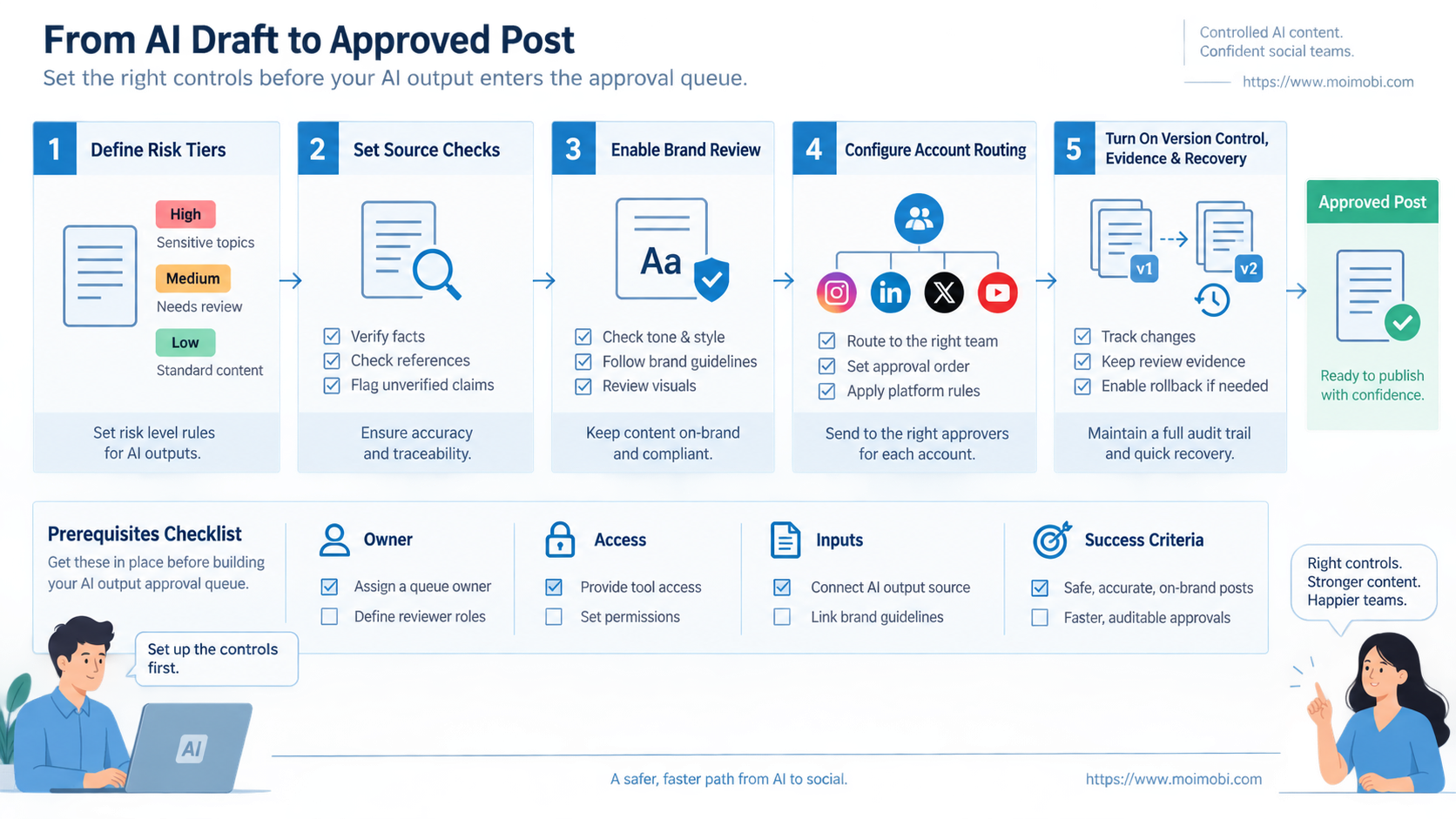
- Review AI output by risk, claim type, audience, account, and action.
- Freeze the proposed content version before a reviewer decides.
- Show sources and policy triggers beside the draft, not in another tool.
- Keep approval, publishing, and remote verification as separate states.
- Measure reviewer corrections and prevented errors, not approval volume alone.
What an AI Output Approval Queue Must Control
The queue is not a folder of drafts. Each item needs a task identity, source request, generated version, target platform, account, campaign, owner, risk tier, required reviewers, decision history, and publish state. This makes the work resumable across people and systems.
NIST describes its AI Risk Management Framework as a voluntary way to incorporate trustworthiness considerations into AI design, development, use, and evaluation. A social approval queue applies that broad idea to one narrow operating surface: generated content that may become a public brand action.
The queue should answer five questions:
| Decision | Evidence shown to reviewer | Result |
|---|---|---|
| Is the output relevant? | Request, audience, channel, campaign | Accept or return |
| Are claims supported? | Source links and approved product facts | Approve, edit, or escalate |
| Does it follow brand rules? | Voice, terminology, asset, prohibited wording | Approve or revise |
| Is disclosure required? | Relationship, incentive, creator, jurisdiction | Insert or escalate |
| May it publish here? | Account, role, approval, timing, platform state | Queue or block execution |
Do not let the model mark its own output approved. It may run checks, identify sources, and explain uncertainty. A separate policy service and authorized reviewer decide whether the task may advance.
Why Social Media Teams Need Risk-Based Review
AI content varies in consequence. A spelling correction to an approved evergreen post is not equal to a health claim, customer reply, limited-time offer, creator endorsement, or crisis statement. One universal approval path either creates a bottleneck or leaves high-risk work under-reviewed.
Create three or four practical tiers. Low-risk content can include bounded transformations of approved material. Medium-risk work may introduce local facts, new creative, or customer context. High-risk work includes unsupported claims, regulated subjects, public disputes, personal data, safety issues, financial impact, or legal language.
The FTC's AI claims guidance warns businesses against exaggerating AI capabilities and making unsupported performance claims. That principle matters when AI drafts product marketing. A confident sentence is not evidence; the reviewer needs the approved source behind it.
Risk tiers should change controls, not merely display color. A low-risk task might need automated checks and one brand owner. A high-risk task may need source verification, specialist review, legal approval, and manual publishing.
Preflight Data for the AI Output Approval Queue
Require these fields before generation enters review:
- content request and intended audience;
- campaign, channel, locale, and target account;
- content type and requested action;
- approved source documents and their versions;
- prohibited topics and required terms;
- offer dates, prices, links, and local facts;
- creator, employee, incentive, or sponsorship relationships;
- risk tier and triggered review rules;
- content and media version identifiers;
- requester, generator, owner, and deadline.
Missing information should create a visible blocked state. The system should not fill a factual gap by asking the model to guess. Route it back to the requester with the exact fields required.
Use an account-specific review and publishing map. A reviewer may approve language for one brand or region without authorizing another account. Account scope belongs inside the decision record.
How to Build the AI Output Approval Queue
- Create a typed request. Bind the brief to campaign, platform, account, locale, source set, and desired action.
- Generate a candidate. Store model, prompt version, retrieval inputs, output, and time without treating generation as approval.
- Run deterministic checks. Validate length, links, dates, required terms, forbidden phrases, mentions, and disclosure slots.
- Assign a risk tier. Use claim type, audience, content format, account, customer context, and action impact.
- Freeze the review version. Give the candidate a version ID and content fingerprint before human review.
- Route decisions. Send brand, factual, local, legal, or customer-support questions to their named owners.
- Collect structured feedback. Require approve, edit, reject, or escalate plus reason codes and optional comments.
- Create the approved payload. Store final text, media, links, disclosure, account, timing, approvers, and expiry.
- Recheck before publish. Compare the execution payload with the approved fingerprint and current account assignment.
- Verify and close. Record the remote post or reply identifier, result, and any later correction.
Keep the queue connected to a controlled social publishing path. Approval should create a bounded execution task, not copy text to a shared chat where account and version context disappear.
Design Reviewer Views Around Decisions
Reviewers need context, not a long form. Put the requested action, audience, account, candidate, changed fields, sources, triggered rules, and previous decisions on one screen. Hide technical generation details unless they help the decision.
Use side-by-side versions when a draft was edited. Highlight changed claims, numbers, dates, links, and disclosures. A reviewer should see whether an approved sentence was removed or altered after an earlier decision.
Provide reason codes such as unsupported_claim, wrong_account, missing_disclosure, brand_voice, stale_offer, private_data, policy_conflict, and needs_local_fact. Structured reasons reveal recurring upstream problems. Comments alone are harder to measure.
Let reviewers approve only their scope. A local manager can confirm store hours while a brand owner controls product positioning. The task advances when all required decisions apply to the same content version.
Source Checks and AI-Specific Failure Modes
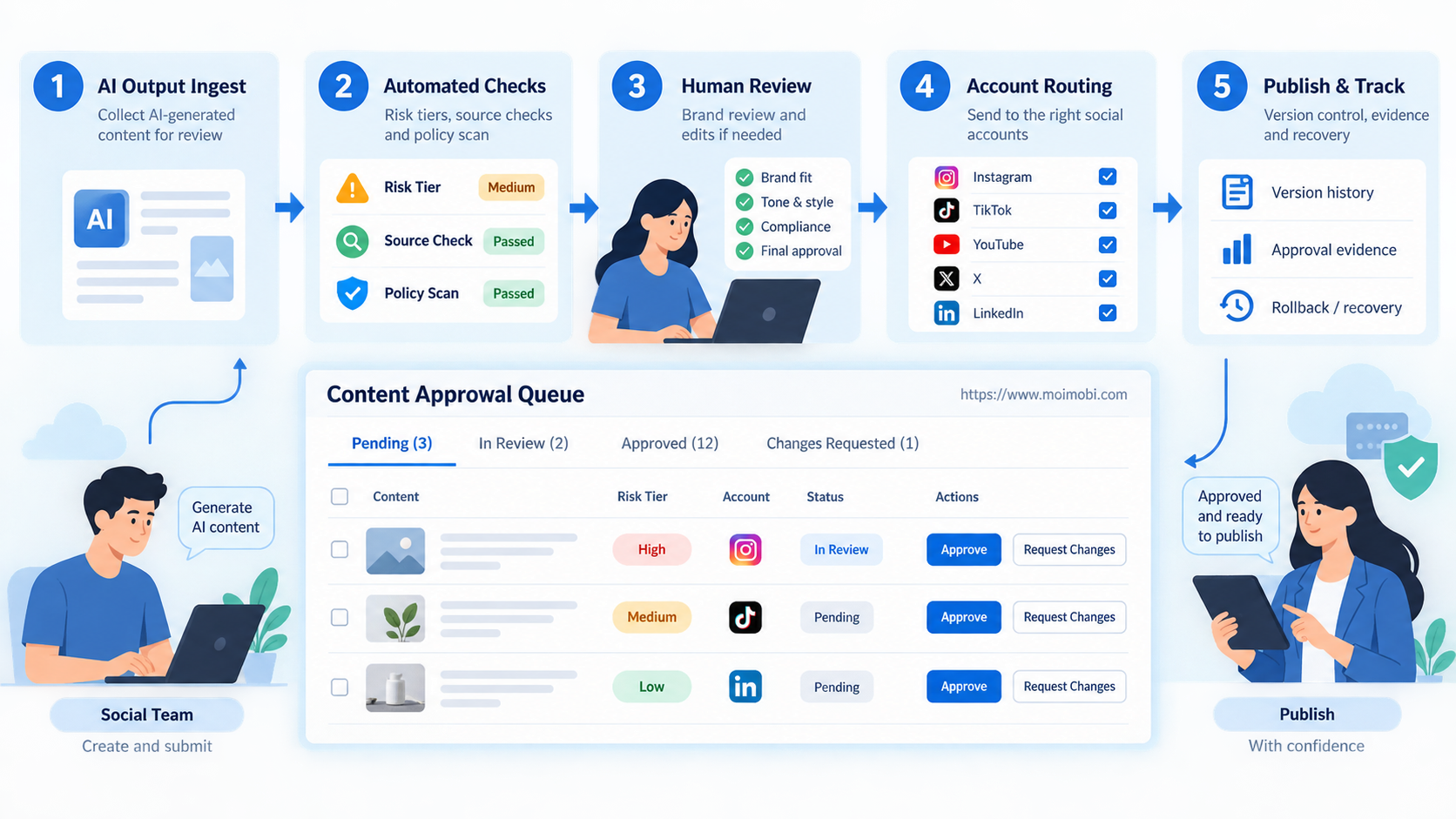
Generative output can be fluent while unsupported. Review should trace factual claims to approved sources and mark uncertain statements. Do not treat citations added by a model as valid until the linked material is checked.
NIST's Generative AI Profile identifies generative-AI risks and suggested actions across governance, mapping, measurement, and management. For social content, a practical implementation includes source control, pre-deployment testing, content provenance, incident handling, and documented human responsibility.
Check these failure modes:
- fabricated product capability or customer result;
- stale price, offer, feature, date, or policy;
- claim stronger than the source supports;
- hidden prompt or retrieved content changing instructions;
- private customer data appearing in public copy;
- disclosure removed during rewriting;
- brand voice copied into an inappropriate support response;
- output intended for one account routed to another;
- image and caption making conflicting claims.
The system can flag patterns, but reviewers need the authority to stop the task. Escalation should preserve the candidate, evidence, and triggered rule.
Versioning, Expiry, and Execution Controls
An approval applies to a specific payload. Store text, media references, destination link, mentions, hashtags, disclosure, target account, platform, locale, schedule, and content fingerprint. A later change must identify which checks are invalidated.
Approvals should expire when a campaign ends, an offer changes, source material is replaced, or a policy update affects the content. The publishing worker must check expiry immediately before action.
For app-based posting, a review-bound mobile execution lane should receive only the approved payload and assigned account. The worker may prepare a preview, but it cannot substitute new text or choose another account.
Match the execution environment to the approved channel. Browser-based publishing can use a controlled browser profile when the platform and workflow support it. An assigned cloud phone is relevant when the approved action must occur inside an Android app. The approval record should name that channel so an operator cannot move the task between web and mobile merely because one environment is available.
Before the final action, render a publish preview from the actual payload. Show the destination account, visible text, media order, link, disclosure, mentions, schedule, and current approval fingerprint. A mismatch should return the item to review rather than letting the executor repair content on its own. This checkpoint also gives a human operator a precise handoff when an app screen or platform format differs from the expected state.
Separate these states: approved, scheduled, executing, submitted, and verified. A local click or API response may prove submission, not final remote visibility. Record the platform object identifier or an independent read-back when possible.
Common Mistakes
Approving a prompt instead of output: The same prompt can produce different content. Review the exact version that will publish.
Showing no source context: Reviewers cannot verify claims when product facts and campaign rules live elsewhere. Attach the approved evidence.
Using one reviewer for everything: Brand, legal, local, support, and platform decisions require different owners. Route by decision type.
Editing after approval: Any meaningful change should create a new version and reopen relevant checks.
Copying approved text manually: Manual handoff loses account, schedule, media, and approval scope. Create a task-bound execution payload.
Measuring review speed only: Fast approval is harmful when it increases corrections, wrong-account posts, unsupported claims, or deleted content.
Letting generated content include credentials or private data: Use a separated account execution workspace and keep secrets outside prompts and review text.
Fit and Not-Fit Boundaries
- Teams generate recurring social content.
- Claims have approved sources.
- Accounts and roles are mapped.
- Review decisions can be named.
- Most work is exceptional.
- Local facts change quickly.
- Legal judgment is frequent.
- Humans write final language.
- The goal is unreviewed bulk output.
- No owner exists for claims.
- Account access is shared informally.
- There is no correction process.
The queue is strongest when content volume is high enough to create coordination problems but rules are clear enough to encode. A small team can begin with versioned requests and structured decisions before adding automation.
Do not use approval software to create the appearance of governance. If reviewers lack time, context, or authority, adding a button will not improve decisions.
Pilot, Measurement, and Recovery
Pilot one content type, one brand account group, and one risk tier. Keep publishing under direct observation. Include accepted, edited, rejected, escalated, and expired cases so every path is tested.
Measure:
- requests blocked for missing inputs;
- deterministic check failures;
- review time by decision type;
- acceptance, edit, rejection, and escalation;
- source or disclosure corrections;
- changes after approval;
- account-routing conflicts;
- verified publish success;
- corrections or removals after publication;
- reviewer agreement on repeated examples.
Test recovery by expiring an approval, replacing a source, changing the account assignment, editing media after review, and interrupting publication. The system should stop the task and preserve the full decision history.
Before expansion, verify that every remote post maps to one approved payload, account, and decision chain. A reviewer should reconstruct why it was allowed without reading private chat threads.
Frequently Asked Questions
Does every AI-generated post need human approval?
Not necessarily. Use risk tiers. High-impact or uncertain content needs stronger review, while bounded transformations may pass automated checks and a lighter policy.
What should reviewers check first?
Start with factual claims, audience, account, disclosure, sensitive data, and the requested action. Brand polish comes after those gates.
Can AI review another AI's output?
AI can flag issues and compare rules. It should not be the sole authority for high-impact publication or unsupported factual claims.
How many approval states are needed?
Use only states that change the next permitted action. Draft, review, changes requested, approved, expired, scheduled, executing, verified, and cancelled are a practical start.
What happens after an approved caption changes?
Create a new version and rerun checks affected by the edit. Claims, links, disclosure, media, and account changes usually require renewed review.
How should reviewer feedback be stored?
Store a decision, reason code, scope, content version, reviewer, time, and optional comment. Keep the event append-only.
What if publication succeeds but verification fails?
Mark the outcome unknown. Check the remote account before retrying so the workflow does not create a duplicate post.
Which metric shows approval quality?
Use prevented errors, reviewer correction categories, post-publication fixes, wrong-account prevention, and verified outcomes alongside cycle time.
Conclusion
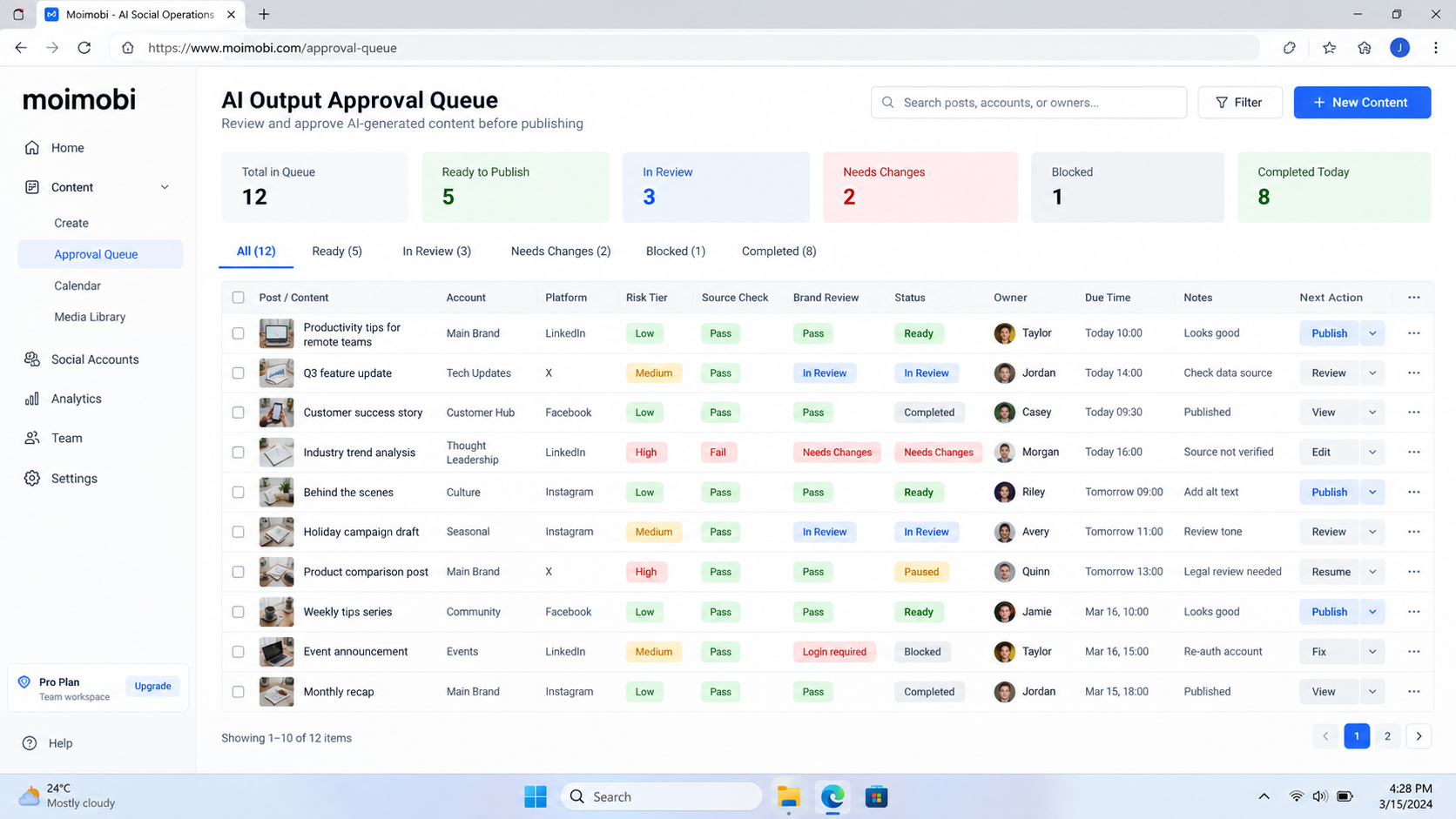
An AI output approval queue turns generated content into accountable social operations. It connects the request, evidence, risk tier, exact version, reviewer authority, destination account, and remote result.
Begin with one repeatable content type. Define required inputs, decision owners, invalidating edits, publish evidence, and recovery. Expand only when approved versions reach the right accounts and reviewers can explain every exception from the recorded workflow.