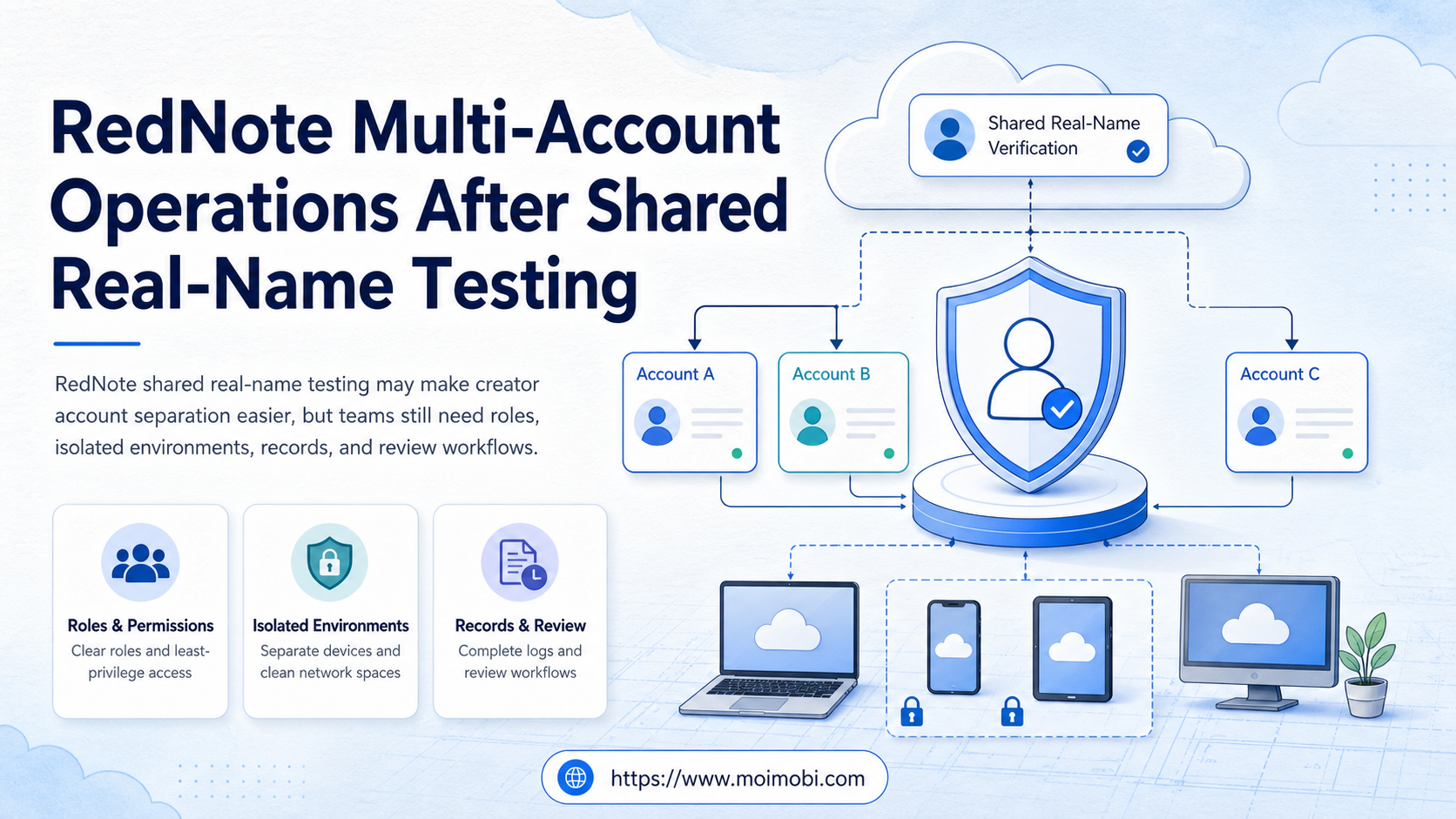
RedNote multi-account operations are not just about opening more accounts. They are about separating creator identity, content purpose, commerce workflow, mobile execution, and review records so each account has a clear job. A recent X Article from HytidelLegend discussed a Xiaohongshu / RedNote test around “shared real-name” verification, where one identity document may be able to verify more than one account. If this rolls out more broadly, it could make account separation easier for creators and small commerce teams. It does not remove the need for controlled account operations.
The useful takeaway is simple: if one person or one team can operate more than one verified account, the operating model must become more disciplined. A second account should not become a duplicate posting lane. It should have a distinct role, separate execution environment, clear content boundary, and enough records for review.

Key Takeaways
- RedNote multi-account operations should start with account roles, not account volume.
- Shared real-name testing may reduce one setup constraint, but platform rules and review boundaries still matter.
- Teams need separated mobile environments, task records, and stop rules before they scale repeatable workflows.
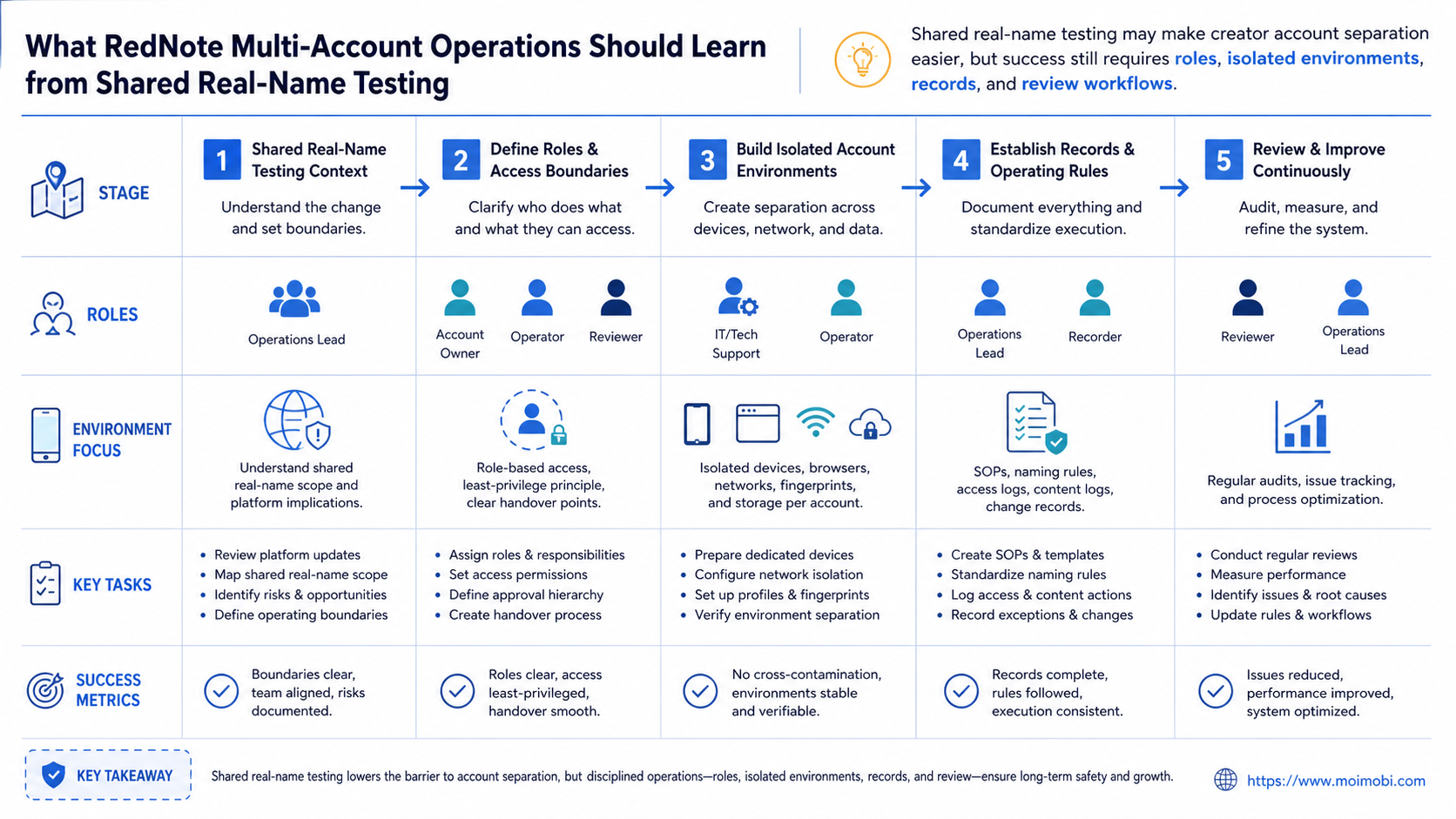
What RedNote multi-account operations should learn from shared real-name testing
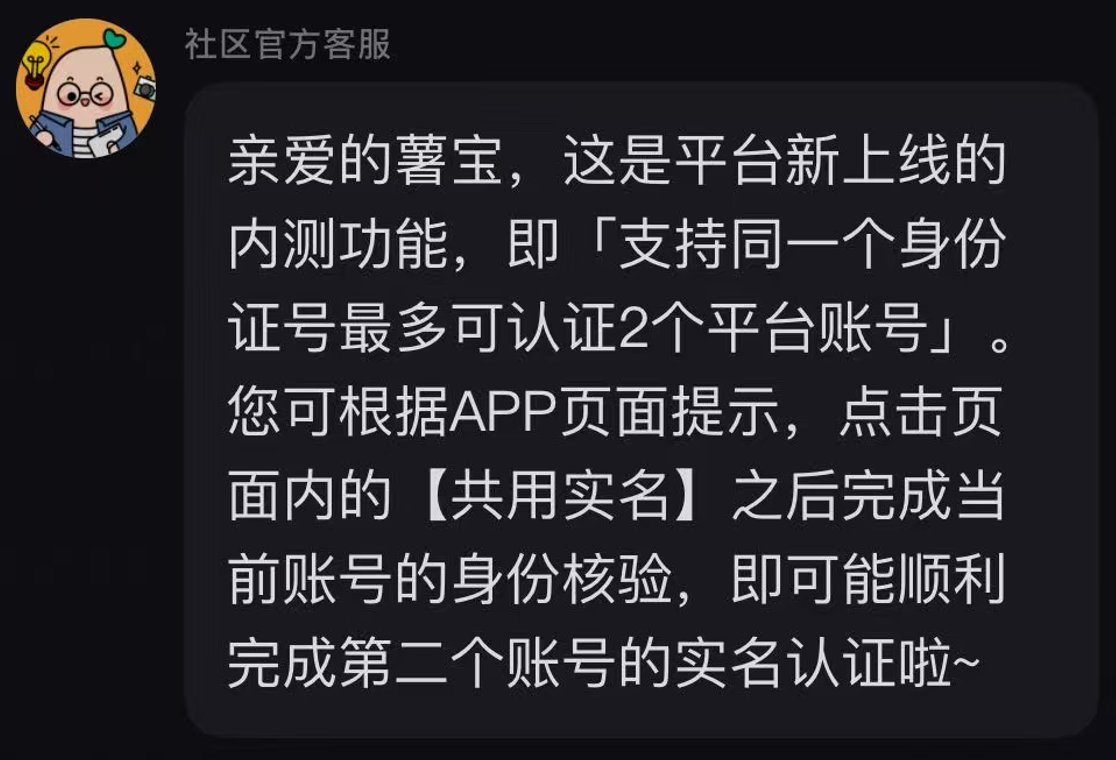
The source article describes a test where the RedNote app may show language suggesting that one identity document can bind two accounts. This should be treated as a product test or phased feature unless the account sees it directly in the app. Platform rules can change by region, account type, creator status, and product rollout stage.
The operational impact is still worth studying. RedNote already connects content, community interaction, and commerce workflows. Its professional account platform describes account identity, data insight, homepage management, follower interaction, shop setup, product cooperation, and promotion capabilities as part of the business account environment. Its identity verification policy also emphasizes that submitted information should be authentic, lawful, accurate, and valid.
For creator teams, a second verified account could support cleaner separation:
- A creator identity account can focus on trust, expertise, and audience building.
- A buyer or product account can focus on recommendations, reviews, and conversion paths.
- A shop or professional account can handle business identity, product details, and customer handoff.
- A test account can validate content formats before the team changes the main publishing lane.
That separation is useful only when the team can manage it. Without account roles, a second verified account can quickly become a second place to repeat the same content.
Why creators split accounts in the first place
Single-account overload is common in creator commerce. One account starts as a personal brand, then adds product recommendations, sponsorships, shop content, customer replies, live sales, and private traffic handoff. The profile becomes harder to understand. The content feed mixes trust-building posts with hard conversion posts. The team cannot tell whether growth came from topic fit, product fit, timing, account strength, or paid push.
Splitting accounts can solve this, but only when each account has a clear operating contract.
| Account role | Best use | Risk if unclear |
|---|---|---|
| Personal creator account | Story, expertise, trust, audience relationship | Profile becomes too commercial |
| Buyer or product account | Selection, review, usage scenes, conversion | Content feels repetitive or promotional |
| Shop or professional account | Brand identity, product detail, support path | Organic content may become too transactional |
| Test account | Hooks, covers, topic testing, early experiments | Results get confused with the main account |
This is where account operations become infrastructure work. Teams need an account map, login ownership, mobile device assignment, publishing workflow, comment and message handoff, and review history. A spreadsheet may work for two accounts. It often breaks once the same team manages multiple creators, shops, markets, or campaign lanes.
Account separation still needs environment separation
Multi-account work is not only a content strategy problem. It is also an execution environment problem.
If every account is opened from the same desktop browser, the same mobile device, the same unmanaged proxy path, and the same shared operator login, the team has limited control over session history, accountability, and troubleshooting. When a problem appears, it becomes hard to know whether it came from content, device environment, operator behavior, platform policy, or repeated workflow mistakes.
For mobile-first platforms, a cloud phone can help create a persistent Android environment for each operating lane. That does not mean a cloud phone makes an account safe by itself. It means the team can assign a stable device context, keep workflows separated, and review execution history more cleanly.
For teams evaluating infrastructure rather than one temporary test device, the next layer is a dedicated Android execution product that supports repeatable mobile execution. For social media work, account separation should be paired with workflow records, role-based access, and a clear stop rule when an account behaves abnormally.
A practical operating model for two verified creator accounts
If a creator or small team gains the ability to operate two verified RedNote accounts, the safest first step is not scale. It is assignment.
Start with a small account charter:
- Define the business goal for each account.
- Decide whether the account is for content, commerce, support, or testing.
- Set allowed content categories and blocked categories.
- Assign one owner for publishing and one reviewer for abnormal cases.
- Keep a task record for content, replies, edits, and customer handoff.
- Review weekly whether the two accounts are helping or confusing the audience.
The two-account model can be simple:
| Operating lane | Account A | Account B |
|---|---|---|
| Personal brand plus commerce | Trust-building creator account | Product or buyer account |
| Shop plus content | Content discovery account | Shop or professional account |
| Testing plus main publishing | Experiment account | Main account |
| Service business | Education account | Lead qualification and support account |
This structure also keeps automation in the right place. AI and automation should help prepare captions, summarize feedback, schedule tasks, collect lead signals, and create review records. It should not blindly duplicate every action across accounts.
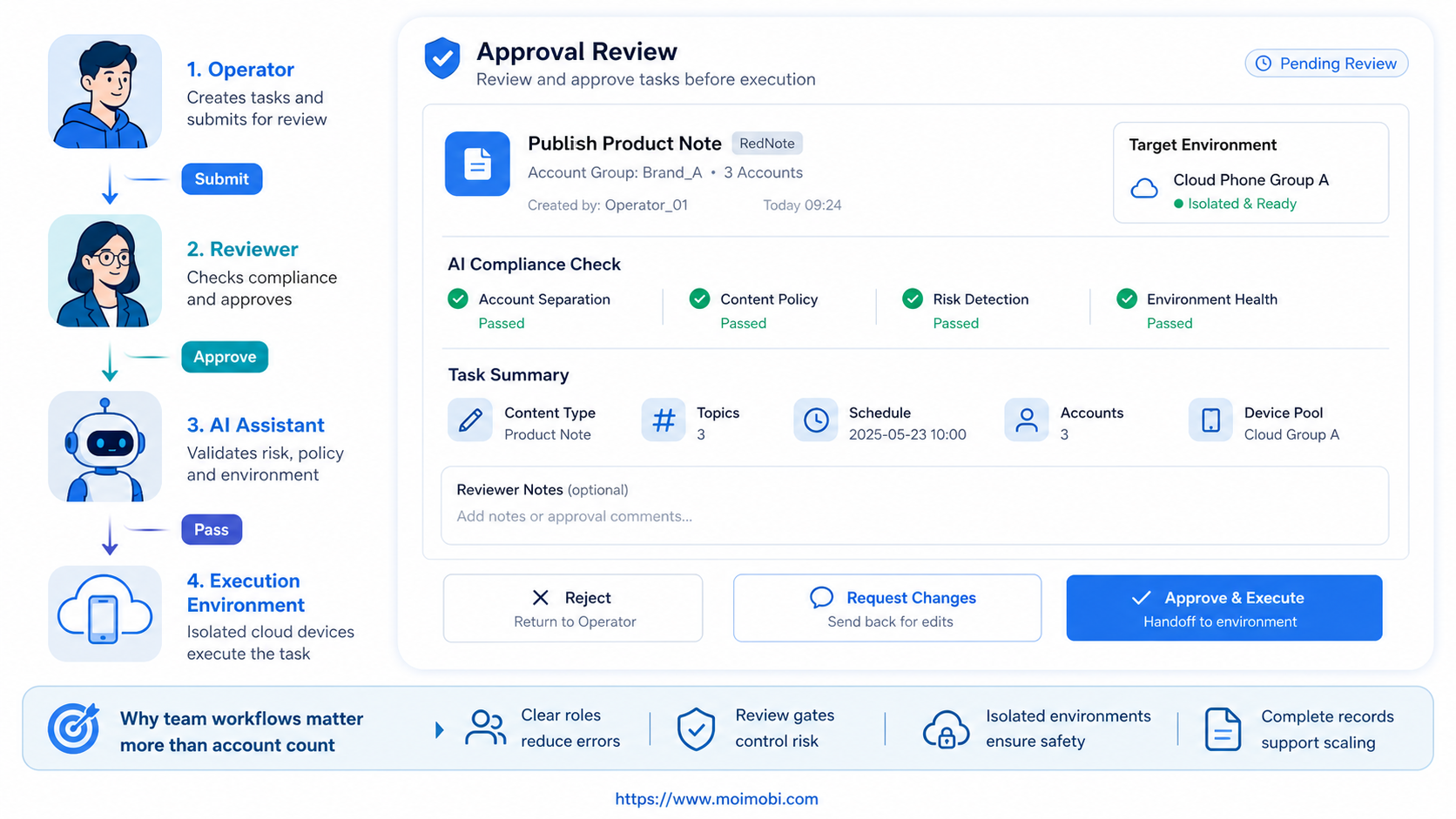
Why team workflows matter more than account count
The source article frames shared real-name access as a potential opening for individual creators and small teams. That is a useful commercial signal, but account count is still a weak metric. A team with two well-separated accounts can outperform a team with ten accounts that all repeat the same message.
Operational quality comes from four layers:
- Account role: what this account is supposed to do.
- Environment: where this account is operated and by whom.
- Workflow: which tasks happen repeatedly and what needs review.
- Feedback: what the team learns from content, replies, conversion, and problems.
Moimobi fits this layer as an execution platform, not a promise that more accounts equal more growth. It can help teams run mobile workflows in separated device environments, coordinate repeated task execution, and keep account operations visible enough for review.
For broader social workflows, teams can connect RedNote-style account separation with RedNote account routing workspace and creator account campaign workflow. The point is to build a system where each account has a job, not a loose collection of extra logins.

What teams should not assume
The biggest mistake is treating shared real-name access as proof that account risk disappears. It does not.
Teams should avoid five assumptions:
- Do not assume every account has the same eligibility.
- Do not assume one verified identity means two accounts have no relationship in platform review.
- Do not assume a shop account and a non-shop account have identical reach behavior.
- Do not use both accounts to publish the same material at the same rhythm.
- Do not let several operators share one uncontrolled login and device path.
Platform rules and business account requirements can change. The Xiaohongshu professional account documentation notes that platform rules may adjust because of regulation, governance strategy, and product changes. That is why the safer approach is to keep account workflows auditable and reversible where possible.
How to use mobile execution without turning it into spam
The best use of mobile execution is not mass posting. It is controlled repetition.
Good candidates include:
- Preparing content queues.
- Checking account state.
- Publishing approved posts.
- Collecting comments and messages for review.
- Recording customer handoff status.
- Pausing tasks when an account enters an abnormal state.
Poor candidates include:
- Repeating identical comments.
- Sending unsolicited messages at scale.
- Logging all accounts from one unmanaged environment.
- Retrying failed actions without understanding the reason.
- Treating automation success as business success.
For teams that already operate mobile social channels, a phone-side task governance layer should be connected to approval, evidence, and review. That makes automation easier to control and less likely to become a source of operational noise.
A review checklist before scaling RedNote account operations
Before adding more accounts or more automation, review the current setup:
| Review area | What to check | Why it matters |
|---|---|---|
| Account role | Each account has a distinct purpose | Prevents duplicate positioning |
| Device environment | Each important account has a stable environment | Makes troubleshooting cleaner |
| Operator access | One owner and clear handoff path | Reduces shared-account confusion |
| Content boundary | Topics, formats, and product lanes are defined | Keeps audience expectations clear |
| Workflow records | Posts, replies, edits, and handoffs are logged | Enables review and recovery |
| Stop rules | Abnormal activity pauses execution | Prevents repeated mistakes |
This checklist is more valuable than a broad promise that “multi-account operations scale growth.” The real question is whether the team can still explain what each account is doing, who touched it, what changed, and what result was verified.
Frequently Asked Questions
Is RedNote shared real-name verification fully available?
Not necessarily. The source describes a tested or gray-release experience. Availability should be verified inside the app and against current official rules.
Does shared real-name access make multi-account work safe?
No. It may reduce one account-creation constraint, but it does not remove platform policy, content quality, device environment, or workflow risks.
Should two accounts publish the same content?
Usually no. Two verified accounts are more useful when they serve different roles, such as creator trust and product conversion, rather than repeating the same posts.
Where does a cloud phone fit?
A cloud phone helps create a persistent mobile execution environment for an account or workflow lane. It should be paired with account roles, routing control, and review records.
What is the difference between account separation and environment separation?
Account separation defines business purpose. Environment separation defines where and how each account is operated. Teams need both.
Can AI automate RedNote account operations?
AI can help with content preparation, task planning, reply drafts, monitoring, and records. Sensitive actions should still have approval and stop rules.
What should a small creator team do first?
Start with two account charters, one workflow map, and one weekly review process. Add automation only after the manual process is clear.
Conclusion
RedNote shared real-name testing is worth watching because it may make account separation more accessible for creators and small commerce teams. The real advantage, however, comes from cleaner operations: distinct account roles, separated environments, controlled mobile execution, and records that help the team learn from each workflow. More accounts help only when the system around them is clear.
References: